Our KAKEHASHI friends


By Jennifer Pineda

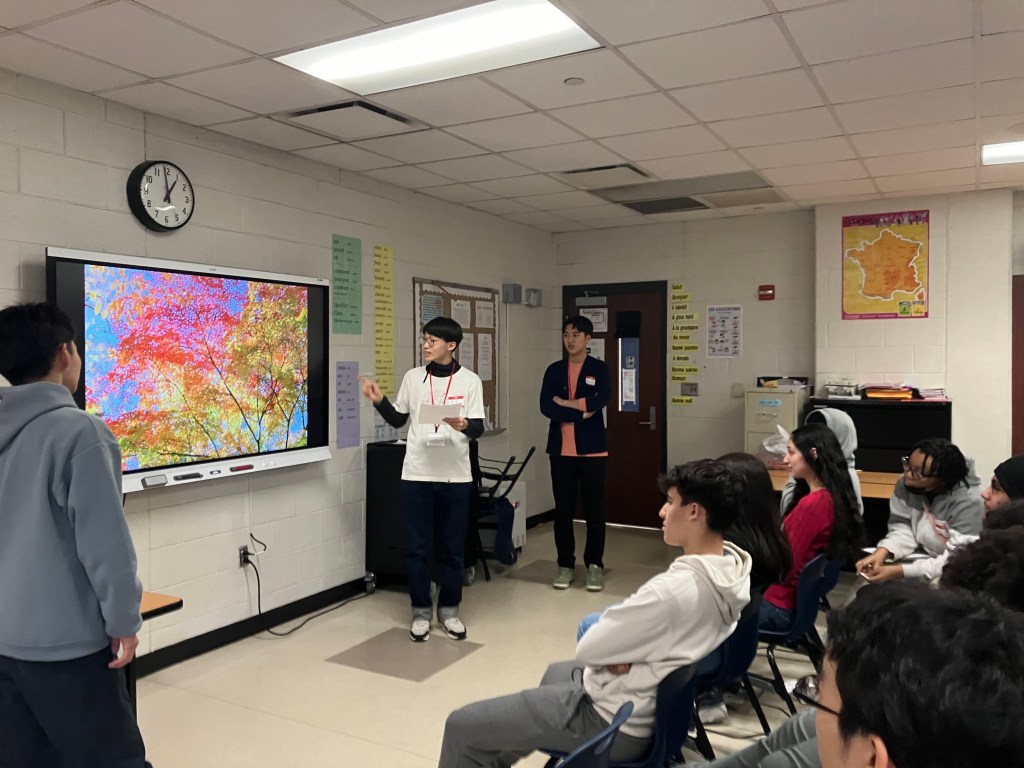
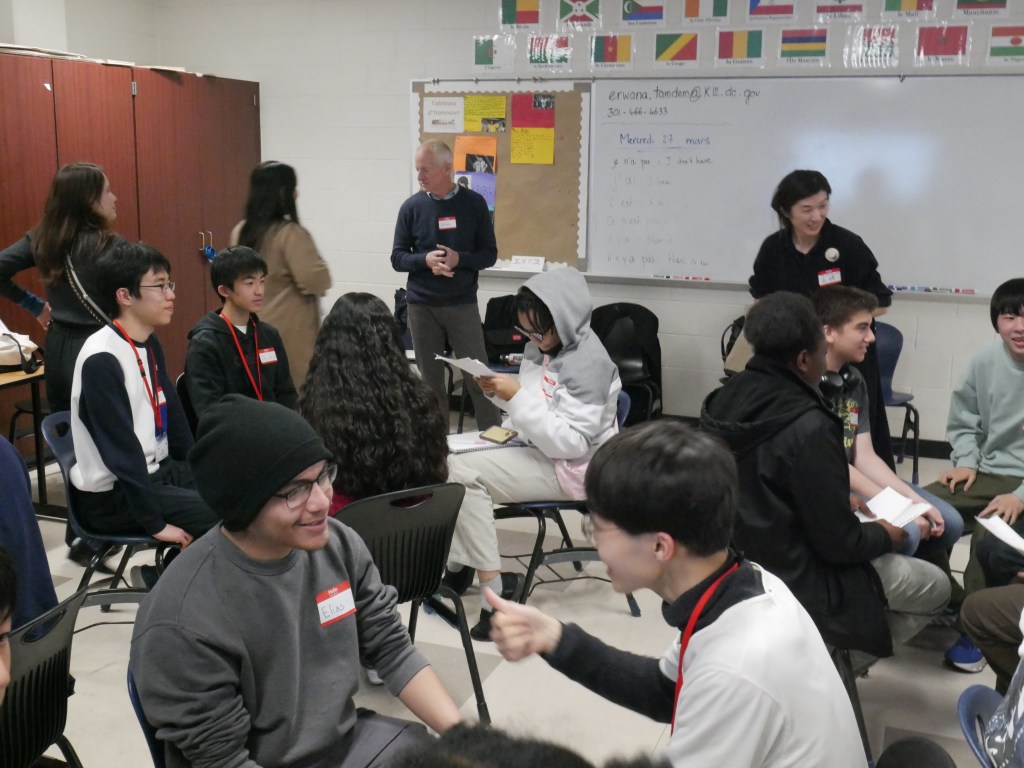
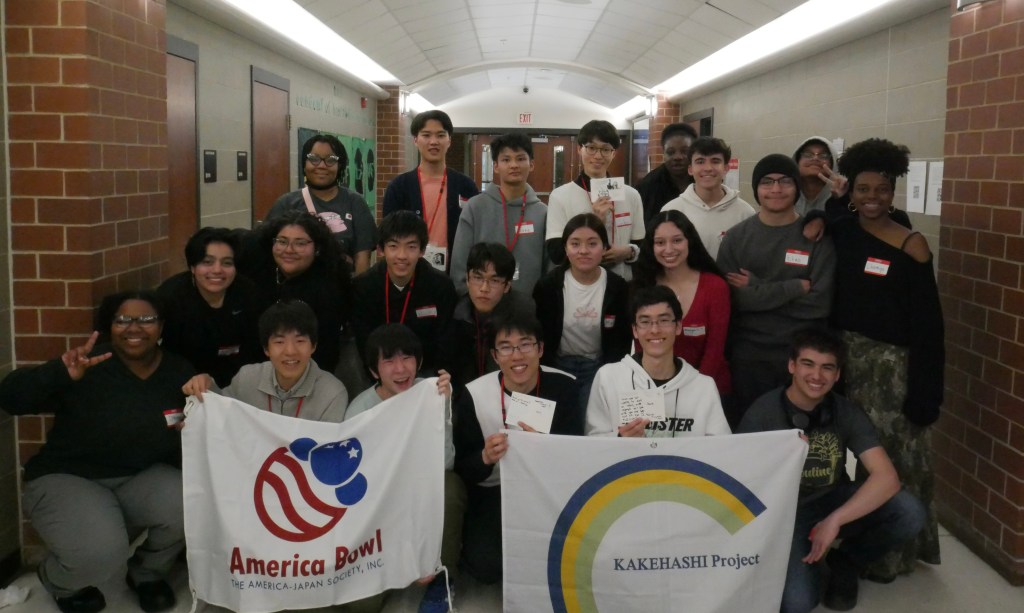
On March 26, some of my Japanese Plus colleagues and I first interacted with the KAKEHASHI group. Our school, District of Columbia International School, first hosted them. I was paired with Riki, one of the nine boys. Over the course of three days seeing each other on different occasions, we got familiar with each other. On Tuesday and Thursday, they visited our school and then visited Japanese Plus on Wednesday. We also hung out on the National Mall, going to a museum and played sports like soccer, frisbee, and badminton just to have extra time together.

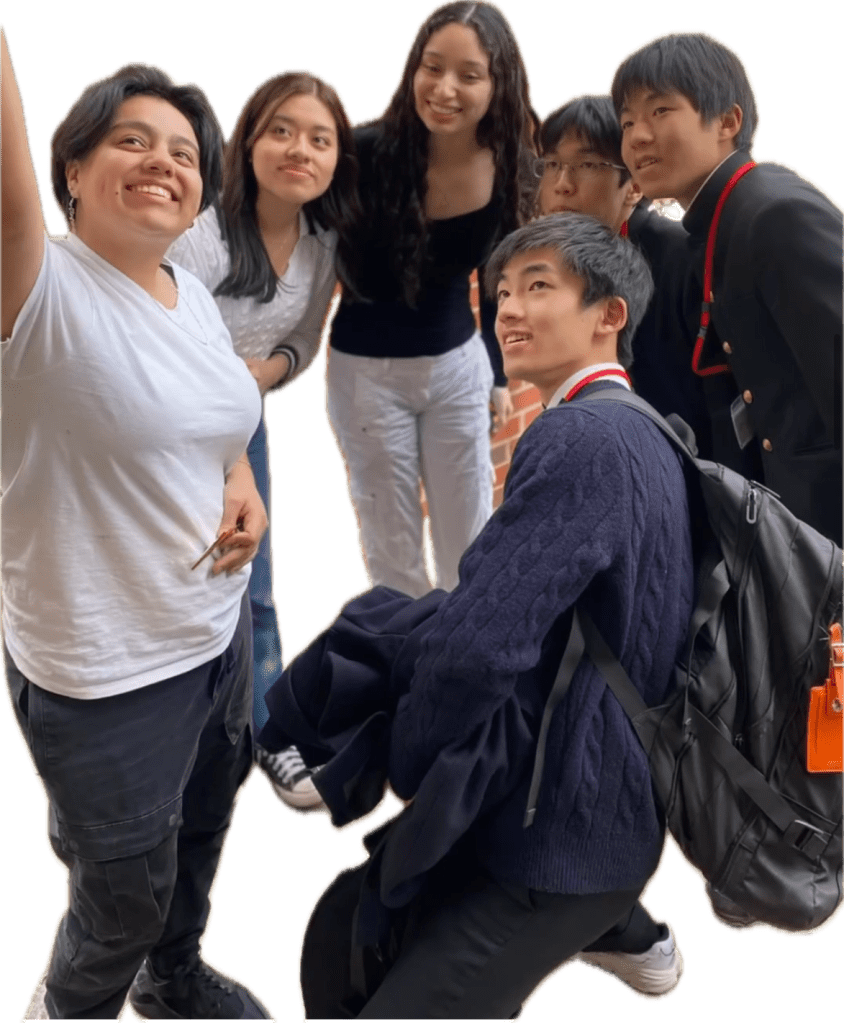
Riki and the other boys were easy to talk to and fun to be around. Riki was an easygoing person and also invested in conversations by asking more questions and wanting to know more. His overall character was very genuine and nice. I’m glad I got to meet him.

That’s Riki in the middle.

I feel as through my classmates and I really made a strong connection with the KAKEHASHI group. I learned a lot from their presentations, like what made a good castle (to make a good castle it should be on a hill and have complex entrances), how to make origami, cherry blossoms (how they also represent the finish of friendships, and how they are short lived but beautiful, etc). I also learned a lot of differences from America and Japan, for example like social media. The US often posts pictures of friends, selfies, and a lot of things we do. Whereas in Japan they often don’t show their faces, often just showing their food and activities. It was exciting to see things in another perspective. For example, how most American foods have cheese on it. Also how squirrels are actually rare to see in some areas.

Sad to see them leave but glad that we met. This exchange was very memorable for me and will continue to encourage me to continue my language learning and my relationship with Japan.

A New Perspective


By Margarita Muñoz-Salazar

Every time I meet a new group of Japanese students I am excited to test my Japanese language skills and meet new friends. While talking with Japanese students, I felt thrilled that I was able to practice my Japanese and that they could understand what I wanted to say. While speaking with them, I got excited to see my own progress.

Due to the scheduling we got to meet two different groups of Japanese students in one week. With the KAKEHASHI group I was able to see their presentations on さくら (sakura), しろ (castles), and おりがみ (origami). It was also very fun with this group because they were able to spend a day at my school, DC International. I’m glad that they got to see the difference between American and Japanese schools. For example, in Japan the students stay in one class the whole day while the teachers are the ones to move around. Here in the US it is the opposite. The next day with the group we got to play soccer on the National Mall.

That same Saturday I was able to meet with students from the TOMODACHI group. While exploring the city and eating lunch with them, something that stood out to me was conversing with girls my age from a different country. From talking about things about school and food to TV shows and boyfriends, these are conversations I will remember and look back on happily. Seeing the students’ perspective on my city and how they would take pictures of things that I considered normal (one student actually said that squirrels aren’t common in Japan) made me view DC in a different light and be thankful that I am here. I hope to meet all the new friends I made again.

TOMODACHI X Globalize DC


By Chamiya Carnathan

Have you ever embarked on the journey of learning a new language only to find yourself drowning in doubts along the way? Were you plagued with questions like, “Am I really getting this right?” or “Will I ever be able to hold a conversation?” For me, learning Japanese has been a rollercoaster of doubt and determination. As I delved deeper into the language, doubts lingered as I was absorbing new material. Could I actually speak Japanese? 

On Saturday, March 30th, Japanese students from the TOMODACHI Amway Japan Foundation Tohoku Future Leader Program came to Washington DC. They were from the Tohoku area and I had the opportunity to immerse myself in their company. I spent the day with them from 10:00 am to 5:00 pm.

In the beginning, I found myself in an unexpected situation. Due to an odd number of Japanese Plus students, I wasn’t paired with a DC partner. Instead, I was thrust into conversations with two or three Japanese peers at a time without an English-speaking partner of my own. It was nerve wracking at first, however, it was thrilling. I realized that I could indeed hold my own conversation. I used new vocabulary such as “おすすめ” (recommend) and “みなさん” (everyone). It was really fun figuring out the extent to how much I understood from the Japanese students. Our conversations ranged from what type of music we like to listen to, to recommending each other different places to visit in our hometowns. 


For one of the activities, we were tasked with a challenge to design a virtual adventure tour for the American students, showcasing sightseeing spots from Tohoku. This activity was aimed to bridge cultural gaps and give us a taste of rural Japan. I was grouped with 3 Japanese students and my classmate, Kori. They were really eager to tailor their experience to our interests and asked us, “Would you want to hike? Do you want to eat traditional Japanese breakfast in the morning? Do you want to wake up early?” Based on me and Kori’s responses, they crafted the start of a morning. We would wake up at 5 am and journey to the top of Mountain Iwate to watch the sunrise. Afterwards, we would eat a traditional Japanese breakfast that consisted of Miso soup, rice, tamagoyaki (rolled omelet), and fish. During the activity, what struck the most was their choice that consisted of natural beauty and local traditions over the conventional tourist attractions such as museums and restaurants. It gave me a glimpse into the life of Tohoku.

After the activity, there was a panel to discuss the tsunami that struck Japan on March 11, 2011 and how it affected Tohoku. The panel featured three Japanese adults, each sharing their perspectives on the disaster’s impact and the recovery efforts that followed. One of the panel discussions that I found interesting revolved around a disconnected landline phone, known as the “Phone of the Wind”. The phone is situated in a small white phone booth which overlooks the Pacific Ocean. However, it offers those left behind the opportunity to communicate with loved ones lost to the disaster. This discussion was interesting to me because it highlights how different cultures approach healing and remembrance. It not only shed light on Japan’s cultural response to disaster and loss, but also underscored the universal need for emotional outlets and communal healing, 

As the day unfolded, our adventures took us to the White House and the Smithsonian National Museum of American History. Every step of the way, I seized the opportunity to engage with as many Japanese students as possible, from creating a TikTok video to delving into a myriad of topics.

In those moments, doubts melted away, replaced by a newfound confidence in my abilities. It was a revelation, a tangible proof of progress that fueled my determination to continue this journey of language learning. This experience not only served as a communication revelation, but gave me more insight into Japan’s culture. 

KAKEHASHI students visit DCI

By Mai Ramirez

On March 26, DC International School (DCI) received the amazing opportunity to meet 9 Japanese exchange students who won the American Bowl to spend a day in the life of a U.S high school student. It was especially exciting because even though I had experienced exchanges with Japanese high school students, it was the first time I would show my school, class environment, and my friends to them. Once the Japanese students arrived to my school, Shunsuke became my partner and he would shadow me during my classes. Before going to class, I met with Margarita and Jennifer with their exchange student partners and gave them a tour of our school. 


They were so surprised because our school is very big and that in my school we only take four classes daily, but they last 1h 25m; meanwhile, in my partner’s school they take seven classes daily. During this tour I found out through Shunsuke that my school and his school share some similarities and differences. For example, they have geology as a science class but we don’t. Meanwhile, my school offers different language classes while they are required to take English. After the school tour, our first was French class. During this class we were reviewing how to compose a sentence with different structure. Shunsuke would ask me questions about the meaning of the French phrases and I thought how studious and cute he was when he would take notes on the lesson. Later, we regrouped with the rest of the exchange students in the library. During this time me, Margarita, Koki, Shunsuke, and Ryo talked about our school experience. Shunsuke would tell his friends that he found my math class really hard, especially a certain math problem which his friends tried to solve and then I told them that they are supposed to use the Maclaurin series to solve the problem. Their faces quickly became surprised because in Japan this type of math concept is learned during college. 


After, our short talk, the Japanese exchange students presented to us their presentation. The first presentation was about さくら (Cherry Blossoms). I learned that the Cherry blossom to people is beautiful, cute, and hope. But Cherry blossom can also means short lived and endings, such as in relationships. The next presentation was about お城 (Oshiro) which means castles which were built for military purposes. I really liked this presentation because in every slide there would be a question and we got to choose how we wanted the 城 (Oshiro) built. The last presentation was about origami. We got to see how origami is used to solve math problems and applied in real life situations which I thought was really cool. We even got to do some origami by learning to make a general hat.

This is us during lunch time

After the presentations, it was lunch time and because it was sunny outside we chose to have lunch in the field. The Japanese students got to see how DCI students spend their time during lunch time like playing soccer and frisbee. During this time we talked about what we like, such as anime, songs, and about our school life. They also gifted some snacks such as candies, cookies, and tea which had a little message in the packaging. Once lunch ended, it was time to say goodbye which made me sad because I wanted them to see more of DCI. This experience showed me that despite our homes being hundreds and thousands of miles apart we still make the same jokes, laugh at the same things, and share similar views.

My Japanese Embassy Visit


By Margarita Muñoz Salazar

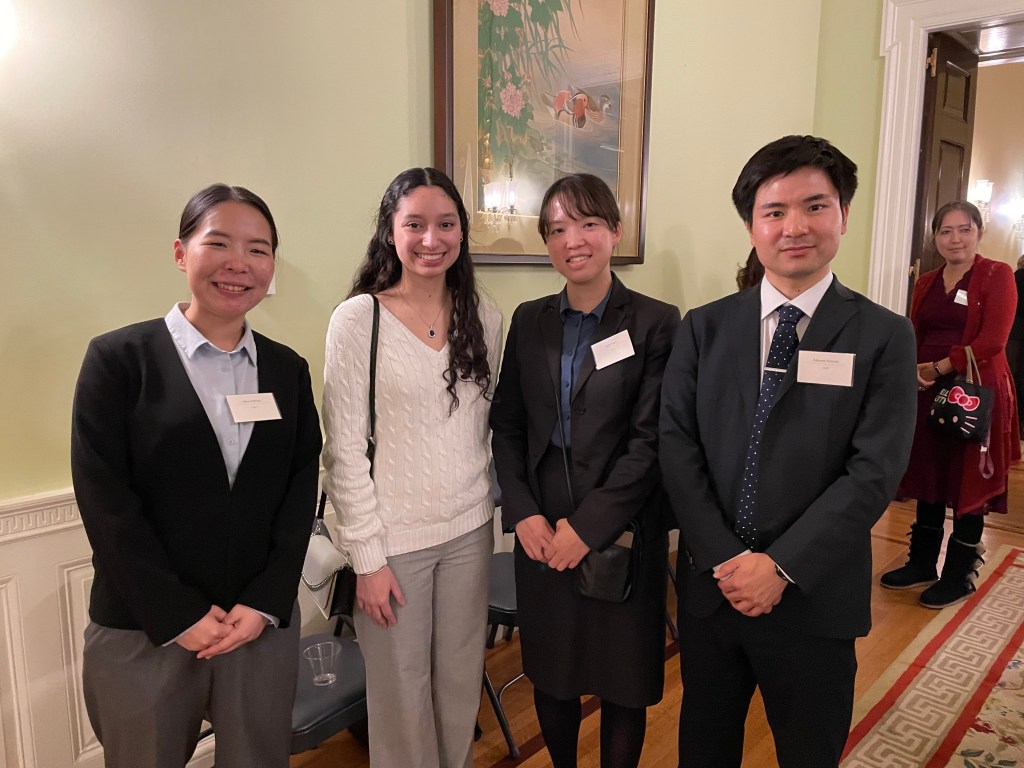
NOTE: On March 22, 2024 Japanese Plus student Margarita Muñoz Salazar and Program Director Sally Schwartz were invited to attend a special reception at the Embassy of Japan held to honor the Japanese participants in the Long-Term Education Administration (LEAP) Program. LEAP, a program sponsored by the Japanese government, brings young administrators from Japanese universities to the United States to learn from and exchange information with international program specialists at American universities. The embassy reception was held at the end of the 10-month program. The participants returned to Japan the following day.   

Going to the Japanese Embassy was a culturally immersive experience, not just an event. Every moment was insightful, from discovering the accessibility of educational possibilities, to witnessing the consistency of Japanese punctuality.

Importantly, the embassy provided valuable information about possibly studying in Japan. It is not easy to start studying in a new country and as someone interested in going to Japan, learning about the wide range of programs and opportunities in Japan was fascinating. One that stood out to me the most was through American University School of International Service which would allow me to get an undergraduate dual degree (BA in International Studies). Students that participate in the program will spend 2 years at American University and another 2 in Ritsumeikan University. Participating in this program will allow me to gain the skills and experience to excel in careers in both countries. Not to mention that the tuition for Japanese universities is significantly cheaper than in America. All the programs and scholarships I learned about motivated me even more to study in Japan, and I encourage anyone interested to keep looking for something that fits their needs because there is bound to be something for them. 

In relation to culture, I considered the Japanese dedication to punctuality to be remarkable.  When I got to the event, it had already started and I was just four minutes late. This would pass for on time in many western cultures, but it would be considered tardy in Japan. It really is proof of the customs and traditions that are deeply integrated in Japanese expectations. This event acted as a reminder of how important it is to respect other cultural traditions and practices, even when it comes to presumably unimportant things like punctuality.

It was also interesting to learn about Japanese business etiquette. It left an impression that swapping business cards was appreciated.  In Japan, exchanging business cards, or めいし, is not only standard practice but also a sign of professionalism and respect. Watching this practice genuinely highlighted how important small actions are to creating trust and relationships.


Of course, visiting the Japanese Embassy wouldn’t be complete without trying some Japanese food. Having sushi (すし), a traditional Japanese dish, was the high point of the visit. Each dish’s excellent flavors and careful presentation showed Japan’s unique tradition.

Overall, attending the event was an honor. It provided a glimpse into Japan’s rich cultural history and left me inspired to explore more of what Japan has to offer.

Reminiscence


NOTE FROM THE PROGRAM DIRECTOR: Visiting the JICC’s exhibit, Recapturing Happiness: The Enduring Spirit of Ishinomaki, had special meaning for Globalize DC. For six years, we participated in the TOMODACHI US-Japan Youth Exchange Program, which allowed dozens of DC public high school students from across the city to visit Tohoku, and to meet many Japanese residents, young and old, who generously shared their stories and engaged with our youth. We’re happy to share a reflection from one of these TOMODACHI alumni, now a college graduate, who joined us on our visit to the JICC.


By Jeffrey (JJ) Jenkins

The JICC exhibit reminded me why I chose to pursue a career in International relations. It reminded me of the enduring spirit that the people from Tohoku possess in times of hardship and their passion for peace. The exhibit took me back to a time when I spoke with survivors of the 2011 Minamisanriku earthquake and tsunami, and I could not help but recall their stories shared with me. Tales of how they gave back to their community when they had little to offer, tales of rebuilding from nothing, and their love for life. Despite losing a lot they continued to give their all, not only for themselves but those who were lost during the disaster. It reminded me of how important cherishing the memories of others is and the unrivaled strength that comes with them. The exhibit made me grateful for my experiences and the connections I have built with people around the globe.

A Visit to “Recapturing Happiness” at the JICC


Jennifer Pineda

On March 11th, some Japanese Plus colleagues and I visited the Recapturing Happiness: The Enduring Spirit of Ishinomaki” exhibit at the Japan Information and Culture Center (JICC). The JICC holds events free to the public to learn more about Japan, Japanese culture, and Japan relations. I was informed that the exhibit was about 3/11, the earthquake that caused a tsunami in Tohoku, Japan in 2011.

When entering the exhibit I was shocked to see a lot of happy photos. Before coming to the exhibit I expected to see sad photos about the damages that were done and a small section of how they’ve rebuilt. But to my surprise that was not the case. A lot of the exhibit was different stories about how people overcame the tragedy and how they are continuing to have hope and resilience despite the damages that were done, and how they cope.

A story that stood out to me was about a couple that lost their three children. They built a playground and commemorated them in different seasons and the photos captured the bright colors to remember them in different seasons and weather conditions. They related rainbows to the spirits of the children and every time they saw a rainbow it reminded them of their children. After speaking with Ms. Shanti (Shoji) she explained further that the couple is tired of news teams interviewing them and sadly talking about their kids. They rather people realize of course they miss their kids, and see how they are doing well and see the positive side of things and that is exactly what the photographer captures in the photos. The bright colors help us see the brighter side of the story and see the happiness and progress.


I enjoyed the exhibit and seeing the happy memories within the stories, but also commemorating loved ones. The exhibition was meant to show the happiness and recovery from the tragedy and not dwell on the past.

Zion Daodu

On 11 March 2011, at 14:46 JST, an undersea earthquake occurred 72 km east of the Oshika Peninsula of the Tōhoku region in Japan. The earthquake was followed by a tsunami. In Japan, this is referred to as the “Great East Japan Earthquake.” The impact was catastrophic, resulting in widespread destruction of infrastructure, homes, and communities, and claiming the lives of over 18,000 people. Many families were torn apart while also faced with unimaginable loss and displacement, as entire towns were swept away by the tsunami’s powerful waves.

The JICC organized an exhibit titled: Recapturing Happiness: The Enduring Spirit of Ishinomaki, featuring photographs by Mr. Keisuke Hirai. It is an exhibition that conveys the resilience of the human spirit, the joy of community, and the moments of happiness that persisted in Ishinomaki following the Great East Japan Earthquake.

Photographer Keisuke Hirai (center) with staff from exhibit sponsors Japan Information and Culture Center and Sasakawa Peace Foundation.

Of the many people featured in the exhibit, the Amano family, and woodworkers Shinichi and Ryoko Endo, among others, stuck out to me, because of their incredible journey and how they overcame it. Following the tragedy, survivors faced a lengthy and difficult healing process as they attempted to come to terms with their loss, their trauma, and the major undertaking of starting over. After the tragedy, families that had been split apart have been gradually reestablishing their ties and seeking comfort and support in one another’s company. But these brittle reunions were cut short when the COVID epidemic struck, leaving many families to face a fresh round of uncertainty and loneliness. As the eldest son of the Amano family wrote, they were not always close but after the earthquake and their mother‘s death in 2020 they began to cherish the memories they were creating with each other.

The inability to be together during the pandemic brought an additional layer of grief and frustration for those who had already lost loved ones or were still looking for missing relatives from the 2011 disaster, adding to the emotional toll of both tragedies. Family members found it difficult, if not impossible, to continue their efforts to physically gather due to travel limitations, lockdowns, and health issues, but woodworkers Shinichi and Ryoko Endo made the 480-km drive from Tokyo to take their long-awaited photo with their daughter and her husband in front of the Ishinomori Manga Museum.


A source of strength, families were reminded of their ties and the value of helping one another through hardship by their common experiences of resiliency and survival following the Tōhoku tragedy. Even though there were clearly challenges brought about by the pandemic, it also brought to light the families’ steadfast endurance and inspired a fresh appreciation for the times they were able to spend together, whether in person or virtually.

Zitlaly Hernandez

When I first entered the exhibit I was kind of nervous because there were important people around and I’m not good at socializing. As I walked around I noticed before and after photos, photos from the past or the present or both depending on the story.

One story that really got to me was one about an older sister and how she had missed the times when she would spend with her sister. It also got to me because her story touched on how she was grateful for her family and how she was thankful for all the things they’ve done for her. This resonated with me because I’m really close with my family and although it’s small, we love big. This is something that Kokoro, the author of the story I’m talking about, illustrated in her story.


Felipe Lemos

What I enjoyed most about the exhibit at the JICC was the fact that it focused more on the stories of the people and how they recovered over time rather than the tragedy itself. Some of the exhibits had pictures from the time of the disaster that were taken in the same spot 10 years later. Some of the exhibits told stories of the changes and improvements in people’s lives, all of which occurred after the disaster. But the shared message that I took away is that the world didn’t end after the earthquake. People’s lives went on and they were able to create stories and memories that were passed on through the exhibit.

One of my favorites was the story of a family who took a photo of themselves in 2012 shortly after the earthquake, and then went back to the same place to take a family picture again. Seeing the people who aged, the children who were now adults, the new members of the family, the background behind them changing to be a clean, new building, it all adds to this sentiment that pushing through adversity and having a positive mindset can lead to happiness long term.

Special thanks to the staff of the JICC for offering extended viewing hours so our students could visit this moving exhibit after school. It’s wonderful to be so warmly greeted.

Dinner afterwards at Donburi in the neighborhood. It was great to be joined by Takahashi-sensei and Nishant Annu (who both lived and worked in Tohoku) and local TOMODACHI alumni Jeffrey Jenkins and Tenaj Gueory.

Remembering 3-11

Photo from our 2018 TOMODACHI US-Japan Youth Exchange Program in Tohoku.

NOTE FROM THE PROGRAM DIRECTOR: On March 11, 2011, the Great East Japan Earthquake struck the Tohoku region of Japan, causing tremendous loss of life and widespread destruction of homes and communities. For six years Globalize DC was privileged to participate in the TOMODACHI US-Japan Youth Exchange Program, which allowed DC high school students to visit towns and cities directly affected by the earthquake, and to meet and engage with their Japanese peers in the region. These experiences have been deeply affecting and informative to all of us. So each year we take a few moments to recall the events of 3-11, to learn, and to reflect. This year our Japanese Plus students watched the emotionally riveting film, The Tsunami and the Cherry Blossom, which vividly documents the events of that day and the aftermath. These are some of our students’ reflections after viewing the film.


Chamiya

It was hard to watch the film about the tsunami that hit Tohoku on 3-11. Watching people lose their lives and witnessing survivors lose hope after experiencing a devastating tragedy was devastating to me. One guy said that he doesn’t want clothes or home, or anything material. He wanted his friend back, and that is something that I relate to. I admire these people for finding hope in the cherry blossoms. Finding something to look forward to, as something as small as watching the cherry blossoms bloom is admirable.

Zitlaly

It was hard to hear of the tragedies and how everyone had to accept the fact that the tsunami changed everything. Despite the fact that many lost what they would consider their lives/reason for living, they still continued to stay positive, to have some type of hope. I admire Japan for persevering and finding something or someone to hold onto during this hard and excruciating experience for so many. Also, I admire that many looked at the blooming of the cherry blossoms as a form of a new beginning, a remembrance, “rebirth,” hope, and a push to keep on going. Despite that, some felt envy for the blooming.

PS. May those who have not been found find serenity.

Felipe

One thing that stood out to me in the film was the man who lost his best friend. At the beginning he was distraught and at one point said that he had lost the meaning of his life and everything that was a part of it. However, once reflecting on the cherry blossoms and what they represented, he realized everybody was trying to bounce back because they were still alive and they shouldn’t give up. Another thing I found inspiring was what the woman at the end of the film was saying. She said she would photograph how the town was rebuilding but she also mentioned how the yearly blossoming of the cherry trees was giving her hope for the future. She said that the next time the trees blossomed, the town would be more rebuilt and the year after that even more. This made me reflect on how time is continuous and things will improve over time if you keep looking forward.

Mai

  • For many people in Tohoku they couldn’t believe that a tsunami was actually happening right before their eyes.
  • How easy it was for the tsunami to destroy and swallow their homes and loved ones. They could only watch, not being able to help.
  • “Nature is filled with beauty and terror but sometimes we forget about the terrors.”
  • The cherry blossoms have different meanings depending on how we feel and what memories we associate with them. They are goodbyes and new beginnings.
  • There was a tree that has lived for more than 80 years. When the Tohoku people saw the cherry blossoms, they felt healed, allowing them to have hope and motivation to rebuild their homes.
  • Cherry blossom trees have steps of growth: ichibu-zaki (which is the first step of the cherry blossoms growing) and maichiru (when the cherry blossom flowers begin to fall).
  • Sakura are yuuga (beautiful but not too showy). The Japanese people have a kanji for the concept of yuuga: 優雅

Jennifer

Although the cherry blossom trees also suffered the tsunami, they managed to strive to be alive. It became a hope to most and a reflection to those who survived. The tsunami hit them hard. Some grew from it, some resented it. The cherry blossoms give a sort of reflection on how they feel about the tsunami and what they feel about the future.

Elias

I noticed the destruction which caused the deaths of many friends and families who mourned for them after the disaster. Going through something as traumatizing as a tsunami taking your home and friends and families led people to lose everything, giving them a sense of emptiness from their tragic losses.

D’Amonie Armstrong

I believe that going through something like this is absolutely devastating and will have long-lasting impact on the people of Tohoku. To see visual evidence of such disaster and watching as people tried to get to a safe haven was very disheartening. The people showed extreme bravery for abandoning or deciding to try to salvage their belongings. Many people suffered badly. However, during this time, the cherry blossoms were also almost in bloom, and that was used to bring hope for a better future. Every year that they bloom around that time, it is seen as a reason to keep going and how with each passing year, the rebuilding gets better and better.

Zion

It was heartbreaking to see the people holding out hope that their families were still alive. Children having to watch their parents get swept away. The people that just watched knowing they could not do anything to save them. The people that were just coming out of their homes, the ones that could have died if they had waited just one second longer and the many other stories of the people who had relatives that died or were missing. I could not imagine going through what they went through and I hope that the people featured in the documentary are still alive.

Margarita

It was interesting to see how much cherry blossoms are integrated into Japanese culture and life. Many people in the film mentioned how they grew up alongside the cherry blossoms. The cherry blossoms were viewed as hope when they start blooming, not long after the disaster of March 11. The film showed how the family of one of the victims had planted their own cherry tree before the tsunami, which had started to bloom afterwards. The difference between showing solidarity compared to America is also very interesting. Unlike in Japan when natural disasters happen or any kind of devastation, in the United States the news and solidarity usually remains local. Across all of Japan people were grieving, which shows just how devastating the event was. I can’t imagine how traumatizing it must have been for everyone affected.

Mermaid of the Blue Sea – Okinawa Style


By Chamiya Carnathan

Have you ever experienced a musical in another language? On January 13th, 2024, I had the privilege to watch “The Little Mermaid” in Japanese. 

Last November, the Director of the Okinawa Prefecture Office in DC, Mr. Kazuyuki Nakazato, invited Sally Schwartz and me to attend an Okinawan performance called The Heart of Ryukyuan Dance. Then last week, Mr. Nakazato gave Sally and some Japanese Plus students another opportunity to attend a performance called “Mermaid of the Blue Sea,” located at Lisner Auditorium. Adapted from Hans Christian Andersen’s The Little Mermaid, the performance featured Okinawan traditional dance and performance styles. I absolutely loved the performance. 

In The Little Mermaid, Hans Christian Andersen introduces a young mermaid princess who falls in love with a prince she saves from drowning. Seeking a chance to be with him, she makes a pact with a sea witch and trades her voice for human legs. However, Ariel will feel constant pain and will only survive if she wins the love of the prince and marries him. Despite captivating the prince, he marries another, unaware of Ariel’s sacrifice. Heartbroken, Ariel faces an ultimatum from the sea witch: kill the prince to revert to a mermaid or face death and become seafoam. Ariel chooses not to harm the prince, embracing her fate.

The Okinawan rendition of The Little Mermaid presented a unique musical experience. Despite the language barrier, the performers’ utilization of items, such as Sensu fans, was flawless. These fans were ingeniously used to represent ocean waves and various sea animals. The musicians were amazing, playing a musical score that effectively conveyed the intended emotions. The music, which was exquisitely melancholic, created a build-up to the touching moment when the little mermaid met her end. The utilization of the bingata costumes to determine if the little mermaid was a mermaid or a human was my favorite aspect of the performance. The little mermaid had a bingata that hung down to her feet, giving the impression that she was nearly gliding across the floor. Upon turning human, she began to show her legs by wearing a bingata that hung down to her knees.

My sole critique was a desire for a longer performance and wishing that I could see more. The production was visually captivating, easily comprehensible, and conceptually exquisite. I loved the performance and I hope to see another one in the future. 

Zitlaly, D’Amonie, Chamiya, Jennifer, and Margarita with Mr. Kazuyuki Nakazato from the Okinawa Prefecture DC Office and Kristen Luck from the GWU Okinawa Collection after the performance.

Welcoming a new year


By Margarita Munoz Salazar

Nengajo (年賀状) is a traditional Japanese New Year’s greeting card. It is sent as a happy-new-year greeting to friends, family, and coworkers. Nengajo usually include drawings or pictures related to the new year, like the zodiac animal for that year, traditional Japanese symbols, or landscapes. People frequently include handwritten notes with the pictures, wishing the receiver good health, happiness, and prosperity in the upcoming year. In Japan, sending and receiving nengajo is a common tradition. It is considered respectful to exchange these cards during the New Year’s holiday. 

I was able to participate in a Nengajo contest for the Japan Information & Culture Center. Since this year is the year of the dragon, I put my drawing skills to the test and made a drawing based on the Japanese film Spirited Away by Hayao Miyazaki. I enjoyed participating in this tradition as it was a fun way to be part of the celebration of a new year. 

As something that is not very common to do in the US, Nengajo is a good way to signify that you care about someone especially if you take the time out of your day to make a drawing or include a message.