By A’mee Barnes
The Chinese language is the number one most spoken language due to the high population in China. There are over 1.2 billion native speakers. This language dates back to 1250 BCE (over 3,000 years ago) when it was found scripted on oracle bones in the late Shang Dynasty. Oracle bones are pieces of the ox scalp and turtle plastron (outer body belly).
When the two countries met in the past there wasn’t a language set in Japan; so Japan adopted this language, and as time went on some characters started to change. Today roughly 70-80% of Japanese Kanji are traditional Chinese characters. Though they might sound different, they still express the same meaning.
Not only has China influenced Japan in languages but also religiously. The two countries showed interest in Buddhism and Confucianism. Although Japan believes is Shinto, there’s still a large number of people practicing Buddhism.
The comparison of the word:
Chinese Word: 学生 (xue sheng)
Sentence 1: 在Wilson高中我是学生。
Japanese Word: 学生 (gakusei)
Sentence 2: Wilsonここの学生です。
By looking at the two sentences you can see similar characters such as “学生;” in both languages it means student. Both sentences mean “I am a student at Wilson High School.”
I’m currently in Chinese 4, which means I have more knowledge of over 2,000 chinese characters than Japanese characters. If I see a certain Kanji written but I don’t know the Romanji (English letters) of it, I would cheat and use the Chinese keyboard to type the kanji since I’m certain they’re the same character. I sometime mix up the pronunciation of both languages. Both languages are hard to comprehend, but through practice you’ll soon understand both languages. Once you start learning a country’s language and cultural style, you start to feel more connected and you might eventually start acting upon it.

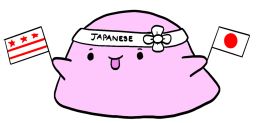
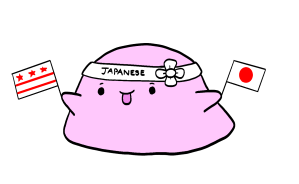 Inspired by the cute mascots from Japan, jello and the Pokémon ditto, punipuni was born. I wanted to make our mascot have a “kawaii” look, similar to the mascots of Japan but also simple so that it’s easy to remember and recognizable. While doodling on homework, I sketched several nameless forms along with a few cats and punipuni was born. Punipuni is holding the DC and the Japan flag in its hand representing Japanese Plus. It’s the only program in DC that offers Japanese to students and the mascot represents how we’re integrating more Japanese culture into DC students. The pink, formless blob represents how this program can take any shape because of the students in it.
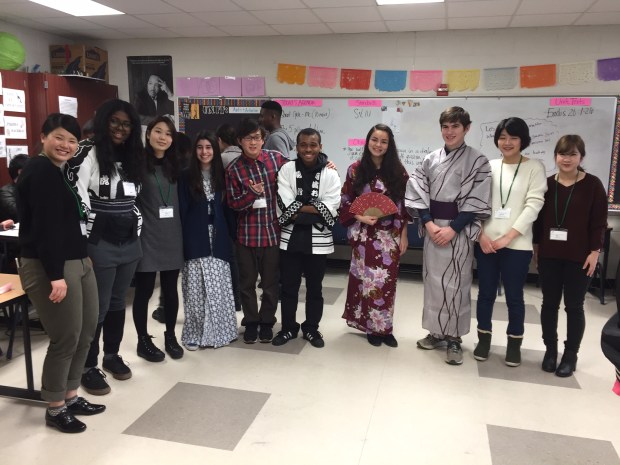
 After meeting the Kakehashi exchange visitors, a few of us went to go to this event where we were able to make Bingata.