Blue Star of Life

By Jazmin Angel-Guzman

On Tuesday, October 31st 2017 I had the opportunity to go to the Blue Star of Life Ceremony at the Kennedy Center for the Performing Arts and met nine wonderful Japanese students. All of us DC students had the opportunity to drop pebbles inside the vase, Blue Star of Life, to symbolize peace and friendship between the United States and Japan.

It was a once in a lifetime experience for me because it was a life lesson that Sally Schwartz taught me and once said, “Life is more than being in a classroom.” It even motivated me to get out of my comfort zone and learn more about our interconnected world. As much as I was nervous of meeting university students and a high school student, it made me realize that they were also nervous and they’re just like me. I wish there were more experiences like this and this has definitely taught me a lot about global citizenship.

Globalize DC joins J-LEARN Fall Seminar at GWU

On November 5, 2017, Globalize DC’s Director, Sally Schwartz, joined a Sunday afternoon seminar, sponsored by J-LEARN, on the current state of K-12 Japanese language education in the greater Washington, DC region. J-LEARN is a grassroots organization created by a coalition of parents, educators, and concerned individuals from the local DC area and dedicated to promoting and supporting the teaching of Japanese language and culture in public schools. The lively presentation and discussion focused on the benefits of Japanese language education for K-12 students preparing to enter the 21st century global economy, and strategies for promoting Japanese in a time of budgetary constraints, competition from other languages, and other challenges. We were happy to share information about our own afterschool model (Japanese Plus) as evidence that Japanese language teaching and learning is taking hold among DC public school students.

The event was held in conjunction with J-LIVE (Japanese Learning Inspired Vision and Engagement) Talk, an annual Japanese language speech competition for university students, held at George Washington University. The occasion was also an opportunity to recognize the contributions of Ambassador John R. Malott, President of the Japan-America Society of Washington, DC, for his work in promoting US-Japan relations and Japanese language education.

This slideshow requires JavaScript.

Japanese Plus welcomes Kakehashi students from Okinawa

Interacting with exchange students from Japan is always a program highlight for our Japanese Plus students. So Saturday, November 5, was an exciting day, when our group hosted 23 high school students from Okinawa visiting DC on a Kakehashi exchange program, facilitated by Youth For Understanding. This was our third time hosting a Kakehashi exchange, but our first group of high school students (last year we enjoyed two university student groups).

First, our Okinawan visitors used power point to share information about their school and key features of Okinawan history and culture. Our students learned that Okinawa has a distinctive history, language, and culture, in addition to its identity as a prefecture of Japan. Then two of the visiting students put on an impressive martial arts demonstration. The Japanese presentation was followed by small group discussions in English and Japanese, and a quick game of Concentration – a way for all students to practice their language and intercultural communication skills. Then it was DC’s turn to share an aspect of local culture – teaching the Cha Cha Slide. Now that was fun!

Once the morning program was ended, the whole group traveled to Columbia Heights for lunch at Z-Burger. That’s when the real communication and bonding could begin! Thanks to our partners at Youth For Understanding for again including Globalize DC’s Japanese Plus program in this cool cross-cultural opportunity.

This slideshow requires JavaScript.

Globalize DC Joins the Blue Star of Life at the Kennedy Center

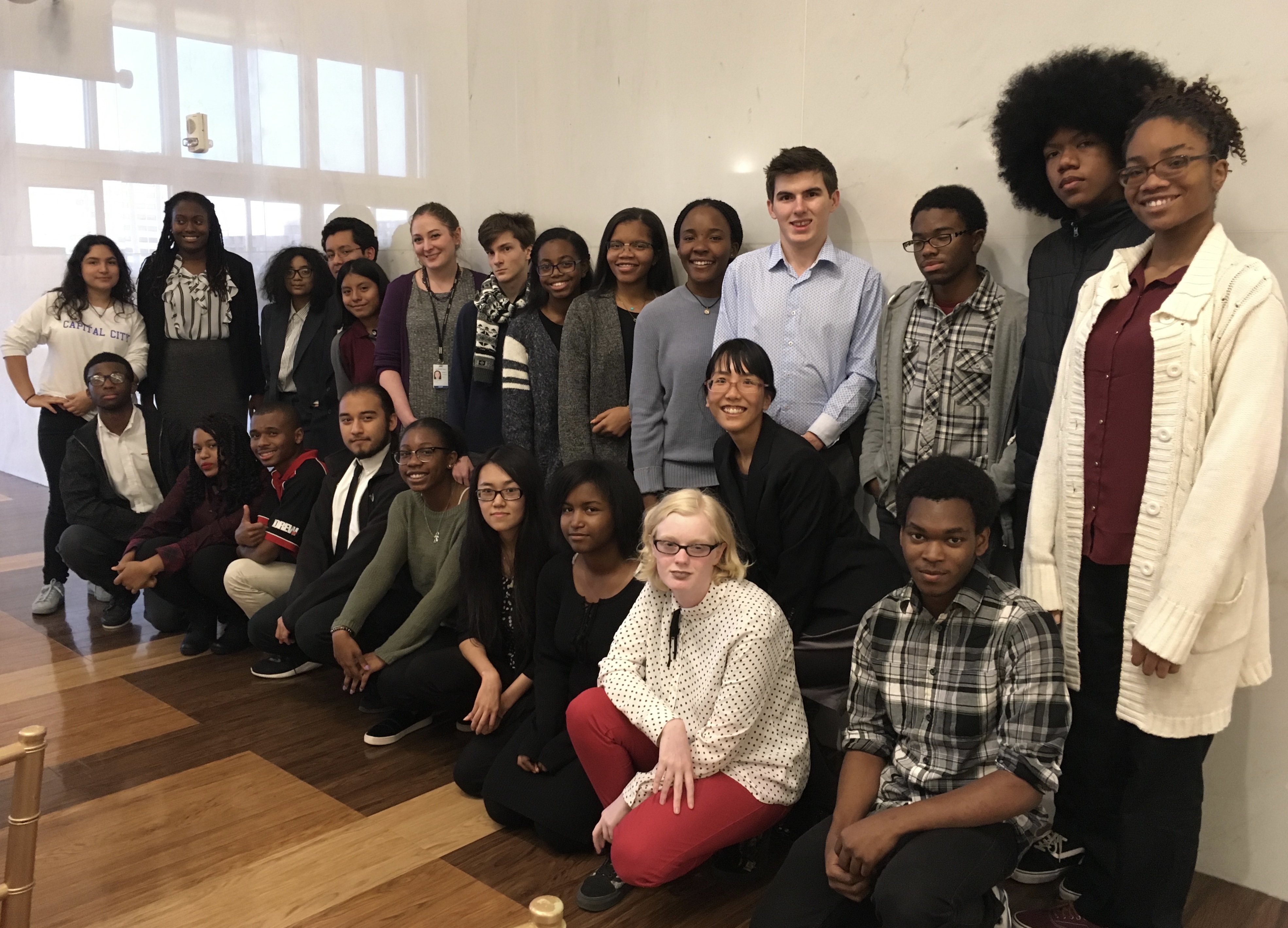
On Tuesday, October 31, eight students from our “Japanese Plus” and “Japan in DC” programs represented DC youth in a very special “Blue Star of Life” Ceremony at the Kennedy Center, organized to commemorate President John F. Kennedy’s 100th birthday and to promote world peace and environment conservation. “The Blue Star of Life” is a large blue and white globe-shaped porcelain vase, designed and created by Japanese artist Yasuhiko Shirakata. The original “Blue Star of Life” vase has been on display at the European Headquarters at the United Nations in Geneva since 1995. In 2015, the Organizing Committee of the “Blue Star of Life” donated a vase to the Kennedy Center, representing the long-standing friendship between the US and Japan. It is currently on display outside the Terrace Theater.

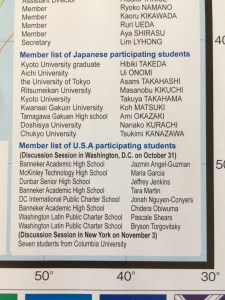
Globalize DC was honored and thrilled to be invited to identify DCPS and DC charter high school students involved in our Japan programs to take part in the October 31 event. Their Japanese counterparts represented different Japanese universities and one high school. The day began with an official ceremony held in the Terrace Theater Lobby. Chidera Obiwuma, from Banneker Academic High School, served as co-emcee. Jeffrey Jenkins, from Dunbar Senior High School, gave a speech on behalf of our DC students. Pascale Shears (Washington Latin PCS) read a message from former Ambassador to Japan Caroline Kennedy, Jonah Nguyen-Conyers (DC International) read a message from the Director of the Peace Corps, and Tara Martin (Banneker) offered a toast at the reception that followed the formal program. Other Japanese Plus/Japan in DC students in attendance were Jazmin Angel-Guzman (Banneker), Maria Garcia (McKinley), and Bryson Torgovitsky (Washington Latin). All students – DC and Japanese – participated in dropping pebbles in the vase, symbolizing the collective will of a new generation of Japanese and DC students to work for peace and environmental conservation.

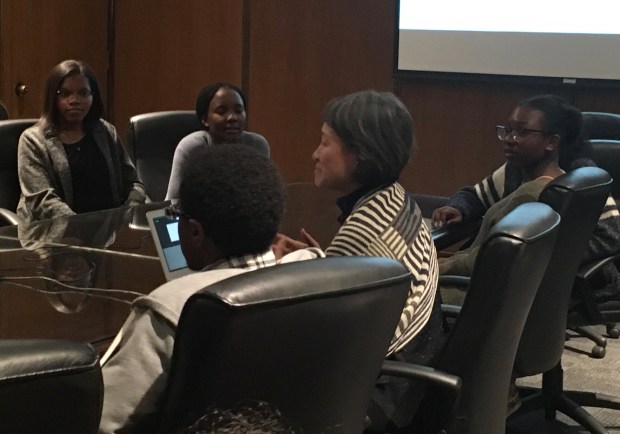
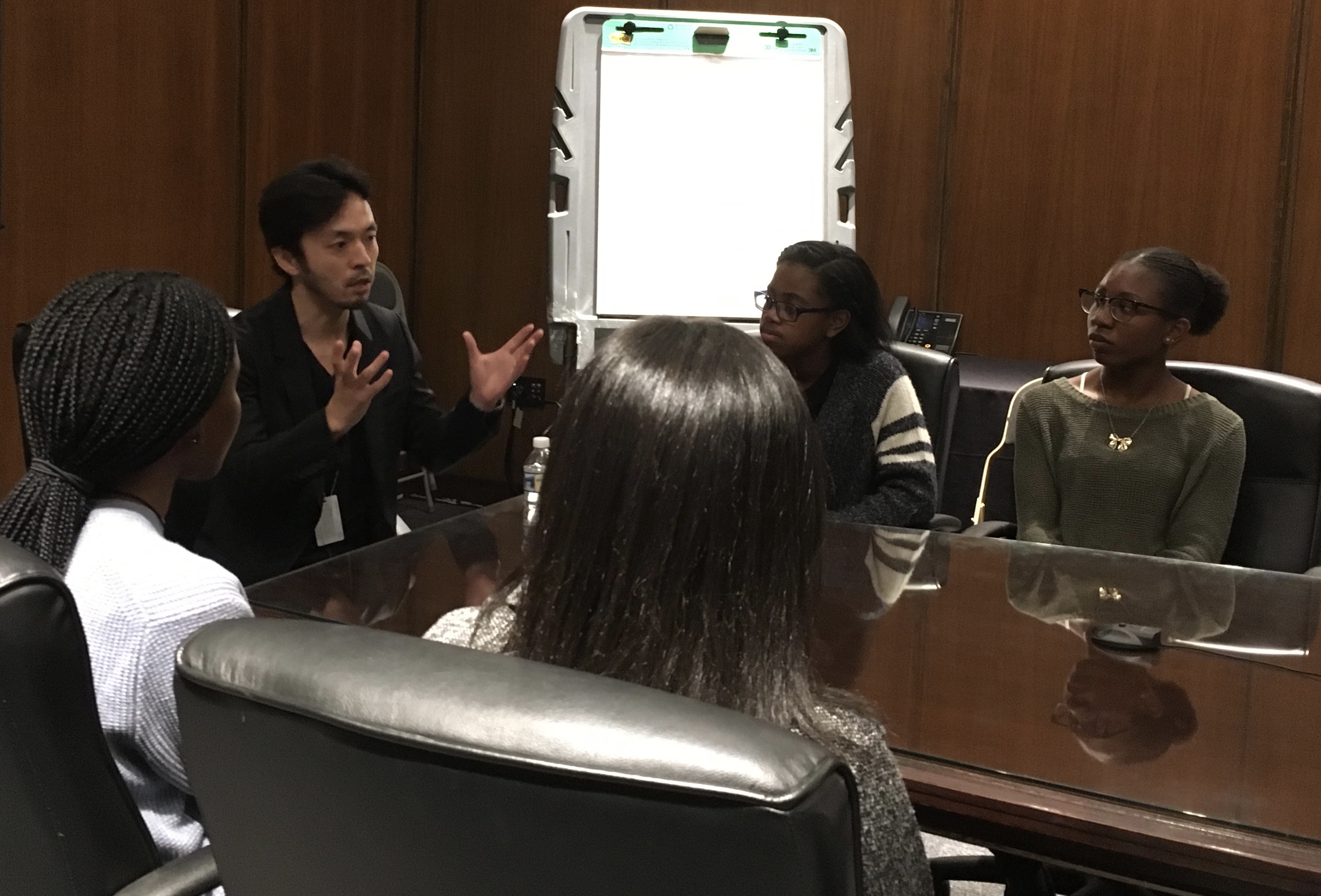
Following the official morning program and lunch at the Kennedy Center, all students and chaperones traveled to the Japanese Ambassador’s Residence for a special tour, and then moved to the Embassy of Japan for student discussions on topics selected by the students themselves. In small groups they addressed Gender, Education, Environment, and Technology, and shared their ideas with the larger group. This was followed by an opportunity for the Japanese students to share information with our DC students about their lives as university students, their majors, and career goals. The long day ended with dinner at Tony Cheng’s Restaurant in Chinatown. This was a very rewarding, provocative, and intellectually stimulating experience for our DC group.

And our students were treated to one more surprise – their names were imprinted on a new map created by “Blue Stars of Life.”  See?

Blue Star of Life Map.
To read some of our student blogs on their “The Blue Star of Life” experience, click here and here and here.

This slideshow requires JavaScript.

Into the ’20s

By Chidera Obiwuma

On October 18, 2017, I witnessed my first live tap performance and it was very enticing and moving. Prior to the show, I was briefed on the life of Kazunori Kumagai, the tap dancer, and how he worked to do something that he loved and his exploration of a combination between Japanese culture and a traditional art form of African American culture, Jazz and tap dancing.

Regarding the live performance, it was very intricate and not only rhythmical to the ears but also appealing to the eye. It was very fascinating how when Mr. Kumagai did rapid taps to make quick rhythms, as I watched his legs, I didn’t see the movement move through his legs. I wondered how many years of practice did it take for him to move his leg at that pace? How fast was his leg even moving? Doesn’t his leg get tired? It was a really pleasing performance to watch, not only because I could tell Mr. Kumagai was in his element and really enjoying what he was doing, but also with the support he got from the other performers, Masa Shimizu on the guitar, Alex Blake on the bass, and Samuel Torres, on the percussion.

Before the performance, Mr. Kumagai said that the performance was not pre-composed but was just spontaneously made as the performance went on, and it was certainly true. As Mr. Kumagai started a certain rhythm with his tap shoes, the other performers would join in, adding their own element to it and outstandingly, they would all be in sync. It was amusing to see the back and forth battle between Mr. Kumagai and a specific performer to see if they could copy his beat. Mr. Blake was very enthusiastic on the bass; he not only played the bass but scatted to it. At some point he was so into the moment, he would lean back and I would get afraid because I thought he would fall out of the seat. Mr. Torres certainly showed that he was a master on the percussion. He moved his hands so fast between the cymbals and conga that his hands started to look like worms to me. Last but certainly not least, Mr. Shimizu was very overpowering on the guitar. Whenever a beat was started, as soon as he joined in, I could hear his guitar really well and it sounded really good to my ears.

I really liked the performance and would definitely like to see another performance between Mr. Kumagai and Co. I would also like to extend gratitude to the Kennedy Center for giving our Japanese Plus Program, not only the opportunity to see spectacular performances, but also to hear about the lives of Mr. Kumagai, himself, and Ms. Reiko Sudo, textile artist, in terms of what it took for them to achieve what they have today.

Beauty in the Strings

By Daniel Ruiz

Now that I have returned once again to the Japanese language and culture studies for a second year, I was excited as to what sort of thing we would be doing next. This presented itself as a visit to the Kennedy Center, who would be hosting some Japanese people in the musical arts. I took interest in a lady, Yumi Kurosawa, who played an instrument called “koto.” I was a little curious at first due to the odd looking instrument which gave me the impression of some kind of piano/harp hybrid. This was something to look forward to. As Ms. Kurosawa proceeded to play the first of her notes, I was very surprised. The way that she moved reminded me of a river. She seemed to flow with the sound of her own string. I looked it up on google which said that a koto will have 13 strings, but sometimes also 17 string variants can be used. While the koto did not have as many strings as a harp or piano, I swear it could keep up with one, if it had a skilled player like the one I was watching from a seat far behind from most of the audience.

There was some kind of tab or something that I think changed the tension on the strings so that different sounds could be played. It was something I noticed, when after every song or even in the middle of one, Ms. Kurosawa would move the knobs, after which a different pitched sound would resonate, and that really intrigued me. I had no idea that such an instrument had existed. Never did I think that it could also be played along with hip-hop dancing. Another performer, Virgil Gadson, had danced hip-hop while the koto player had remained with her strings. An unlikely combo that had me skeptical at first. It was good to be able to witness the integration of cultures which would have in my head been very distant from one another.

I was so moved by this music that I went home, booted up YouTube and searched up “koto music.” I even had my mom listen to it and we killed a good hour or so listening to the beauty of the string.

My First Tap Experience

Kazu Kumagai

By Raven Bluford

This was my first time ever seeing someone tap dance, so I didn’t really know what to expect and I was really anxious. Once we met Kazunori Kumagai, my anxiousness turned to anticipation because when he talked about how he got into tap dancing it really showed me that there was so much more to tap dancing than what I originally thought. I learned that tap dancing tells a story and the story can be told with more than one story-teller. The story can be told with tap dancers, trumpet players, bass players, and drum players.

The performance overall was really intense and I loved seeing how everything had a solid contribution towards each other. The background music and the lights really set the mood for the music being played and made the experience more intense, which caused me to be quite emotional. I loved seeing how attuned all of the musicians were with each other, because every time the musicians played something, Kazunori knew how to tap to it in a way that made you feel like it was rehearsed, but also made you feel like it was impossible for it to not be impromptu. If given the chance again, I would love to be able to watch another tap performance.

Japan meets Europe: Koto

By Bryson Torgovitsky

Yumi Kurosawa’s koto performance was not at all what I had anticipated. Then again, I did expect it to be unlike anything I had ever heard or seen before, so I suppose my expectation was to be surprised! Kurosawa-san’s skills are undeniable. Not only could she play classic Japanese songs on her koto, she added her own unique spin to the art by meshing it with classic European music.

In what I believe was Kurosawa-san’s third piece, she played a tune that I recognized, but I could not remember its name for the life of me! Afterwards, she informed the audience that she had played Vivaldi’s “Four Seasons.” If Kurosawa-san had not told us the original composer, I would have thought that she had played a Japanese piece. She was that adept at transferring a European piece into her style! That meshing of cultures reminds me of what we are doing in Japanese Plus, and it was amazing to see on stage.

At the end of her performance, Kurosawa-san played an original piece of hers. It felt simultaneously calm and energetic; something that I have found in much of my favorite Japanese music. She added that this piece, as well as several other of her original compositions, would be available for purchase next month. I hope that I can buy them, even though I am in the US!

Kennedy Center Experience

Kennedy Center Japanese Connections

By Rakiya Washington

On Wednesday, October 18, 2017, I had the great opportunity to watch Koto Player, Yumi Kurosawa, and So You Think You Can Dance dancer, Virgil Gadson, perform together for the first time. While watching the duet, I was in tears as the beautiful Koto playing and the breathtaking, skillful dance meshed together perfectly. Since I had never experienced something like this before, I was simply stunned with the amount of skill and technical competence that both performers inhabited. I have always been a fanatic for great music and beautiful dance, yet this experience has made me love both so much more than I have ever before, and I would love to have the opportunity to watch something as breathtaking as this was again.

Hip Hop Dancer at the Kennedy Center

By Chi Onyeka

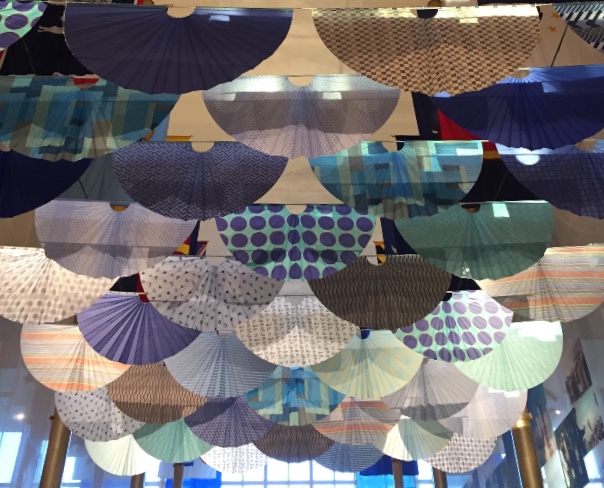
When we went to the Kennedy Center on Wednesday, October 18th we received a talk from Kazu Kumagai (the tap dancer we later saw perform) and Reiko Sudo (the designer for Fantasy in Japan Blue, featured in the Kennedy Center Hall of States). After the discussions, we then had dinner and watched performances from Kazu Kumagai and Yumi Kurosawa, a koto player.

During Ms. Kurosawa’s performance, I was left in curiosity about the instrument she was playing, the koto. I wondered how she interacted with the strings to make such clean, quick, repetitive sounds. After the first two songs, Virgil Gadson was introduced as her hip-hop dancing partner. When she said that he was a hip hop dancer, I was excited to see how it would turn out, because I listen to rap so it was interesting to think of how he would incorporate his dance into her music. Watching him dance seemed really engaging to me. The way he moved around the stage, he was very intact with his balance, as he could put himself into poses that would require an immense amount of focus on one part of the body, say the forearm. I realized that he kept his tempo in sync with the tempo of the koto player, making it easier to follow him and the music as well.

I also liked trying to figure out what message he was trying to convey, or was he just going with the flow? In the end, I loved how he interacted with the koto player, kind of breaking the fourth wall in a way. The two made it seem like they weren’t working on their parts separately, as with this small little section when he changed the direction of Ms. Kurosawa’s focus to an imaginary apple tree, as if playing charades because he didn’t speak. He ended his portion of the performance by making reference to this episode and pulling what seemed to be an apple out of his jacket.

As a person who can’t dance, or at least has no rhythm, I was just star struck and surprised after he finished, because I was expecting him to do sort of stereotypical hip-hop moves, like two-steps, three-steps, I was imagining him touching his toes with one of his hands pressed firmly against the ground with a boombox beside him, but his dance was more like ballet to a beat. I could sense that he had experience in ballet, judging by how flexible he was, and how fluid his movements were, and how he could easily shift where he put his balance.

Watching the performances at the Kennedy Center gave me a sense of intercultural appreciation. I thought maybe I would just see one Japanese tap-dancer on  the stage tapping his toes as fast and rhythmic as he can and a gorgeous koto player, stringing her heart out, both by themselves. But both performances were very diverse. One of my favorite performers was  Alex Blake who played the bass during Kazu Kumagai’s tap dance. I loved how dedicated he was, almost falling out of his chair at one point (a point that admittedly made me giggle), showing his enthusiasm.

My first time at the Kennedy Center, will be something I’ll always remember, reminiscing about the enjoyment I experienced watching these performances.