By Christian Garvin
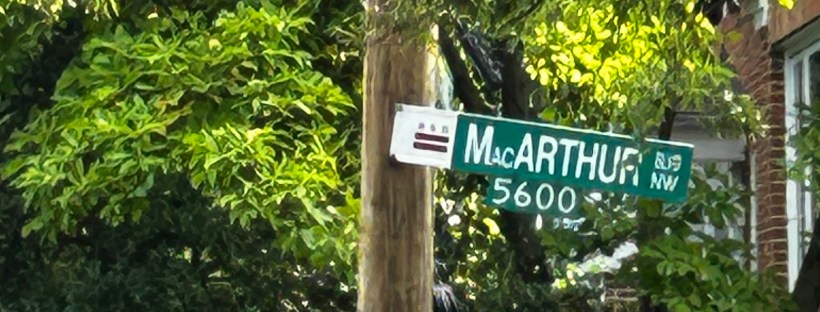
As part of Japan in DC’s ongoing efforts to unveil DC’s deep connections to Japan. I’m fortunate enough to live on a street whose name has great significance in the history of US-Japan relations: MacArthur Boulevard.
Walking to school every day, I always wondered how the name MacArthur Boulevard came to be. Living on this street I have so much love for the community I am a part of, the high school (MacArthur High School) I go to, and the people I am surrounded by. So when I discovered the rich history of this small community I was shocked. Long before MacArthur Boulevard was named after the American General Douglas MacArthur, it was simply named Conduit Road. Now one must wonder “Why was the street name changed?”
The actual answer is simple, drum roll please… war hysteria and patriotism were the cause. But, let’s back up even further to the year of 1859. The capital of the nation had just finished building another fresh water pipe that traced the route of the Washington Aqueduct and named the street above it Conduit Road. At that time, the only people living on or using this street were the people repairing the pipe, and it was like this for nearly a century.
Yet this all changed in the 1930s when a new community started to be built, the Palisades, which turned farmland into the suburbs of DC. Residents of the Palisades believed that the name “Conduit Road” was unflattering for a road that was turning into a desirable area to live in. However, at this time their push for a new name was ignored by officials.
Luckily for the Palisades community, an opportunity appeared to rename the street. In the midst of World War 2 after Pearl Harbor, the new name was put in front of Congress by a man named Chauncey Carter who suggested that Conduit Road be renamed to MacArthur Boulevard as a way to honor the rising American war hero Douglas MacArthur.
The Arkansas-born West Point graduate Douglas MacArthur was in the Philippines, leading the most grueling defensive stand in American military history against the Japanese invasion force. MacArthur was completely unaware of the bill that was being passed to rename the Washington DC street after him. During this time President Franklin D. Roosevelt had just ordered Douglas MacArthur to evacuate the Philippines and head to Australia to regroup. While there he wrote on the back of a letter to the press “The President of the United States ordered me to break through the Japanese lines… for the purpose, as I understand it, of organizing the American offensive against Japan, a primary objective of which is the relief of the Philippines. I came through, and I shall return.”
Nearly two years later, on October 20, 1944, during the Allied invasion of Leyte Island, in the Philippines, MacArthur broadcast his now iconic message: “People of the Philippines: I have returned.” After the nuclear bombing of Hiroshima and Nagasaki as well as Japan’s surrender in 1945, General of the Army Douglas MacArthur was placed in charge of building the new State of Japan which was now to be a pro-democracy and Western-adjacent nation.
Funnily enough, in 1951 President Harry Truman fired MacArthur for insubordination, yet the street name stayed the same.
MacArthur Boulevard is a perfect reflection of how Americans see the war hero Douglas MacArthur: A champion of American ideals and democracy. Today, MacArthur Boulevard runs from Georgetown through the Palisades all the way to Great Falls National Park in Maryland. It holds some of the best parts of Washington DC like Mac’s Market, MacArthur High School, Sibley Memorial Hospital, and my home.
*SPEAKING OF RENAMING: In August, 2026, at the beginning of the new school year, MacArthur High School itself was renamed for John Thompson Jr, long-time winning basketball coach at nearby Georgetown University and DC native.

