This picture features General Frank D. Merrill with interpreters Herbert Miyasaki and Akiji Yoshimura. The photo represents a fraction of the 14 Japanese American linguists and infantrymen who were part of “Merrill’s Marauders,” which fought in the Asia theater after Pearl Harbor. This picture specifically intrigues me because the men are smiling at something behind the lens. Regardless of the cause of their smile, it’s heartwarming and comforting to me. These men of different ethnicities have worked with each other. They collaborate with a shared objective in mind. They are enjoying each other’s company. In a strange sense, it gives me comfort to know that anyone can enjoy each other’s company if these men, of different ethnic backgrounds, can.
Although I unfortunately was not able to attend the Pearl Harbor memorial event, I was deeply moved looking through the pictures taken by the class. One that especially touched me was this one, showing Japanese soldiers recruited by the United States army to fight in the Second World War– it’s hard to imagine what they must have been feeling at that moment. On one hand, they were Americans, and I’ve heard many accounts of Japanese Americans who were proud to fight for the U.S. On the other hand, fighting against one’s homeland must be a difficult thing to do no matter if one was born there or not. Additionally, this photo was taken just a few months after the United States government began imprisoning Japanese Americans in internment camps, so this likely complicated the new soldiers’ feelings as well. Though at first glance this photo seems somewhat impersonal, all the layers to the soldiers’ predicament make the image a very touching one.
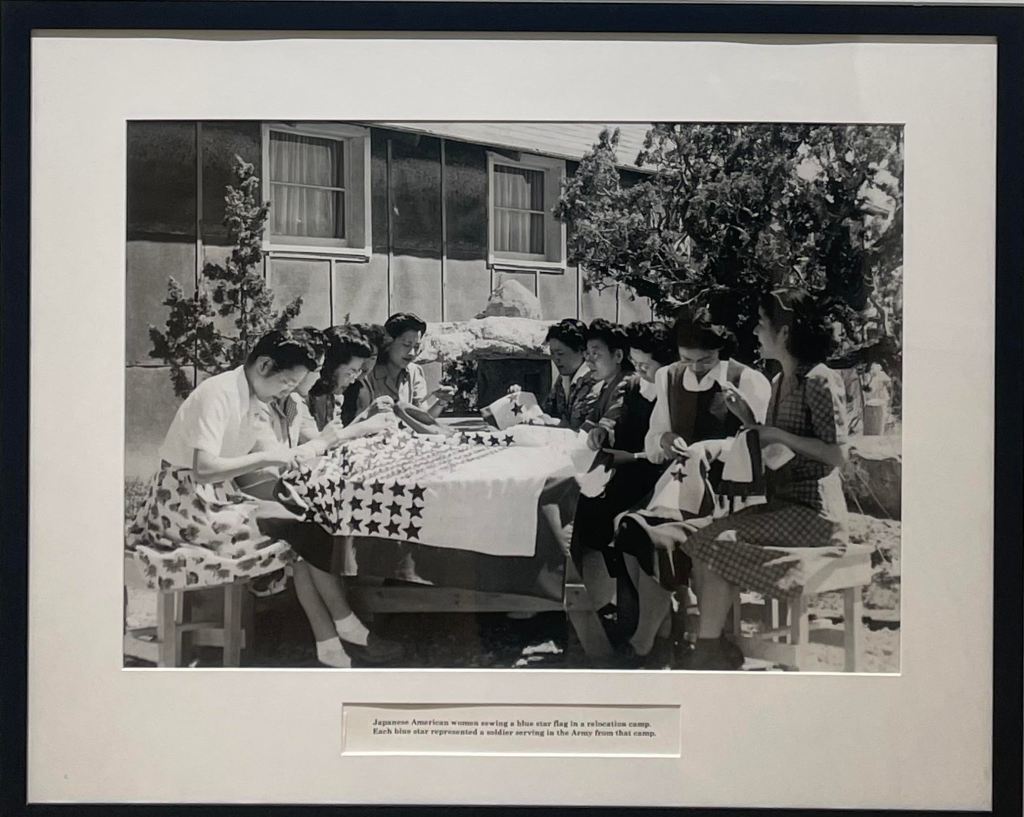
During World War II, a worldwide conflict emerged, encompassing countless individuals from different nations, all of whom made substantial sacrifices for their respective countries. Amidst this chaotic era, the often-overlooked narratives revolve around Japanese American women who found themselves confined in Internment camps alongside their children, while their husbands dutifully served in the United States Army. During the aftermath of the Pearl Harbor attack in 1941, numerous Japanese American women, alongside their families, were compelled to relocate to internment camps. Despite the difficulties posed by internment, these women actively participated in volunteer activities within the camps. One notable example was their involvement in sewing blue stars, symbolizing each Japanese American soldier serving during that period, as depicted in the provided image.
During the war, Japanese American women, like their counterparts across the United States, stepped into roles traditionally occupied by men who were serving in the military. They took up positions in various sectors such as manufacturing and agriculture, making significant contributions to the wartime economy. Following the war, these women encountered the daunting task of rebuilding their lives. Many had suffered the loss of their homes, businesses, and belongings due to internment, yet they played a pivotal role in the resettlement process. They adapted to new circumstances and actively participated in the post-war recovery efforts. The strength and resilience displayed by Japanese American women during World War II and the internment period highlight their unwavering determination in the face of adversity. Moreover, their unwavering commitment to supporting their communities and country further exemplifies their remarkable character.
Japanese Plus went to the Japan Information and Culture Center (JICC) to visit their World War ll “Go For Broke” exhibition. There were many photos of families, relatives in the army, the Japanese-American contributions to World War ll, and many more. One thing I noticed while walking around is that most of the photos were in black and white because of the period of time. However, there was one photo that was in color near the entrance that was a reunion of the Japanese-American veterans fighting for the U.S.
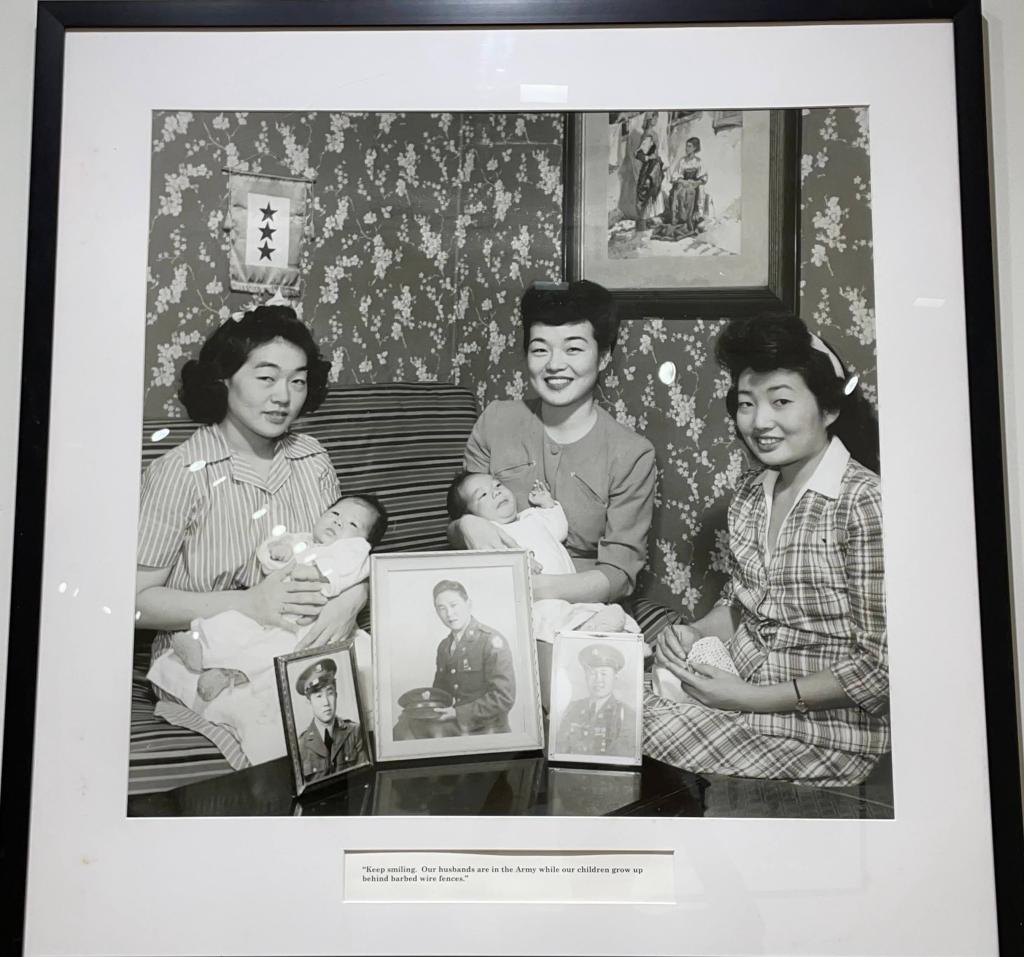
While walking around there were many photos that caught my attention. One that captured my attention the most was of three women sitting around a table smiling at the camera, two of whom held babies in their arms, and on the table were three pictures of their husbands in their military uniforms. At first, I thought that this meant their husbands had passed away until I read the caption. “Keep smiling. Our husbands are in the Army while our children grow up behind barbed wire fences.” This was in reference to the Japanese-Americans being in camps because President Franklin D. Roosevelt issued Executive Order 9066. E.O. 9066 meant Japanese-Americans were sent to camps behind barbed wire fences, weren’t able to leave, and had no role in deciding if they wanted to stay in their homes. The Army took volunteers to help fight in battle and their brave husbands stepped up to the plate along with many other Japanese-Americans, despite being held in imprisonment.
The realization that these babies have to grow up in a harsh environment without their fathers made me feel sad. Then I also realized that the wives must be very worried about their husbands that they can die in the line of fire, and yet these strong women are still able to smile for a picture and continue to live in inadequate living conditions while taking care of their children. There was a deeper meaning behind this photo which is what really captured my attention. Not only the bravery of the husbands fighting in combat but the strength of the mothers. “Keep smiling” is the phrase that made me realize how grateful I should be. It makes us realize how privileged we are and reflect on how we should be more grateful and appreciative.
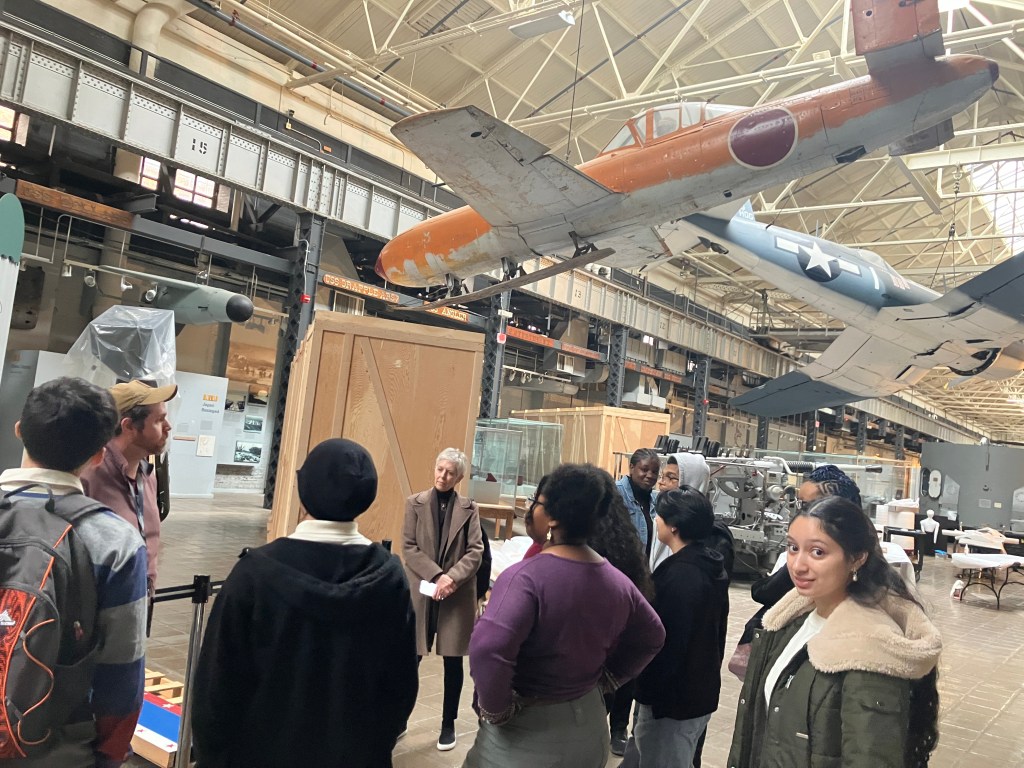
On December 7th, our Japanese Plus program got to go to the Navy Yard in southeast DC to participate in a special event commemorating the lives lost when the Japanese attacked Pearl Harbor in 1941. We were invited to take part in a Pearl Harbor Remembrance Day Program there by the National Museum of the US Navy. On behalf of our whole group, we want to express appreciation to Education Director Paul Perry and the others at the museum for inviting us and for being such great hosts.
Tristan, Elias, Kori, Felipe, D’Amonie, and me – with our Japanese teacher Takahashi-sensei, DC State Board member Dr. Jacque Patterson, and Globalize DC’s Sally Schwartz. Paul Perry giving us instructions for the day.
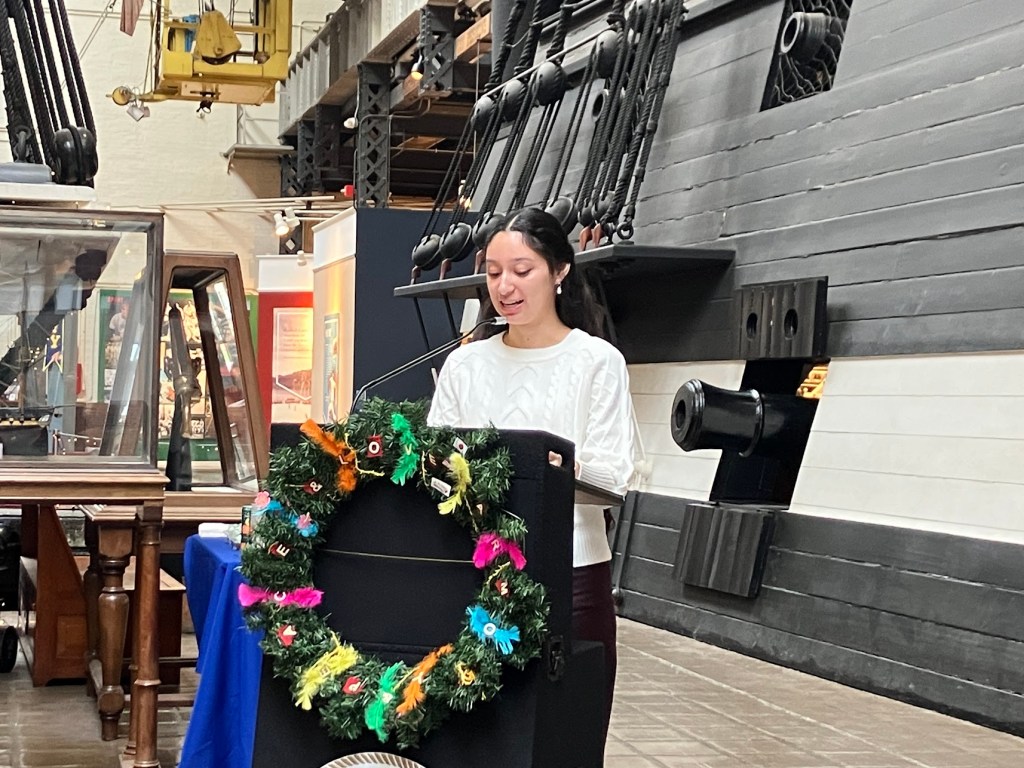
Days before the event, thanks to a visit from Paul to our class, we got the opportunity to create our own wreaths that would be put on display. Wreath making was fun as we all got to show off our artistic and creative skills. Not only that but it gave us a chance to reflect on why people should commemorate the loss of life at Pearl Harbor, and how to include those thoughts on our design.
On top of making the wreaths we had to write a statement on why we believe it’s important to commemorate the lives lost, both Americans and Japanese. Coming up with the statement required me to reflect on the war’s involvement in history and how it affected people at the time. I was able to reflect on the consequences of war and the importance of avoiding similar tragedies.
“Remembering both American and Japanese-American lives lost during Pearl Harbor is important in acknowledging the complexities of history. It recognizes the significance of respect and compassion among diverse communities while accepting the pain and losses suffered by people on both sides of the conflict.”
The Navy Yard itself is magnificent; it is as if I was walking into a history book. All the artifacts and ship models were so remarkable. It was as if I was learning about American history all over again. My personal favorite exhibit was the life sized version of the inside of a wooden boat. Being able to see a life sized cannon is not something very common. I recommend that people go see the museum themselves.
When learning the days of the week, it was fun . . . . Usually I struggle with what we’re learning. However this lesson was one of the lessons I was easily able to understand. In addition, it was one of my favorite lessons because we were able to listen to a music video that helped us memorize (in a way) the days of the week.
Coming up to Level 2 in Japanese, I was beyond excited to dive into more complex language, the toughest writing system to really grasp, Kanji. I have been anticipating both the hardship and excitement of what Kanji would bring. Our first few characters we learned were the days of the week. There was a days of the week song that sensei showed us. It was for kids but it helped me memorize the days in order.
In English, we start our week from Monday and end at Sunday. In Japanese, the week starts on Sunday and ends Saturday. The particle for “day,” regarding to of the week, is よう日 (youbi), so we had to memorize the characters for specific days. The characters have distinct meanings. For example, the character for Tuesday 火 (ka) is also the character for wild(fires), Wednesday’s character 水 (sui) is also water. My absolute favorite in terms of writing and meaning is Friday 金 (kin), meaning money!!! Friday is money day; payday!! The character itself is the most complex with the total of eight short majestic strokes.
I can’t wait to continue this journey of diving deep into essential kanji to further my comprehension skills at this level.
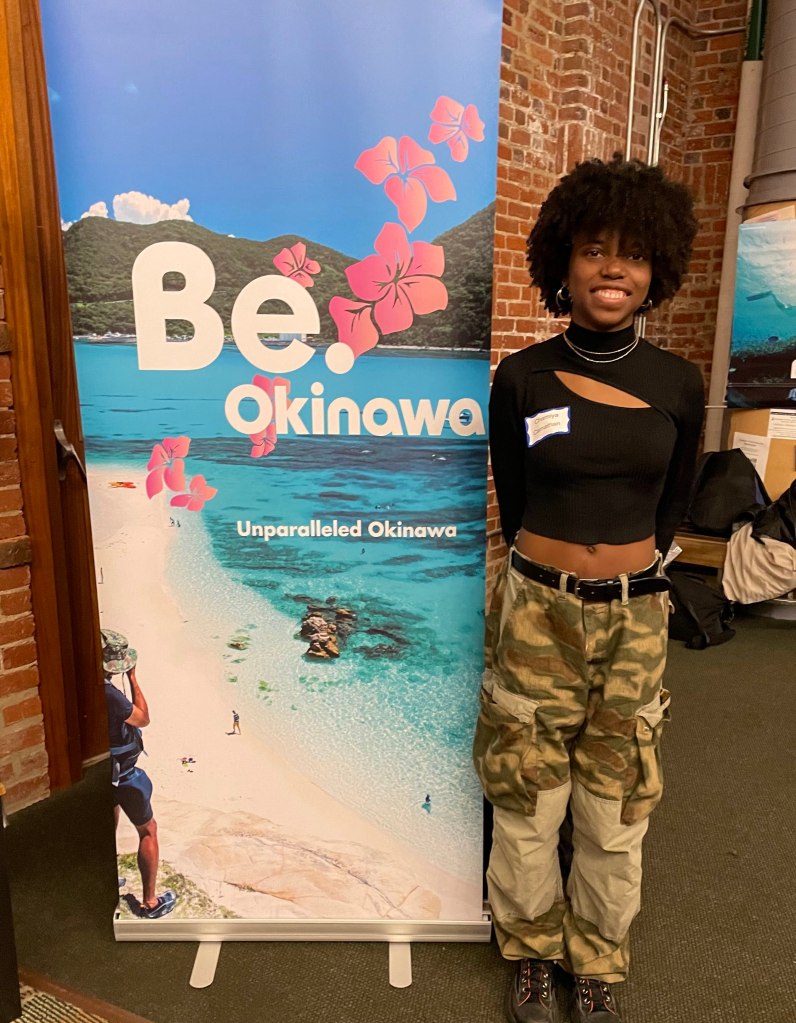
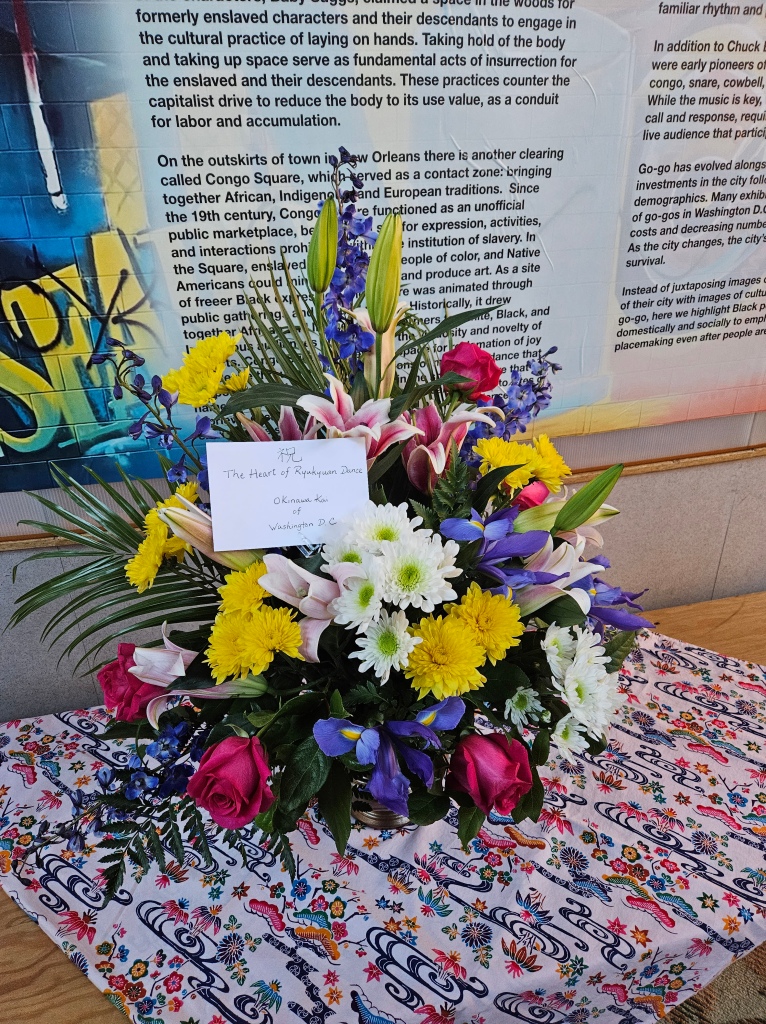
On November 18, 2023, Sally Schwartz and I attended the “The Heart of Ryukyuan Dance” performance which was located at Georgetown University’s Davis Performing Arts Center. Five masters of Ryukyuan dance from Hawaii, San Francisco, Los Angeles, and Washington, D.C. were featured in the performance. The five Ryukyuan Dance Masters from various academies came together for the first time to share Ryukyuan culture and art. Sally and I were generously invited by the DC Okinawa Prefectural Office to both the performance and the reception afterwards, and I greatly appreciated the event that I attended.
To provide some context about the significance of the Ryukyuan dance, Ryukyu is the ancient (and original) name for the Okinawa region of Japan. From its founding in the 15th century until its incorporation into Japan in the 19th century, Okinawa fostered its history and culture as the autonomous “Kingdom of Ryukyu” for 450 years.
I didn’t know what to expect when I attended the event but it was way better than I expected. In all, ten dances told stories that included cultural tapestries, love stories, and much more. Every dance was distinct in its own right, whether it was a lively, upbeat dance or a slow dance. I loved watching the dances and connecting the dance moves to the story itself. The dance that sticks in my memory the most is called “Kanayo Tenkawa River,” and it tells the story of two lovers who chose to exchange vows by the Tenkawa River. The fact that the dance included props made it something I truly adored. The dancers used a piece of cloth to show that they were interconnected through their love.
The dancers’ demonstration of a move used in Okinawan dances to the audience was my favorite part of the performance. They then invited the audience to join in on the dance, which I thought was a great way to involve the audience. We were able to learn a cultural dance move and take it with us home. My other favorite event was the decision to combine GoGo music — Washington DC’s official music — to Ryukuyan dancing. I would never have imagined that the two cultures could coexist, so it was really fascinating to watch. Although the dance and music are very different from one another, they nevertheless blended incredibly well.
I greatly appreciate the dancers and everyone involved for creating a wonderful experience. I loved every ounce of it and I would love to attend another event like this again.
To me, and I’d like to assume to the others as well, going to places that hold historical significance towards Japan helps keep my motivation to pursue Japanese language learning even further. Reading, looking, and imagining how everything was put into place behind the history just inspires you to read more into it, wanting to learn more about the topic and the overall history.
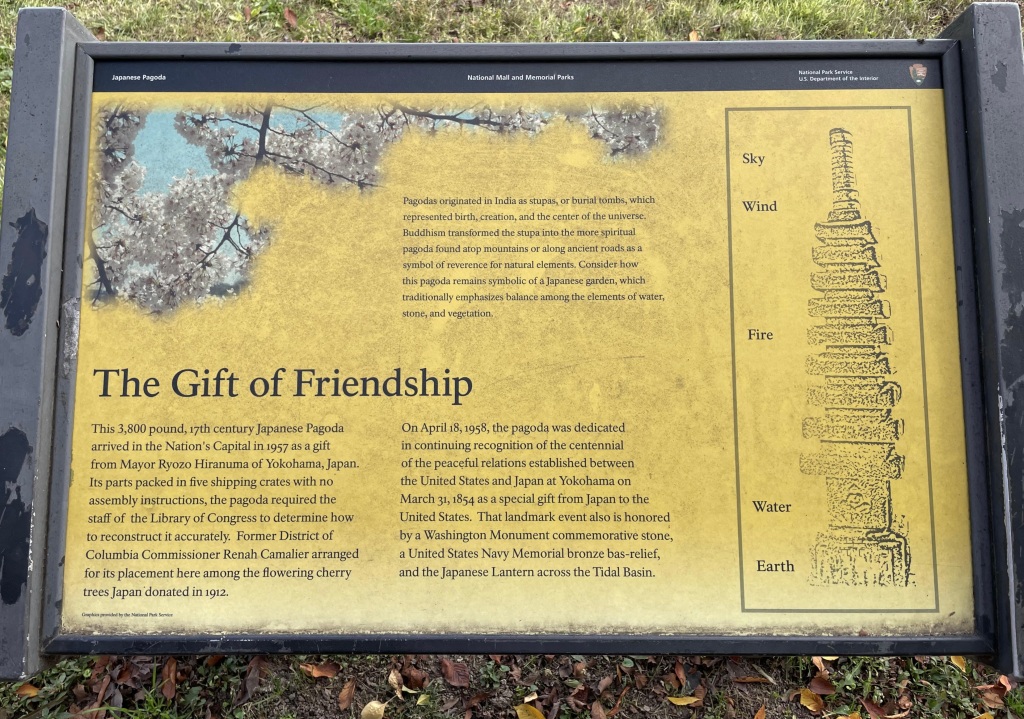
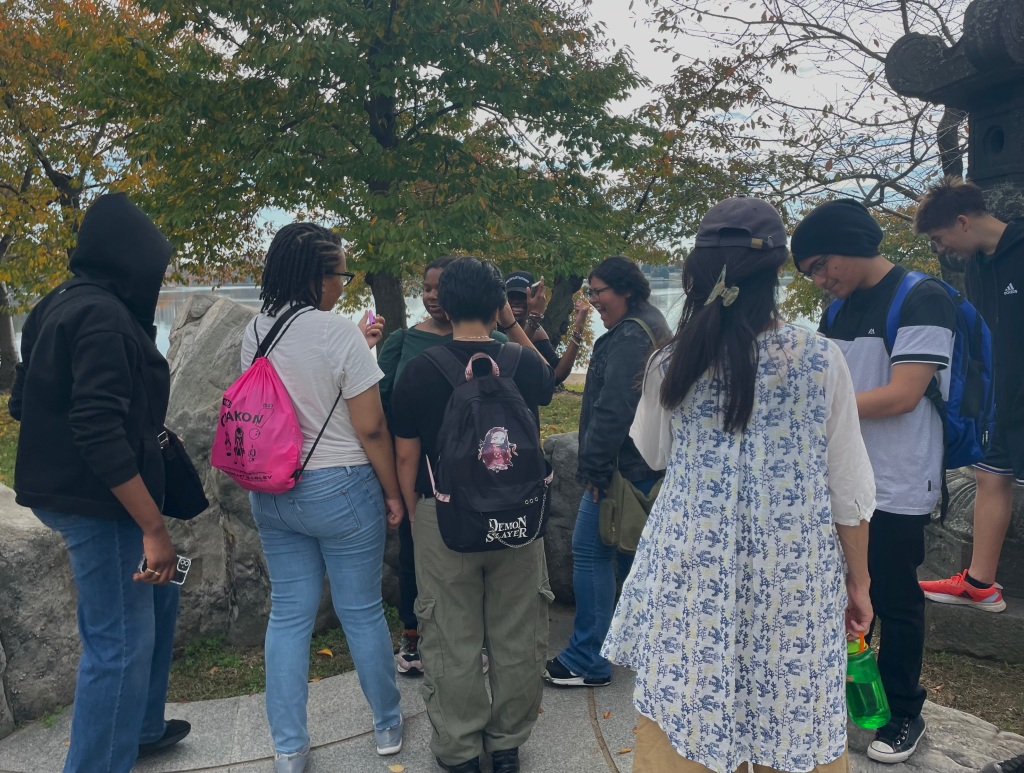
Thankfully, in Washington D.C., there are historical landmarks and workshops we’ve gone to. For example, we spent a Saturday morning last month walking around the Tidal Basin, which is located near the National Mall. A pagoda we found near the FDR Memorial includes the 5 elements: Sky, Wind, Fire, Water and Earth. This historical piece was given to the United States from Mayor Ryozo Hiranuma of Yokohama, Japan in 1957. It’s honored and kept in good condition by the people who choose to admire the piece instead of attempt to vandalize it. It’s respected by all, signifying the US and Japan relationship to be strong, and shows Japan’s appreciation to the US by giving them a piece of themselves along with the cherry blossoms around the Tidal Basin.
Furthermore, on November 4th, Japanese Plus students attended another workshop by Onigiri Action, sponsored by Table For Two, which happened at Marianne’s Cafe on the first floor of the Martin Luther King Jr. Memorial Library in downtown Washington D.C.
The workshop allows you to make your own onigiri (rice balls) to enjoy, savoring the taste. But in return, taking a quick picture and posting it on social media using their hashtag or on their website will allow you to feed starving children around the world. The significance this has on children’s lives by only making an onigiri and posting it to the public for more awareness is a wonderful experience and action.
These are just a few experiences the class and I have attended. Hopefully we get to attend more field trips surrounded by Japan’s history, whether its music, art, environment, and even architecture. Because of these field trips, we all are replenishing the drive that drove us to join this program: learning the culture and language of Japan.
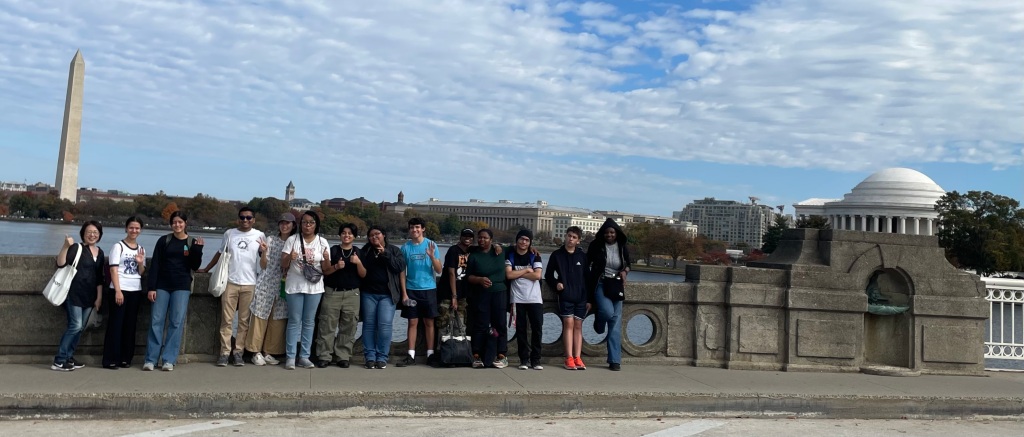
On October 28, I had the pleasure of walking along the Tidal Basin along with my Japanese Plus classmates as well as some visiting teachers from Japan. This was a great opportunity to practice my Japanese along with my classmates and learn new words and phrases from the teachers. The rules were clear, we were only allowed to conversate in Japanese throughout the entire walk. This meant we would practice both long phrases to describe various things we saw on the walk, and short filler words from daily conversation. We learned how to play “I Spy” in Japanese as well. We learned how to say the different colors in Japanese and used that to play I Spy with various different monuments that we could see around us. This was helpful for learning not only the colors but also the names of common objects, like trash cans or trees.
We were also able to appreciate Japan’s cultural influence in DC as we walked by the out-of-bloom but still beautiful cherry blossom trees that would turn beautiful shades of pink come spring. The walk was an overall success as I felt that it was a great chance for me to practice my Japanese in a more casual setting outside of the classroom. We were also able to catch some tidbits of Japanese influence along the way, such as a lantern that came from Japan and references to World War II in the FDR Memorial.