Nengajo

By Tara Martin

During December, we learned about the Japanese new year’s card: nengajo. The custom dates back to nenshi-mawari, or new year’s visit. The visit was intended to keep good relationships in the new year. When post offices began sprouting up, sending cards became popular. Nowadays, you can buy one, send one virtually, or hand make one. They’re extremely popular, over 4 billion are sent each year! Many people still make theirs by hand with brush calligraphy, painting, stamps, and creativity.

Nengajo incorporate common symbols: the zodiac, Mount Fuji, the rising sun, tako (kites), hagoita (Japanese badminton), kadomatsu (festive decorations), and common characters. The postal service also holds a nengajo lottery (where the lottery numbers are on the cards). There’s also a specific etiquette for sending nengajo. For example, you shouldn’t send a nengajo to a family in mourning (out of compassion). The culture behind nengajo is very interesting!


Giri

By Tara Martin

Giri translates to something like obligation or social duty. Giri is the belief that you are indebted to someone who has given you something. I find this concept very interesting because it shows that there is a moral obligation to returning a favor or giving a thank you gift. It’s kind of similar to the US, where we feel that we must get a gift for our loved ones and those who have given us a gift. However it’s not really seen as mandatory and you usually give gifts because you’re being kind, not because you’re indebted. Giri really shows the level of gratitude in Japan.

The first time I walked into a Christian church

By Ana Nguyen

The first time I walked into a Christian church, I was 15 years old.

So, my family are Buddhists. Though I was raised with the statue of Buddha in my house, and my parents practiced Buddhist traditions and praying methods, it wasn’t strictly ingrained into me. Though churches here can have a welcoming atmosphere, no matter the area one is in, I felt really uncomfortable walking into that church. Religion wasn’t a huge thing in my upbringing, and I felt like I was trespassing on someone’s house.

From “A Geek in Japan,” I learned religion is entwined with the culture and daily life of people in Japan compared to the U.S. In Japan, one can be Christian and still go to a Shinto shrine to make a wish. Religion in the U.S. stays within the church or home mainly, and yes, people practice their religion in their daily lives, but it’s not widely done. That’s compared to Japan where saying “itadakimasu” before eating is a habit to say thank you for the food, but it also stems from a religious practice similar to giving grace. That separation of religion and school or work sort of creates a barrier. It’s amazing that religions like Christianity, Catholicism, Buddhism, or Shinto can cross over one another in Japan, while here it stays separate.

Striking up a Conversation

By Shawma Brown

We were in Z-burger having lunch when the instructor told us to mix it up a little bit with the Japanese students from Meiji University. I sat at a table with four Japanese students. I just sat there exchanging awkward looks with them. It was awkward to be surrounded by people I didn’t know and that were from another country. The word that kept popping in my head was socially awkward. That is what I was being. I had so many questions I wanted to ask but I was very nervous. It was not until three of the students left that I was able to talk. Me and one of the students started conversating. He asked me why I was holding back from talking. I said I was just nervous.

I was glad to have conversated with him, because I was grateful for every single moment of the conversation. We started talking about food, education, American and Japanese society in general. The most intriguing part of the conversation was how he told me how Japanese see Americans. He said they talk too much. That made me laugh. I then said why do we seem to talk too much. He said we talk to strangers and we have no boundaries. I was just astonished because this was true, whether I would like to admit it or not.

Our Meiji Kakehashi meeting

By Raven Bluford

We had another Kakehashi visit from another set of students – from Meiji University. This time we got a chance to practice our Japanese with them. The conversation was very hard due to the fact that we had to talk for 7 minutes in Japanese and I don’t really know that many questions in Japanese. But the person I was talking to was very willing to try and understand what I was asking, even if the way I was asking questions could be seen as confusing due to the questions lacking sentence structure.

Like the other Kakehashi visit, we were invited to go to Z-burger with them. This time I decided to sit with two of them and try to practice my Japanese. I asked them questions about what they think of America and their response was quite interesting, because the way they saw America was quite different from the way I look at America. The first thing they thought of when I asked that question was large serving sizes, which was quite funny. I also asked questions about what they do and about them learning English. Overall, I really enjoy getting to have experiences like this because it allows me to meet people and interact with actual Japanese people in ways I otherwise never would.

Trying New Foods

By Shawma Brown

I never understood why people eat foods that they never tasted before. I do eat foods that are new to me but they’re mostly American food. Trying food from another culture always intrigued me. Going to a Japanese restaurant and trying miso soup for the first time was magnificent. As soon as I put a spoon full of the soup in my mouth an unreadable look appeared on my face. The words “OH MY GOD” had slipped out my mouth. Eshita Sensei and Layana had looked at me with a concerning facial expression. They asked me what was wrong? There was nothing wrong with me; it was just me admiring the miso soup. Like I never had tasted soup that was so good. To many people this may seem like not a big deal, but it was for me because food is my soulmate. If you’re ever wondering what I ‘m thinking about, it’s always food because food is an obsession for me. I plan to go back to that restaurant and have miso soup again.

Eating red bean ice cream for the first time was weird. First of all the idea of ice cream being made out of beans sounds utterly ridiculous. Usually I’m not a picky eater but I turned into one real quick. I have always gotten the same ice cream flavor all my life – vanilla. Trying a new ice cream flavor was heartbreaking for me because I was betraying my first love, vanilla. I got over my heartbreak fast. The red bean ice cream was so good. I just couldn’t get over the texture. There you go, I was being picky about food for the first time. The texture of the ice cream was so weird but the taste was exquisite. The miso soup and the red bean ice cream was my favorite part of the restaurant.

Religion

By Skyy Genies

In Geek in Japan in the Religion and Philosophy chapter, I read about how “most Japanese don’t believe in one specific religion but combine aspects of several religions in their daily lives, often unaware which one they’re following.” I find this as a huge contrast to American perspectives on religion. In Japanese society, religious flexibility and freedom is normal, where here in the United States our religious institutions and practices are more rigid. For an example, in our cultural conversation, one of my classmates, Talia, spoke about how uncomfortable an Islamic person may feel if they walked into a Christian institution and vice versa. I think this may be due to the religions sprouting from similar ideas/locations in Japan rather than here in the United States where the religions practiced are very strict and came from many different places. Which is expected given the homogeneity of the Japanese society and the diversity of American society.

Additionally, the values in America and Japan differ, which influences the prominence of religion in everyday life. As Eshita Sensei said, she didn’t know how much her daily activities were rooted in religion until she learned about religion in college. Everything (almost) has a religious aspect in Japan. This may seem true at first glance in America; however, we separate our religion and social, business relationships. Religion can’t be discussed/taught in school. This idea is also tied to the changes in America today, where many Americans are non-religious and questioning what they once believed. This is very different from Japan where respect and avoiding confrontation is an automatic standard. It’s just so interesting to me!

Photo Spotlight: Meiji Visit

By Raven Bluford

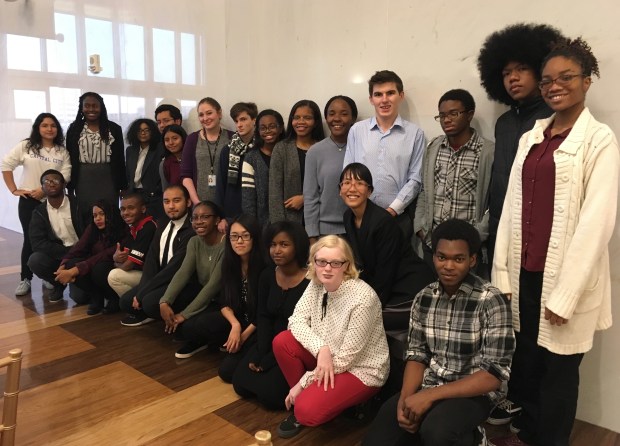
This picture was taken during the second Kakehashi visit at Z Burger, where we got a chance to meet up with the Japanese students from Meiji University again. This allowed us the opportunity to practice some more of our Japanese. One of the things I remember the most about this experience is that as we were struggling when speaking in Japanese due to the limited amount of Japanese that we know, the Japanese students were struggling just as much when trying to speak in English. This made me feel much better and also motivated me to try to become as close to fluent in Japanese as I can, because being able to break the language barrier would be quite useful in trying to communicate with other Japanese people to learn more about their quite intriguing culture.

It’s What I Believe

By Chidera Obiwuma

I found it interesting how free Japan is with religion and philosophies. They mix and combine the different religions and philosophies amongst them. For example, in Japan, it is normal to be baptized in the Shinto ritual, get married in a Christian way and celebrate a funeral using Buddhist traditions. This is very unlikely in the United States, where people tend to be defined by and just strictly follow one religion. It is unlikely to see a Christian practicing parts of the Islamic religion, because more than likely it will be frowned upon and criticized. In the United States, you can get discriminated against because of your religion, but that is unlikely in Japan since no one is really subjected to one religion.

So what’s religion like in Japan vs the US?

By Chi Onyeka

So I was born and raised to be an avid Christian and I remember getting into an argument about whether God was alive or not in the 5th grade. Here nowadays, you can’t do that because people are sensitive about things like that, hence the reason why you’re not supposed to talk about religion in public. It’s not at all that the US isn’t religiously diverse, it’s just that there are so many strong opinions developed about religion in the US that people prefer not to be so open about their religion. For instance, you wouldn’t see someone openly saying the grace at a restaurant or blabbing about atheism, because they wouldn’t want someone to get offended. Religion isn’t really applied to the daily life unless you attend or reside in a place that identifies strictly as one religion.

In Japan, on the other hand, people don’t really identify as one religion; they merge different aspects of each religion into their daily lives. The main religions practiced in Japan are Buddhism, Shintoism, and Confucianism. Some people even practice two religions at the same time! But Chi, what do you mean by they apply religion to their daily lives? Well reader, here’s what I mean. Take itadakimasu, for example. Itadakimasu is the practice of saying thanks before a meal to the gods and everyone who contributed to making the meal. If you’re about to eat a nice warm bowl of miso shiru at the most popular restaurant in Tokyo and you say “Itadakimasu!,” no one would give you side eye because that’s a part of their culture and you’d probably get more side eye not saying it anyway. That’s what I mean.

In conclusion, there’s definitely more than one religion in both the US and Japan. It’s just the portrayal of religion in Japan would be more open and common because it’s normal to be a Buddhist in the morning and a Confucist in the evening. Whereas, in the U.S, that kind of stuff is rare because we follow mainly monotheistic religions that tell us to not bow down before another God, so if a Christian says “God Bless you” to a Muslim..that might be seen as a problem. So in the US and Japan religious diversity is handled differently.