Performers at the Sakura Matsuri

By Raven Bluford

My shift for our booth at the Cherry Blossom Festival was from 4-6 p.m. and I had arrived at about 10, so we had a lot of time to explore the festival until our shift. A few of us spent a lot of time at the JPOP stage, where there were various Japanese performers performing throughout the day. The performances ranged from bands to dancing groups to fashion shows. My favorite performances were by a J-Rock group called Kanadete sourou and a J-Pop group called Jr. Exile. I’d never heard of Kanadete sourou and I’m not a big fan of rock, but I really enjoyed the songs they were singing considering the female vocalist had a really amazing voice and she was really energized. Another thing I liked about them was that the speakers were really loud, so you could really feel the vibrations from the drums and guitar. I knew Jr. Exile because two days prior we had watched them perform at the Japan Bowl, so I was really excited to see them because I was amazed by their performance at the Japan Bowl. I think their performance at the Cherry Blossom Festival was better than the Japan Bowl because the audience was louder and more pumped, which made the performance more exciting. I really liked Jr. Exile because they’re really good dancers and very good singers. I especially liked the dancing because they were in-sync and they did a few stunts as well. This was a really great experience because it has influenced me to explore more about them and their music.

Chi’s Sakura Matsuri

By Chi Onyeka

Cherry blossoms are trees that bloom once a year that were gifted to the U.S from Japan in 1910 as a symbol of friendship between the two countries. They (sadly) all died at first, because it was unknown how to take care of them, but later in 1912, more trees were gifted to the United States and were better taken care of. Now, in DC, we annually celebrate the blooming of the cherry blossoms in spring from their peaks until after the time their petals gracefully fall. There is another festival in DC dedicated to serve the same purpose, except organizations and different programs involved with Japanese culture get to gain awareness and if an organization gets lucky, someone might become a donor. There’s also other booths that are just for fun and music from J-Pop bands as well as traditional Japanese dances. This festival is called the Sakura Matsuri, which I had the pleasure to attend this year with Globalize DC.

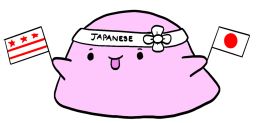
I arrived at the festival around 7-8:30 in the morning with Ms. Sally and met two other students there. From there we set up and discussed about how we were going to address the wind issue since our tent activities were primarily paper-based whether it be coloring sheets or papers providing more information about the Japanese Plus program. We ultimately decided that we would use water bottles to set on top of the papers. Though it wasn’t the most aesthetically pleasing, it was helpful even though at some times during the day the wind was so strong it knocked the bottles over and papers ended up flying anyway. Once we finished setting up the tent, we began to explore the festival before people were let in. Since 10:00 (when people started to enter the festival) until 2:00 (when my shift ended) I was primarily tasked to draw people to the tent, take a picture of people with puni puni, explain the meaning behind puni puni’s name and to provide more insight to people about our program. I’ve seen many interesting people in doing so, and the hardest part was coping with rejection, because a lot of people were blunt and said “No” off the bat, then others (the majority) said things like “I’ll come back later” or “Not right now” which was easier to accept.

Before the Sakura Matsuri, we spent a lot of time in class deciding what we were going to do for the children that happen to encounter our booth. My group had the idea of teaching participants five different types of sushi then playing a matching game and those who remembered the most types of sushi got a booklet with pictures of the sushi, the name in romanji, as well as the name in hiragana/katakana. When it came time to run the booth during the festival 90% of children were drawn to the coloring section and most people who came to participate in our activity were adults interested in our program. Many people were excited to receive the booklets, but I didn’t give out all that I made. When I finished running the sushi activity, my shift ended so it was time to go explore.

So, the first thing I did once I was free was to go see what music they were playing and it was really interesting how it wasn’t just traditional songs or J-Pop. There was dancing and we even played and interactive game with the host (It was pretty much “If You’re Happy and You Know It” in Japanese). Then I roamed around a little bit to see what other activities they had with friends. There were so many things that I wanted to buy I didn’t have the money for them because I made the horrible decision to blow $9 on ramune, leaving me with $2 left :(. There was also a Karuta booth. I had never played karuta before so I was rendered clueless throughout the whole thing asking things like “wait, what?” or “what do I do now?” pretty often. I beat two other people playing (surprisingly) and was up against a girl who spoke Japanese and read hiragana like lightning. I was kind of intimidated, but I was still optimistic. If you wanted to know, I got 2/10 cards and she got the rest. It was still surprising to me that I got similar to 2nd place, having never played Karuta before. It was fun. We also ventured to other booths where they had really cool things like optical illusions through mirrors and coloring! Excuse me, I really like coloring. I got a Ponyo mask and boy am I happy to have it! We also saw anime booths that had merchandise for one of my favorite animes but once again, I only had $2 so I sadly walked away from the anime booths.

It was high time to leave around 6:00 so on they way home I discussed the best encounters with people I made with my transit buddy. We talked about how useful the experience was in terms of exposure to Japanese culture as there were SO many activities to do regarding Japanese culture. We both loved it, both our time in the booth, and our time roaming elsewhere in the festival. If I had the opportunity next year, I would definitely clear my schedule to come again. As well as bring a lot more money next time.
The Meaning of Cherry Blossoms

By Shawma Brown

I never really cared for cherry blossoms, they were just trees I walked past everyday on my way to school. I always thought they were lovely, but I didn’t care for them because I had no idea what they symbolized. It was until I saw a film, The Tsunami and the Cherry Blossom, that made me care for Cherry Blossoms and what they stand for.

The film showed what cherry blossom trees meant to the Japanese. The tsunami that happen in Japan on March 11, 2011 was very devastating. Many people died, went missing, were injured, and lost their homes. After the tsunami happened the Japanese were crushed. It was the cherry blossoms that gave them hope. A cherry blossom lasts for a short period of time then falls off the tree. I think cherry blossoms symbolize that life is beautiful but short. Ever since I knew what cherry blossoms symbolize I haven’t taken them for granted. I always stop when I see a cherry blossom tree and admire their beauty.

Our (sort of) class trip to Sakuramen

By Chi Onyeka

For starters, I wasn’t able to go to Tono Sushi because my school forced me to be there on the one Saturday that I would be able to go to a ramen shop for the first time, with the rest of the class. I know. Sucks right? On the brighter side of things, Sally, our program coordinator, offered a complimentary class trip to a ramen restaurant near our class. I was too excited to hear this news, but some of the students didn’t come, making it a sort of class trip.

So we didn’t go to the ramen shop right away. We stopped by Hana (はな) market and picked up things we would need for our Sakura matsuri, or cherry blossom festival booth. While in there, I got to explore and see more of what they have and asked the lovely Eshita-sensei, our Japanese teacher, to help me figure out what items were that were written in kanji. Then.. I came up with the idea that I should ask the cashier where the seaweed was in Japanese. So with the help of Eshita-sensei, I found out how to say seaweed in Japanese and proceeded to the cashier’s desk. I knew I wasn’t in the wrong for this because I’ve heard the employees there speaking Japanese among themselves, so it wasn’t like I was assuming their nationality by speaking Japanese instead of English. And it worked! She showed me where the seaweed was and I looked at the prices and were pretty satisfied since I’m currently planning to make my own onigiri once I get the money (and time) to do so. When we were leaving, Eshita-sensei gave us all newspapers in Japanese. After Hana market, we walked to the ramen shop called: Sakuramen.

Once we got to Sakuramen, we stood outside for a bit, waiting for seats suitable for all of us. We were told to go in and examine the place just to get a look of what we might have to experience, being in the ramen shop. I got to go in first and I noticed that there were mainly people in groups of three or four and the music was fairly loud. And if I’m remembering correctly, the bottom half was dimly lit but it suure did smell good in there! Because we were a large group of people, we ate on the upper half where it was quieter and less crowded. The music was faint and we all got a pretty decent time to order. I ordered gojiramen which was pork, bamboo, onion sprouts, and a thick noodle all drenched in chicken broth. It was very very good and I’d definitely revisit on my own or with a friend. On the way home, when I told my mom what was in the ramen bowl, she was so surprised that I ate bamboo and asked all these questions along with telling me to google nutritious facts about bamboo just to know how healthy bamboo is (yeah, my mom hovers over my diet like that). The thing is, there are so many species of bamboo and I didn’t know which one I ate so I couldn’t just google bamboo and find out “hey! It has a lot of calcium” or something like that, so to calm her down, I told her that bamboo is a multipurpose plant, that I’m pretty sure is good for you.

The trip to Sakuramen was definitely a memorable experience as it was my first time going to a ramen shop. Of course the whole class didn’t go, and I couldn’t order in Japanese, it wasn’t make it as memorable as Tono Sushi would have been, but it made up for my absence. And since the ramen was very oishii, it was totally worth the experience and I would definitely do it again.

Counting in Japanese

By Nuu Hightower

Counting isn’t hard, right? We’ve all learned that the second we walk in the school building back in Pre-K. However, the number system in Japanese isn’t all the same, and instead uses different systems depending on the context. These contexts include people, objects, and just in general. The first time I learned to not use the general numbers for counting how many people are in my family, I was confused, and didn’t get why there was a different way of counting just to count up the number of people. Then again, I shouldn’t have expected a different language to be like English.

Now here’s the general Japanese counting system:

1 = ichi

2 = ni

3 = san

4 = shi/yon

5 = go

6 = roku

7 = nana

8 = hachi

9 = kyuu

10 = jyuu

However, you don’t use these numbers when you count, let’s say…potatoes. Instead, you use these numbers instead:

1 = hitotsu

2 = futatsu

3 = mittsu

4 = yottsu

5 = itsutsu

6 = mutsu

7 = nanatsu

8 = yatsu

9 = kokonatsu

10 = to

Now you know how to count potatoes (at least, from one to ten). Notice how almost all of them end with “-tsu”. These are the numbers that you use for objects, as mentioned earlier. But how about counting people, you may ask. Well, you use these numbers:

1 = hitori

2 = futari

3 = san-nin

4 = yon-nin

5 = go-nin

6 = roku-nin

7 = shichi-nin

8 = hachi-nin

9 = kyuu-nin

10 = jyuu-nin

As you can tell, there’s another pattern that’s present in these numbers; almost all of them end with “-nin”. You may think that it can be confusing to constantly keep switching to different ways of saying “three” depending on the context, and you’re right in a way. However when you start to keep using these sorts of numbers over and over again while learning different subjects slowly, you can get used to it. In one class period, we’ve learned to count how many family members we have, and started to learn that number system before moving on to a different subject and thus a different number system to get used to. It’s nice that when I thought that learning counting in Japanese would be really difficult due to many ways of just saying numbers, but then realizing that I’m getting the hang of it is good to know. Remember: “-tsu” is for objects, “-nin” is for people.

Satoshi Fujimura Presentation

By Skyy Genies

During our Wednesday, March 22, 2017 meeting, our class had the opportunity to receive presentations from a panel of people who work in relations with Japan or work to expand the knowledge of Japan nationwide. One of the panelists was Satoshi Fujimura. During their presentations the panelists were asked to speak about their job and the steps they took to get to where they are. Satoshi Fujimura’s presentation resonated with me the most because he started his academic and career journey with an interest in Chemistry like me.

The most intriguing part of his presentation was his role change. He spoke about how he worked at Sony in many different positions. Then he “changed his role again” to Mistletoe Inc. I found his presentation very inspirational because it showed me that life isn’t a guaranteed thing. You may or may not have an exact plan of where you think your life is going to go; but his presentation showed me that it’s not certain. He also showed me that I should not be afraid to change my path if that’s where my heart leads me, because after his whole journey, he ended up in a place that he is comfortable and content with. Always follow your heart.

Chotto

By Kharan Pierce

As read in A Geek in Japan, the word chotto is used by the Japanese on a daily basis as an alternative for saying no. In America, it’s absolutely no problem to tell someone “no, I don’t want to eat salad,” but in Japan, the abruptness of simply saying no is rude and almost only used in tense situations. Along with chotto is a slight tilt of the head, which indicates that someone wants to say no or is disagreeing with whatever situation. I think that if someone were to use chotto in America, they’d be thought of as extremely shy and would eventually be pushed to share their opinion directly. On one hand, stating exactly how you feel isn’t bad, but this is coming from someone who was raised to do so. In a culture completely involved in avoiding confrontation and being direct and therefore terse, something like chotto is perfectly okay.

What do you think?

How We Start Our Class

By Kharan Pierce

At the beginning of each class session, the students in Japanese Plus mimic traditional Japanese schools by performing a series of actions, triggered by command words, that show respect for the teacher and the rest of the class. Our sensei selects a student at the beginning of class to be the class leader. This student will stand to indicate they’re ready to lead the commands. They then say “kiritsu” which calls for the rest of the class to stand. Then, they say “kyotsuke” which calls for the class to stand with good posture facing the teacher. They then say “rei” which calls for the class to bow and greet the teacher by saying either good morning, good afternoon, or good evening, in which the teacher responds accordingly. Finally, the leader says “chakuseki,” which calls for the class to sit down and prepare for the lesson.

By doing this before every class, it is sort of a call for focus and a shift from our days at school into the program.

Nengajo

By Tara Martin

During December, we learned about the Japanese new year’s card: nengajo. The custom dates back to nenshi-mawari, or new year’s visit. The visit was intended to keep good relationships in the new year. When post offices began sprouting up, sending cards became popular. Nowadays, you can buy one, send one virtually, or hand make one. They’re extremely popular, over 4 billion are sent each year! Many people still make theirs by hand with brush calligraphy, painting, stamps, and creativity.

Nengajo incorporate common symbols: the zodiac, Mount Fuji, the rising sun, tako (kites), hagoita (Japanese badminton), kadomatsu (festive decorations), and common characters. The postal service also holds a nengajo lottery (where the lottery numbers are on the cards). There’s also a specific etiquette for sending nengajo. For example, you shouldn’t send a nengajo to a family in mourning (out of compassion). The culture behind nengajo is very interesting!


Giri

By Tara Martin

Giri translates to something like obligation or social duty. Giri is the belief that you are indebted to someone who has given you something. I find this concept very interesting because it shows that there is a moral obligation to returning a favor or giving a thank you gift. It’s kind of similar to the US, where we feel that we must get a gift for our loved ones and those who have given us a gift. However it’s not really seen as mandatory and you usually give gifts because you’re being kind, not because you’re indebted. Giri really shows the level of gratitude in Japan.