J.LIVE 2019!

By Alexx Thompson

Recently, I’ve attended the J.LIVE event for the second time! J.LIVE is an annual speaking competition for university students studying Japanese. This event is held annually at the GW campus. The competition is comprised of three levels – Level I, II, and III. Three students compete against each other in each tier.

I arrived in time for the second level, and I was really excited to watch the presentations. Since I’d gone the year before, I had a general idea of what to expect when I came, and I was grateful to find the setup was still the same. During the presentations, students usually have a slideshow prepared, and explain their topic all in Japanese. Then afterwards, they open up questions from the audience, and then the judges in Japanese as well.

There was one presentation that caught my eye however. Usually most projects I’ve seen while attending are experiences with Japan, or something relating to a research project. It’s a bit harder for me to grasp the concept of what they’re explaining since I’m usually not familiar with the Japanese terms, but one presentation was different!

A girl named Yiman Wang stepped up, and instantly my mind clicked in recognition as her title popped up, paired with the image of a gacha card from an idol game. Her presentation was called “Virtual Idol, Sena-kun.” I leaned forward in my seat, and watched as she explained that Izumi Sena, a virtual idol from the game Ensemble Stars (Enstars), was her inspiration. She displayed pictures of her making friends and even cosplaying as ways the game has helped her branch out and have fun in life. All because of one virtual idol.

I don’t know much about Enstars, as I don’t play it, but I have friends who like it a lot! I could also understand more of the vocabulary she used, as it’s something I’m very familiar with, as I’ve played idol games similar to it, like Love Live and Idolmaster (both which focus more so on girl idols). It was really nice to hear, and I also found myself agreeing with her presentation points, as in what makes us happy in life. What drives us to be great? Even something like loving a virtual idol can help us all get through the day! I could relate, as I find using fictional characters as encouragement is a great way to push through, and find happiness in the things you do in life!

Recently in my struggles in school, I was losing motivation, didn’t really feel like coming as it stressed me out too much. But I had started reading a new novel and found myself daydreaming scenarios of the characters urging me on, helping me find the strength to keep going when I felt like it wasn’t worth it anymore. I experienced a life-changing turnaround. I frequently showed up to school early and started becoming motivated to finish my assignments despite having none before! I know the idea seems rather silly, to rely on fictional characters for support, but it can help in more ways than you can really imagine.

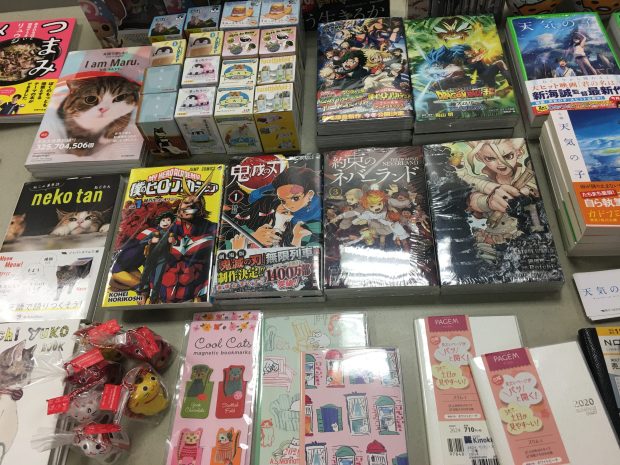
After the presentations, the rest I could understand the basic idea, but not any specific details. We went to go browse the expo booths, in which there were various Japan related companies and colleges! I even saw Kinokuniya there to sell books and manga! They even had a copy of Kimetsu no Yaiba (Demon Slayer), which is one of my favorite mangas that recently spiked in popularity, having sales that outsold One Piece which has been the long standing #1 for years! I really wanted to buy a copy, but unfortunately, by the time I’d circled back around, all the copies were gone! さすが鬼滅の刃ですね!
I got to see a lot of familiar faces, and some people had even recognized me from seeing me at various Japan events, which I was quite surprised to know they’d recognized me! At the end of the competition, and all the winners were announced, they introduced the new J.LIVE competition, now open for high school students! I really hope I can participate in it!!

My Ikigai

By Cyrus Johnson

We recently learned about Ikigai in class. Ikigai is the purpose of living, and is broken down into what you love, what the world needs, what you are good at, and what you can be paid for, ikigai being the intersection of all four. A lot of people believe that finding your ikigai and following it can let you live with more direction and for longer. When we started learning about it, we were given a packet to read with a diagram of the four parts of ikigai intersecting, and we were gonna go around and share what we put in each part.

I don’t know what the world needs, or what I’m good at, but I’ve been told I was good at picking things up and putting things together. I’m not too sure what that meant, but it would explain why I can learn Japanese easily. I like to play games and draw, so I put those in the “what you love” section, and for the “what you can be paid for” section, I put making games and selling my work.

After we all shared what we put on the diagram, Sally asked us what we would reflect on positively when we’re older, and we all shared. I said that I’d probably remember the people I did things with more than the thing I did, and that they would make up for the things I didn’t like in that activity. At my school, since we don’t meet any new students past 6th grade, we make really close friends with our classmates, and more often than not we end up going to school more because we want to see our friends than because we need to, or at least I do. We wouldn’t be able to meet other people without looking for a new thing to do outside of school, so I hadn’t met many new people until I started this class.

What I met, at the MET!

By Alexx Thompson

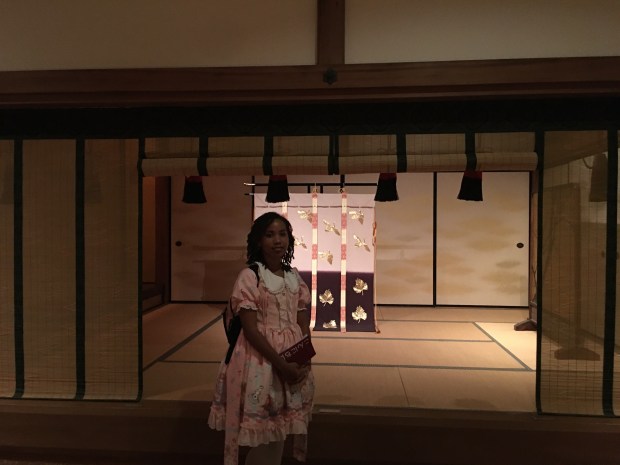
Outside of our lovely Japanese Plus class, I went on a field trip to New York with my school! I go to an arts training school, Duke Ellington School of the Arts, which prepares us to work as an artist in the professional field, and there are various arts training departments you can audition into. I’m in the Visual Arts major/department, which means I learn a variety of art skills such as painting, sculpture, animation, drawing, and printmaking. Our first trip of the year was to the Frick Collection, as well as the Metropolitan Museum of Art (the MET).

Unfortunately, the moment I arrived in New York I had fallen ill, and could no longer keep up the enthusiasm I’d had prior to boarding. With great reluctance, I had to let my friend join a different group so I could leave the group to go get medication, and thus missed a great deal of the first museum. Luckily I was able to rush through it, although not to the extent I would’ve liked.

Still unwell, I made my way over to the MET, and had lunch, that was ridiculously overpriced, and overwhelmingly bland. However as I was ill, I didn’t really have any care for what kind of food it was. With new energy and my illness finally subsided, I’d returned to my earlier plan. The MET had an Asian art gallery, and I was determined to see the Japanese collection. I was beyond delighted to find a MET guide in Japanese, and used that to guide me. Not only that, I was more than happy that I could actually understand it enough to use it to get there!

Now that I was in the hallway leading to the exhibit, my excitement heightened as I admired modern Japanese pottery on display, noting the beautiful craftsmanship and effort put into it. My mother, who was accompanying me as a chaperone, was perplexed at the sight of one pot, exclaiming that it didn’t look as neat as the others. I thought about this for a moment before remembering the concept of wabi sabi—something I’d learned about in Japanese class—and explained to her that it was likely the artist’s intention for it to be that way. Or rather, nature’s intention if you will.

We finally headed into the exhibit and I was interested in the Chinese and Korean exhibits; however the exhibit for the Korean gallery was small, but still very nice. I also had recently become fascinated with the Chinese exhibits since at the time I’d started to read a fictional history/fantasy Chinese novel, and could now visualize what kinds of things the author drew on to create that novel.

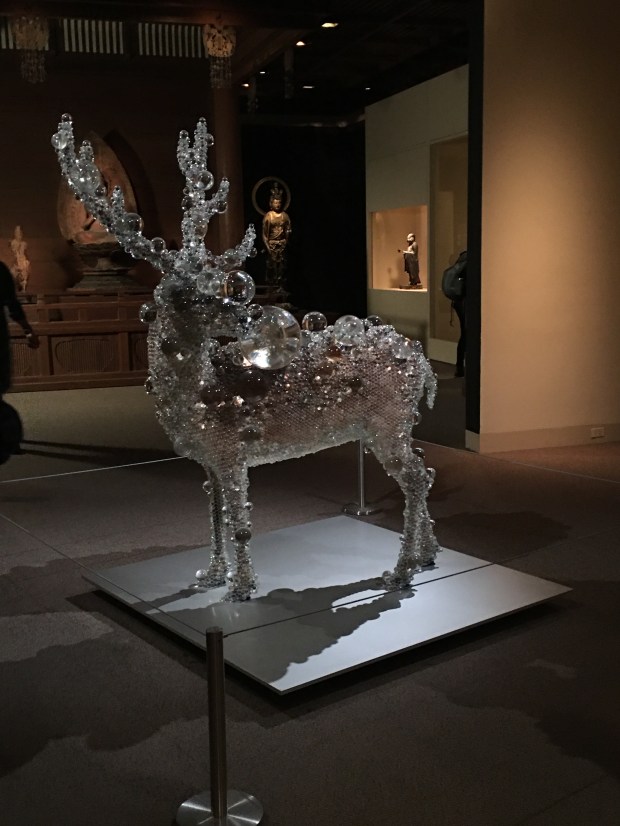
As I exited the Chinese exhibit, I noticed two glass doors and atop them was a title reading: Sackler Wing Gallery! Now where have I heard that name before… None other than the Freer-Sackler Gallery of Asian Art! Thus I knew I’d found the Japanese exhibit and pulled open those doors to reveal a glistening beautiful glass statue of a deer. I gasped in awe and quietly made my way around each art piece, carefully examining each one, as well as the writing on pieces to see what I could decipher.

In many places there were very meticulously put together traditional rooms depicting historical architecture and interior design, or small enclaves displaying cooking pans and pots on tatami mats. My personal favorite however, was a large rock. To be more accurate, a fountain disguised as a large black stone. This is the Water Stone, created by Isamu Noguchi. Upon looking at the stone, I first thought it to only be rather shiny, but then I noticed the faint sound of water and realized that there was in fact, water flowing seamlessly over top the stone! It was very calming, and since the exhibit itself was quite silent, I simply sat there and enjoying sitting by it for a while.
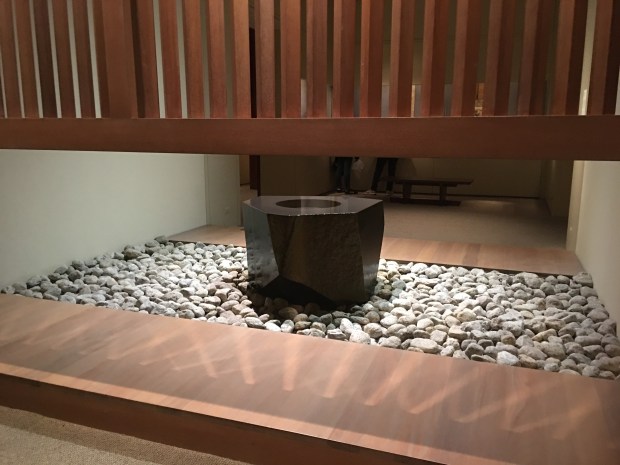
Finally, I left the exhibit after looking around at all the pieces, and wandered around the museum until it was time for us to depart. Please do take time to visit the MET though, if you’re interested in Asian art, as their selection is gorgeous!


Applying Japanese to my life

By Asa Marshall

On Wednesday, November 15th, 2019, my AP Language teacher, Ms. Berke, gave us a prompt from the Pulitzer Center’s contest for an under-reported news story. We were free to choose any topic, write a letter to a Congressperson that discusses our opinions on an issue, and propose ways to fix it as well as why it is important to us and our community. I was really excited to do this assignment and even though I wasn’t eligible to enter the contest, because my news source of choice was not permitted, I immediately thought of ways I could use what we discussed in Japanese class, where we always read very interesting articles and discuss topics that could be connected to the rest of the world. I recognized one of the sites our teacher allowed us to use for the assignment, which was The Atlantic, and I found a publication titled, Scenes From the Aftermath of Typhoon Hagibis in Japan, by Alan Taylor, which was a collection of images from the disaster that happened around October 8th-15th, 2019. It caught my attention, because we recently discussed the article, Climate Change Could Turn the Tokyo Olympics Into a Disaster, by Eric Margolis from Slate, that discussed the growing concerns surrounding climate change, the effects it had in Japan, and new worries of how it would affect the 2020 Summer Olympics in Tokyo. I decided to use the photos to write my letter to Congresswoman Eleanor Holmes Norton.

A part of my letter stated that, “While this publication had no opinions presented, it can offer some insight to both culture and the environment which could greatly influence us in America by bringing up these topics of the worsening climate, while also reflecting on the differences in cultures and ideals that would be beneficial to adopt into our own society.” My main idea was to make comparisons to the damages of the earthquake and typhoon in Tohoku on March 11th, 2011, Typhoon Ida of 1958, and World War II, but also the unity of the rebuilding process. It is important to improve the environment and rethink pulling from the Paris Agreement, but it is just as significant to analyze the morals of Japanese society, which would greatly better America if we were to adopt a similar mindset of working for the community to reach common goals.

I was very passionate about my letter and I hoped to get a good grade because so far, my teacher was very impressed by how much I knew about the topic. She explained to me that being in Japanese Plus is an excellent way to become a better global citizen. From what she saw, many students had trouble fully grasping their topics, because they didn’t have a lot of prior knowledge. This made me feel very proud of my work, but also made me wonder if I wanted to explore more into political sciences and consider becoming a diplomat or ambassador after college.

I’ve always found it exciting to learn about other countries and the issues, commonalities, and differences we all share. For example, an organization I have been a participant in was LINKS Inc., which is a group of African-American women who meet with students in order to discuss international trends and is devoted to education and advocacy and volunteering in African-American communities. I’ve been a part of this program since 6th grade and on this past Tuesday, I met the Haitian Ambassador, His Excellency, Hervé Denis. This was one of the many experiences that made me really wonder if this was something I wanted to work on later in life. Being in both Japanese Plus as well as LINKS and taking part in the mini U.N for a couple years, while also writing the letter for the Pulitzer Center assignment, really inspired me to use my interests in history and culture to help me get a better idea at what I want to be when I grow up. I found these connections very intriguing and it is likely going to be an enlightening experience I will always remember.

Cleanliness

By Katie Nguyen

In Steve John Powell and Angeles Marin Cabello’s article on cleanliness, called “What Japan can teach us about Cleanliness,” the authors talk about how Japan keeps their streets and buildings clean and it surprises me how this is their everyday norm. In Japanese schools, kids are required to clean their classrooms and empty out the trash to keep it pristine as they have no janitors to do the job. They even leave their shoes in lockers and change into trainers to avoid picking up dirt as they come into the school. Also, on Japanese streets, there are no trash bins, yet people don’t litter.

The awesome seven-minute Shinkansen train-cleaning ritual video, provided in the article, shows how workers are able to clean and check at least 400,000 passenger seats in 7 minutes. You have to watch!

Japanese football players’ supporters in the World Cup football tournament, in Brazil and Russia, even stayed to help pick up trash from the stadium.

In addition, these are some other things Japanese do to maintain a clean place: bringing portable ashtrays, wearing surgical masks to avoid spreading germs, ritual purification in shrines, and many more. Compared to the US, American schools have janitors to clean classrooms and students are able to walk in without having to change shoes. Furthermore, you can see trash on the streets and sidewalks, even though there are trash bins almost everywhere in the US. In my opinion, America should really step up their game and start picking up trash to keep our streets clean so that maybe someday people too can question how we keep our streets clean like in Japan.

Here’s a link to the original article so you can read it yourself: http://www.bbc.com/travel/story/20191006-what-japan-can-teach-us-about-cleanliness

Japanese Plus student heading to Japan for university

Jonah Nguyen-Conyers with Eshita-sensei after sharing the good news!

Jonah Nguyen-Conyers, a senior at DC International, has taken advantage of just about every Japan opportunity that Globalize DC has been able to offer to DC students. He first joined our Japan in DC summer program in 2017. He was a participant in our Blue Star of Life program at the Kennedy Center the following fall, and was included in our February 2018 KAKEHASHI trip to Tokyo and Gifu. He then took the very serious step of applying to our Japanese Plus afterschool program in fall 2018 as a Level 1 Japanese language student. He is currently in our Level 2 class. Jonah is a unique, joyful, and intellectually curious personality, and has been a great member of our Japan-focused community.

So it was with great excitement that we learned the wonderful news that Jonah has been accepted into Temple University, Japan Campus, to start in September 2019. We believe that pursuing his language and culture studies at a Japanese university will open doors to future career and life opportunities that have been percolating in Jonah’s imagination over the last few years with us. We are so excited for Jonah’s accomplishment. This will be the first student from Japanese Plus to make the big choice to pursue his undergraduate education in Japan. A former Japan in DC student, also from DCI, is now in her first year at TUJ.

We asked Jonah to reflect on his Japan journey, and to consider the impact that Globalize DC’s Japan programs have had on his life and future goals. Enjoy!

Ted Adams, Eshita-sensei, Jonah, and Sally at the Blue Star of Life program

Jonah’s Reflection

I think people should invest in Japanese Plus because this is just an awesome opportunity for students like myself to find motivation and a passion for their own success. Japanese Plus was able to guide me in ways that no other programs or organizations have, making sure their students experience enriching and impactful opportunities. All the things we did in the class allowed me to be more focused and passionate about my love and interest for Japan, with echoing effects that transcended the classroom and into my daily life. I really am happy I was given the opportunity to be a part of this program.

I was motivated to sign up for Japan in DC in 2017, because I had some kind of interest in anime, and the summer program was quite close to my house, and I got paid (through the DC Summer Youth Employment Program) to go. After the experience in Japan in DC, I really felt invested in the Japanese culture, and wished to learn more. So the Japanese Plus language class really was the best opportunity for me and my interests. I am beyond happy with my choice to join the afterschool Japanese language program.

The most significant aspects of Japanese Plus for me were the extensive access to very enriching opportunities that revolved around Japanese language and culture, along with great influence on the opportunities available after high school that related to college, giving me a lot of foresight of what opportunities for higher education in Japan could be for me and the other students in the class. This class allowed me to look into my future from a Japanese language student perspective and see a future I never knew I desired.

Japan in DC, Japanese Plus, and the KAKEHASHI trip to Japan were the foundations I needed to understand the way I wished my life would go in. These opportunities that I never thought I would have really just allowed me to see a future that I can work hard and be passionate about. I really just loved the whole journey that I’ve taken to get to where I am now. Without these opportunities I honestly think I would be less passionate and dedicated to my future.

I decided to apply to Temple University, Japan Campus (TUJ), as the process of getting the information from my friend and website and other means were quite efficient and fit my life during the time of applying. I was hoping to apply to other Japanese universities (and still might), but this was one of the schools I was able to apply to through the Common Application, for which I was given a lot of guidance through my school, as it is a nationwide application service. So applying to TUJ at the time was a great choice when considering my own circumstances and the other things in my life.

In the future I wish to go to college, and learn the Japanese language to the extent and fluency of a native speaker, and be able to share and communicate with Japanese people, hoping to understand their lives and culture, something I will be learning forever. I hope to go to college, get a Japanese language degree, be an English teacher or art teacher, and just have the experience of being a part of this vastly different country. After teaching I don’t know what I might do, but I would love to reach back to my Chinese and Vietnamese passions and get more invested in those parts of my identity, maybe through the Peace Corps. As long as I am learning at all points in my life, I will be happy, and that’s what this future can provide for me.

Jarid’s super inspiring visit

By Lucca Bey

This week during Japanese Plus we actually had a very special visitor come all the way from George Washington University to talk about their experience with learning Japanese. What’s more, our visitor, Jarid, more or less started their journey into Japanese language the same way that we did (with Globalize DC and the TOMODACHI program), which I have to admit was super inspiring. As senior year seems to be approaching faster and faster every day, the more stories such as Jarid’s seem to strike a chord with me.

The fact that something as small as a Japanese class can end up guiding my career and shaping my life isn’t something that I took seriously as a possible reality until this year. Talking to Jarid and asking her questions really gave insight into the reality of studying in Japanese class in postsecondary education. While Japanese is something that’s more personal to her that she wants to pursue, she’s also studying Biology and Education, and hopes to go to Japan in order to make language accessible, as well as to understand different education concepts around the world to learn how people learn. She announced to the class that she’s going to be applying to the JET ALT Program to pursue this goal.

Having people like this, coming from the same city, program, same schools even for some of us, who come in and show us that the sort of career that we dream about is indeed achievable, is really awe-inspiring for us, making our goals seems even closer than before!

Embassy visit to our classroom

By Lucca Bey

A couple classes ago, we had some very special visitors from the Embassy of Japan who gave us an interactive lesson about Japanese history, geography and culture. As they were giving the presentation and we were playing a fun game of truth or false, I was really surprised by how much we actually knew about Japan as a class. For example, they quizzed us about products that came from Japan that we see in our everyday DC, such as metro cars, cameras, and of course, video game systems. You see, when you learn something, you absorb the information, of course, but you don’t really grasp the magnitude of how much you’ve learned because of how abstract knowledge is as a concept until it’s laid out in front of you, and honestly, the visit from the Embassy of Japan did just that. Even the representatives from the Embassy of Japan were pleasantly surprised with our knowledge of things about Japan that weren’t inherently Japanese language related, and I’ve got to admit, it was definitely a boost to our confidence.

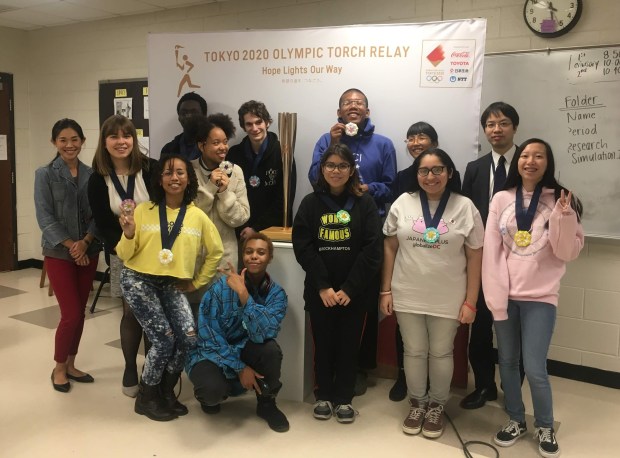
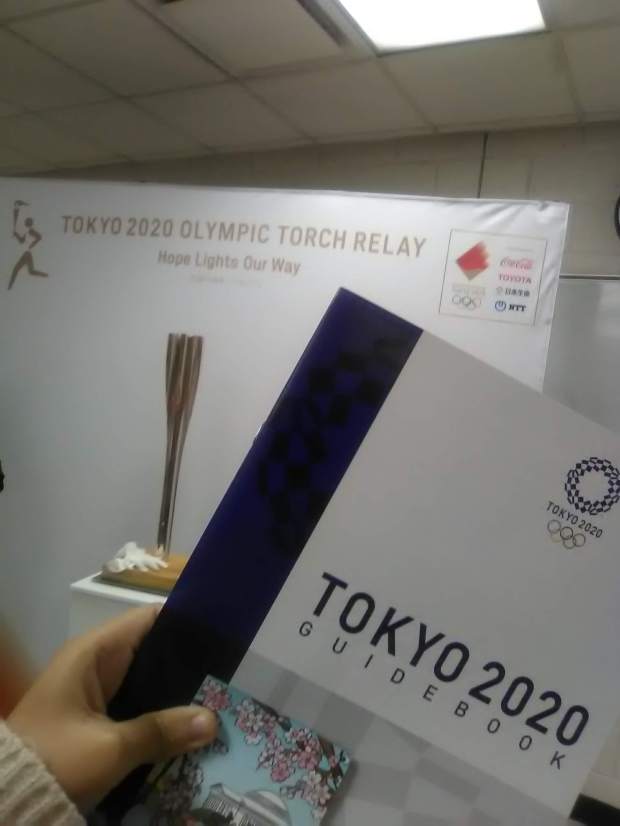
Aside from the more formal part of the Embassy’s visit, we also got to make these adorable (albeit very complicated) origami Olympic medals, to go along with the Olympic motif, since the Olympics are being held in Japan this year! We even got the privilege of seeing one of 100 models of the Japanese Olympic torch. Fun fact: If you look at it from the top side, it’s shaped like a cherry blossom, which besides being Japan’s most celebrated flower, also has ties to our very own Washington, DC! The experience within itself was such an educational, fun, and informative experience. Japanese Plus is so thankful for them taking the time out of their day for us!

Getting ready for the Tokyo Olympics

By Jonah Nguyen

When the Japan Information and Culture Center (JICC)  came to our Japanese class and gave a presentation on the coming 2020 Tokyo Olympics, we were so excited! It was a very interactive experience for the students, as we were tested on our knowledge on history and culture from Japan. During the whole experience we weren’t only tested but were also enlightened with new knowledge, and learned new things that were more specific to the Tokyo Olympics, like the 100% recycled metals that were turned into the award medals in the award ceremonies. Then we did origami, learning how to make paper medals, in theme with the 2020 Tokyo Olympics. This was a super enjoyable experience for me and my classmates, we had so much fun!

I have had past experiences with the JICC, and each time interacting with the organization I had so much fun and learned so much. I am super glad to have been able to meet and have these experiences with the JICC. All were memorable, enlightening, and so fun. I hope to see them again.

Carrying the Sun

By Lucca Bey

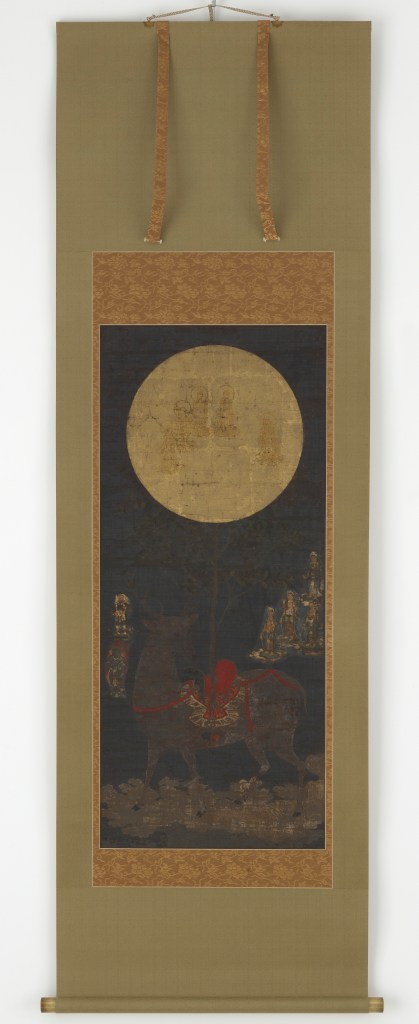
Last week, we ended up visiting the Freer|Sackler museum to expand and apply the Japanese history we’ve been studying in class about the happenings of different historical periods. Seeing how the different events affected the style and content of art during that period is way more interesting than it sounds on paper. For example, most of the artwork in the Japan exhibit was from the Kamakura period, which depicted a lot of religious symbolism as well as primarily paintings, which matches up to the events during that period. I won’t go too much into that though, I plan to talk about an art piece that in particular, caught my eye:

[Pictured: Carrying the Sun by Kasuga Mandala, courtesy National Museum of Asian Art]

For context, deer are considered messengers of the divine in the Shinto religion, and the sun above the deer is meant to symbolize the kami Amaterasu as well as the Buddha Mahavairocana. I found this piece particularly eye catching due to the symbolism of two distinct religions depicted here, and what’s more, the museum’s explanation for this was the fact that during the Nanbokucho period, both the Kasuga Grand Shrine and the Kofukuji, a Buddhist monastery, maintained close ties to each other and were sponsored by the same clan. I’d personally like to imagine the piece as a symbol of solidarity between both groups, and the gold painted onto the sun as well as the border of the scroll makes this art even more beautiful.