The Bingata Festival

By Chidera Onyeka

As students in the Japanese Plus program, we get a lot of opportunities to experience Japanese culture through festivals. One I attended was the Bingata festival. Bingata is the traditional art of dyeing cloth. It’s a time consuming process in which a special paint is brushed onto a special cloth with a specific motion in a certain order. Once the design is finished, it must sit for 3 days to let the color sink in and then ironed, soaked, and then air-dried.

Before we made our own Bingata, we took a tour around two floors where there were myriad kimonos. I saw a group of people wearing beeaauutiful kimonos and I had to ask them where they got them from. They told me that there are communities online that guide you to making the whole outfit (because they also wore a lot of other accessories including a fan). They pointed out that the kimono required a lot of patience and skill. After a talk about how I could make them myself, they told me I could just take the easy way out and buy it online for up to $20. So after taking pictures of different cloth designs, just wandering around with Daniel Ruiz, we made our way down to the Bingata workshop, where we had a sensei who gave us instructions in Japanese.

For my own interpretation, I was able to pick out a word here and there but still had no idea what we had to do. Luckily, we had a translator explain to us what to do in English. During the process, I managed to mess up once and be told that I couldn’t fix my mistake and then mess up the exact same way again. Then once we were finished, the leader of the workshop announced that they would pick out the best paintings from each group and make them sumo wrestle for a prize… and I was skeptical about it because half of the room was full of kids no older that 10 and the other half were adults along with 10th graders and 11th graders. Good thing they didn’t follow through with the idea because I don’t know how I would have reacted to a 17 year old and a 9 year old in a mawashi (what sumo wrestlers wear) fighting to the death. Well maybe not to the death but until time is called or someone wins. It was after everyone was done with their designs that we were told about how to soak it to “erase” the paint outside. Ironically, we were told to paint outside the lines and just glop the paint on there and shove it around.

At the end of the day, I was really excited to soak my cloth and I couldn’t wait 3 days but being a perfectionist and someone who’s a magnet to instructions, I forced myself to. In the end, I learned about a method of traditional Japanese art. It taught me to be patient and worry-free with my art because art isn’t just something I can always conjure up in an hour. It taught me that to achieve true beauty, it takes time, and relaxation. The event was very helpful to me because I tend to do those exact things, rushing and worrying too much about it looking good, when I draw. I would definitely recommend it for anyone interested not only in art, but in Japanese culture.

Tea Ceremony

By Laura Lainez

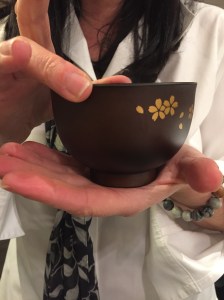
In Japan they serve tea differently than we do in America. The host serving the tea is very diligent with how he/she makes it. They scoop the matcha (green tea) into the tea bowl with the Chashaku (a bamboo scoop) and whisk the tea powder very well with the Chasen (bamboo whisk) making sure to mix well the matcha powder. After serving the tea the recipient picks up the bowl with their right hand and puts it on their left palm, rotating the bowl two times admiring the bowl’s design. You have to bow your head in a show of thanks towards the host who served the tea. Since the matcha is bitter, you eat sweet snacks while drinking it. The university students had different snacks to try before we drank the tea.

It was a new experience because we have green tea in my house and I drink it often, but the tea they gave us was in powder form. We don’t serve it like they do in Japan where someone makes it and the other drinks. They also give thanks to the host, where here we don’t really do that, because we make the tea ourselves. I knew that green tea is bitter so I expected it to be and the sweet snacks balanced out the taste.

The Shikoku Kakehashi visit

By Dakharai Murray

Origami

Origami is the Japanese art of paper folding and requires precision and patience to accurately create each paper craft to produce the desired result. Certain origami, such as the origami crane, have a symbolic relationship within Japanese culture and represent something positive, such as good luck and peace. A yakko-san is a samurai’s manservant who performed different tasks for their samurai master. At the origami station, we were taught how to make origami cranes & yakko-sans. I found that both crafts had many steps and would be hard to memorize and complete without instructions, especially the crane. Overall, origami is a very unique art style that is interesting and entertaining for its participants, and the many different crafts can keep you occupied for a long time.

Karate

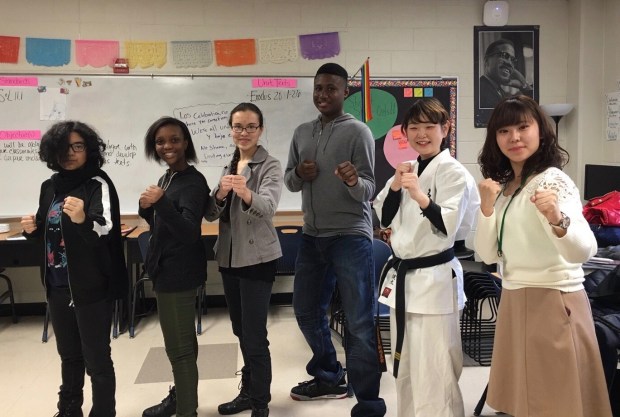
Karate is a system of unarmed combat, using the hands and feet to deliver and block attacks, but it’s widely practiced as a sport, worldwide. Karate students are ranked by belt colors, with white being the beginner level and black being the master level. During the Kakehashi visit one of the students hosted the station and she taught us a basic pattern of moves from one of the beginner belts. She also demonstrated how to properly deliver a front kick. I found the demonstration to be informative and interesting because it requires more speed, agility, flexibility, and quick reflexes to become a successful karate student.

Z-Burger

By Tara Martin

Recently we’ve been visited by students from Shikoku University. Their presentations were great. After class, the students and I went to Z Burger for lunch. They were extremely kind and generous. Since I was there before the rest of the class, I got to know the students more. It was a great opportunity to practice my Japanese, especially because we learned how to introduce ourselves. Before I left, I was able to exchange business cards (very informally, but still). It was great to get this opportunity to be with the Japanese students, since I wasn’t able to go with them to the afternoon festival. Overall, they were very friendly, kind, and interesting. This was definitely a great experience. 🙂

z-burger-tara

tara-shikoku

Kakehashi Calligraphy

By Charity Chukwu and NUU Hightower

Charity: As part of the Kakehashi Exchange program, a group of college students from Japan came to meet the Japanese Plus program as a way for them to advocate for Japan. They made a beautiful powerpoint about the prefecture where they go to school, and then presented with six different stations, each with a different aspect of Japanese culture. One of the stations was about Japanese calligraphy—stylized. First, you would choose to have your name written in either katakana or kanji. One of the students would write it first, then you would write it.

NUU: The paper itself was really thin and the ink could easily seep through it. However, the technique they did was put one blank sheet first, then the paper you write on above it. Once you’re done writing, they’d put another sheet on top of the written paper and apply pressure on the ink to dry it off. I was able to take the written papers home without having it look so messy with ink. It almost looked like it was printed in fact, it was that neat..!

Charity: It was one of my favorite stations. Even WRITING can look like art! I chose katakana, and my name looked amazing! I tried to do it the exact same way as the demonstration, but I put too many strokes with my brush, so it made a small tear in the paper… Whoops! I still love it though, and definitely plan on eventually framing it.

NUU: My thoughts on the presentation were similar; really fun..! I remember learning calligraphy in Chinese classes, so I thought to maybe try it out again here since I liked it so much. I wrote my name three times, although the third time was unintentional. It was because one of the Japanese students was telling me something but I couldn’t hear it that well so I asked “Moo, ichido?” to repeat herself. She kind of mistook it as wanting to write again and handed me another sheet, but I didn’t try to protest since I wouldn’t want to make a big deal out of it. Other than that small awkward moment on my end, it was nice meeting the students and learning of their station!

Charity: Afterward, I had a thought-provoking conversation with the student who did the calligraphy with me. She was telling me about how schools in Japan still teach calligraphy as a class. It reminded me of when my elementary school teachers would teach cursive writing. I told her that, nowadays, it’s rarely expected for a child to know how to do it, but I wonder if it would hold any benefits if it were still a general class in present-day schools.

Imagine learning how to write like in cool calligraphy art!

Suggested link: http://pin.it/wdQ986j

How to make your own Matcha tea

By Talia Zitner

After watching the Japanese exchange students show us the traditional Japanese tea ceremony, I decided to recreate it in my own kitchen. Using the tea cup the students gave to us as a gift and Matcha powder from Japan, I set to work trying to replicate the unique flavor of the tea.

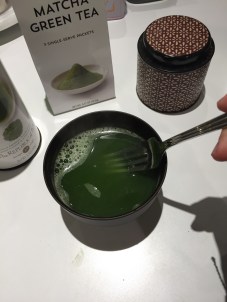
Step 1: Set up your tea and powder. Matcha is is finely ground powder of specially grown and processed green tea.

matcha1

Step 2: Boil your water and pour the powder into the teacup.

matcha-2

Step 3: Pour in water and whisk with fork or other utensil (unlike other tea, instead of steeping the powder. is dissolved by mixing!)

matcha3                matcha4

Step 4: Once tea is dissolved, hold in left palm and rotate clockwise twice in order to admire the design on the cup!

matcha5                 matcha6

Step 5: Enjoy!

matcha7

Awa Dance

By Anastasia Wass

On Saturday January 28, a group of Japanese students from Shikoku University visited our class to teach us about Japanese culture. They came to the United States as part of the Kakehashi program, a fully-funded youth cultural exchange program, for students from Japan and the United States to experience and learn about each other’s cultures.

The students from Shikoku University presented many new and interesting aspects of Japanese culture, through presentations and interactive stations. One activity that struck me was the Awa dance, a traditional dance from the Tokushima prefecture in Shikoku, Japan.

Shikoku, home to Shikoku University, is known for their Awa Dance Festival, which is held for a few days of August of every summer as part of the larger Obon Festival. It is the largest dance festival in Japan, attracting many tourists every year. But the tradition of the Awa dance goes back much further. There is record of similar dances in the area as early as the 1300s.

Female and male dancers have distinct dances, in part due to the different costumes of the dancers. Male dancers dressed in the looser yukata dance a crouched dance that allows for much more freedom of movement, whereas female dancers wearing the more restrictive Kimonos, dance with a more lifted upright posture. Today, however, dancers can participate in either dance regardless of gender.

We were taught a simplified version of the Awa dance as a healthy exercise. The dance steps were all simple, but the pace of the movements was meant to make the activity a more strenuous exercise. I found that the dance was relaxing, and after doing the movements, I felt less stressed. The movements were complex enough that my mind was occupied, but not so much that I was scrambling to keep up. And I liked the idea of connecting with such an old and culturally meaningful dance through a more modern lens.

My experience with the students from Shikoku University

By Chi Onyeka

On Saturday January 28th, 23 students and two leaders from Shikoku University paid the Japanese Plus group a visit on behalf of the Kakehashi Exchange program, organized by the youth exchange organization, Youth For Understanding. Shikoku University is a private university located in the Tokushima prefecture in Japan. The students spent a little bit less than a week in DC while visiting various places, such as historical sites, museums, and schools.

In Class Experience

When the Shikoku students arrived, we had to introduce ourselves and after introductions, they presented powerpoints about the Tokushima Prefecture in which Shikoku University is located. Then they set up various stations including Yukata (a style of traditional dressing), Japanese tea or Ocha, calligraphy where our names were written in Kanji, Karate, the traditional Awa dance and my personal favorite, the Origami station. After we completed the stations, they gave us many gifts and with hopes to be able to contact the, I and some other students gave them our business cards.

shikoku-karate

Outside Experience

After class, we went to Z-burger and questions were exchanged such as why we decided to start learning Japanese. When we departed, the other Japanese Plus students and I went to a Bingata Festival. As a side note, we all left with at least two bags of fries because after they finished their burgers, they were full so they gave us their fries because they wouldn’t be able to take them along and we were just overwhelmed with the amount of fries we had to eat!

The next day, Sunday, I and four other students met up with the students at Arlington National Cemetery. Funny story, Bryson Torgovitsky and I got lost trying to find them and we went all the way up the hill not knowing that we passed them and we met them around the middle of the hill. Once we found them we looked at a bunch of war artifacts and visited various important tombs, like the burial site of President Kennedy.

shikoku-at-arlington

Afterwards, we went to Pentagon Mall for lunch and it was there that I heard the best question of the weekend that completely baffled me, was: How do I feel with Trump as our President? I didn’t know how to answer the question because I didn’t want to glorify America, nor did I want to demoralize it because I didn’t want to sound conceited, but it was their first time visiting and I didn’t want to just rant about it so I just said “It is what it is, and four years to come, there’ll be another election”.

It was at our next stop that the kindest thing was done. First things first, we went to a Japanese New Year’s festival and they had a lot of performances, food (it’s also where I had my first ramune, yummy!) and games. So I wanted to play a game that required a ticket so I whipped out $5 to pay for three tickets to find that one of the students paid for Bryson and I to play the game! I was so grateful and afterwards I just felt in so much debt from all the gifts, food, and experiences I had gotten from them in the past weekend. At the time I really didn’t know how to thank them.

Gift Exchange

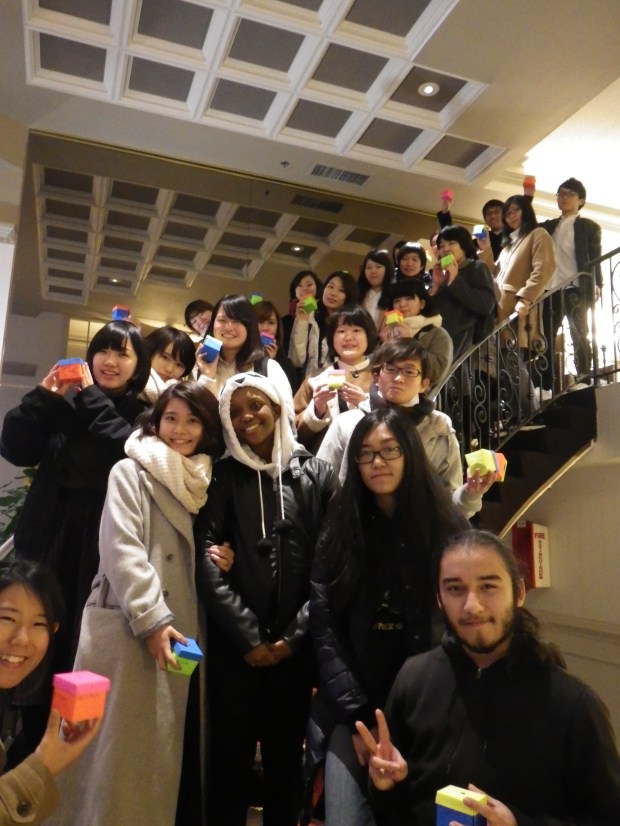
As said before, I really didn’t know how to thank the students for their kindness. I wasn’t the only one. After the New Year’s festival, I went to Ana Nguyen’s house to make gifts for them including candies and little notes expressing our gratefulness. They had previously complained about how long it took them to make the boxes and I was reluctant to believe them because I thought “How hard could it be to make and fill up 27 boxes?”

Once I got permission from my mom, I bought my sweet contribution and headed on over to her house. Daniel Ruiz and another friend of theirs had been working since morning and just finished making the boxes and lids when I arrived. I got there around 5 in the afternoon and didn’t leave until 10 at night. Apparently it was that hard to make and fill 27 boxes. In total, 14 hours were spent making the presents for the students. We didn’t want to just buy them something to take home because they would already have that initiative since this was their first time visiting the US. We also decided to make them at home because we learned in class one day about how much the Japanese valued homemade gifts.

To be honest, the next day, the 14 hours we slaved making the boxes was totally worth every second. The looks on their faces couldn’t have been made just buying them something and putting it in a gift bag. We took a lot of selfies together and one final picture before our last departure. The only thing that made me feel bad was that they gave me even more things before we left! I still feel in debt to them but I can do nothing but hope they had an amazing time in the United States.

Shikoku with gifts.JPG

Charming in Yukatas

By Layana Turner

At the end of January students from Shikoku University came to visit and gave us presentations/performance of different famous Japanese activities. It was like a cultural immersion day!

While the students were setting up their tables I spotted a long Maroon Robe with pink and purple flowers littered on it. My attention was snatched from whatever I was doing before (I still can’t remember) and my sole goal was making sure that my friends and I got to that table as soon as possible.

When I arrived a very nice student named Yayoi Osugi told me that I would look best if I tried on the Maroon “Yukata.” Little did she know I’d been eyeing it ever since it was sat on that table. She asked me if that was okay and I said yes, maybe a little bit too quickly but she seemed happy about my excitement so I wasn’t too embarrassed. Yayoi helped me into the yukata along with some really pretty accessories. I really love kimonos and yukatas so I felt as if I had checked something off of my list of things to try. Yayoi then asked if we could take some pictures together, so I proceeded to take many pictures with her and all of the other students. After, she asked if there was a way for me to contact her, so we exchanged information and I said goodbye as I moved to the next station.

I feel very grateful that I am able to participate in things like this and I will make sure that this experience isn’t wasted by keeping in contact with Yayoi.

yayoi-yukata

Okayama University

By Rakiya Washington

On January 28 my Japanese program was able to receive a presentation about Okayama University and its Discovery Program. I learned about the extremely lenient tuition and room and board fees and how international students are already eligible for the scholarship provided by the Discovery program. I really enjoyed the university’s atmosphere and environment. I also appreciated how considerate they were with accepting students. The acceptance to the college is not strict at all and they keep your GPA out of their choosing process because they want to give everyone a fair chance. I just thought that was so caring and sympathetic, which is why I have decided that I would start to look at this college and other colleges in Japan. The presentation really pushed me to research about more of what’s available in my country, but also internationally.