Wabi-Sabi

Ana Nguyen

Wabi-sabi represents imperfection and incompletion.” It’s the idea or point of view, where things that are imperfect have an aesthetic value of melancholy and harmony but also wisdom. The American phrase for this is most likely, “nothing is perfect, nobody is perfect” which gives off a different message compared to wabi-sabi. It’s interesting how this philosophy or term is woven deeply into the culture. Wabi-sabi can be seen in a sand garden, art, stories or even in a person. Despite all of the phrases telling people here that everything isn’t perfect, our culture has many perfectionists and the imperfect things aren’t viewed positively all the time. A broken jar in Japan may be looked upon as wabi-sabi but in the U.S it’s seen as a useless.

Giri and presents

By Raven Bluford

The section in Geek in Japan about giri and presents is quite interesting to me because in some ways it is similar to what we do in the United States, but in some ways it is completely different. I found it quite intriguing that the gifts Japanese people give to people depends on the relationship of those two people, and that if you give a person a really good gift, but you just met them, they would be offended because they are obligated to get you a gift that is just as good. This is a little similar to the United States because almost everyone puts more effort and spends more on a gift for someone they are close to, as opposed to someone they just met.

Another thing that I found fascinating is that Japanese people give gifts to people for funerals, whereas in the United States it is seen as impolite to give gifts to someone who recently lost a loved one. Japanese people also give gifts on the first day of work to your boss or co-workers, while in the United States doing something like that is quite uncommon.

Soto-Uchi

By Chidera Obiwuma

All over the world we treat those we are closest to and not close to differently, but it was surprising to learn about the high value Japan places on this distinction in treatment. In Japan there is a difference in how the Japanese treat those close to them and those who are not close to them. The way the Japanese treat their family and circle of friends is known as uchi and the way they treat other people is known as soto. Due to this system it is very difficult, almost impossible, to become part of a group if you come last or don’t belong to that group. In uchi, it is necessary that all members agree on an issue, no matter how insignificant, and how to proceed. This is done to keep the harmony among the uchi. There are also different levels to uchi. The first level is family, followed by friends, then your company and lastly, your country.

Foreigners are the most soto that you can get. No matter how long you live in Japan, the Japanese will treat you as soto because they see you as a threat to their harmonious uchi. This is one of the reasons that Japan is a closed country, one of the most advanced countries with low immigration. However, it is highly important to know that being treated as soto doesn’t mean that they will disrespect. The Japanese will treat you kindly but there will still be a barrier between you and them.

Sakuramen review

By Talia Zitner

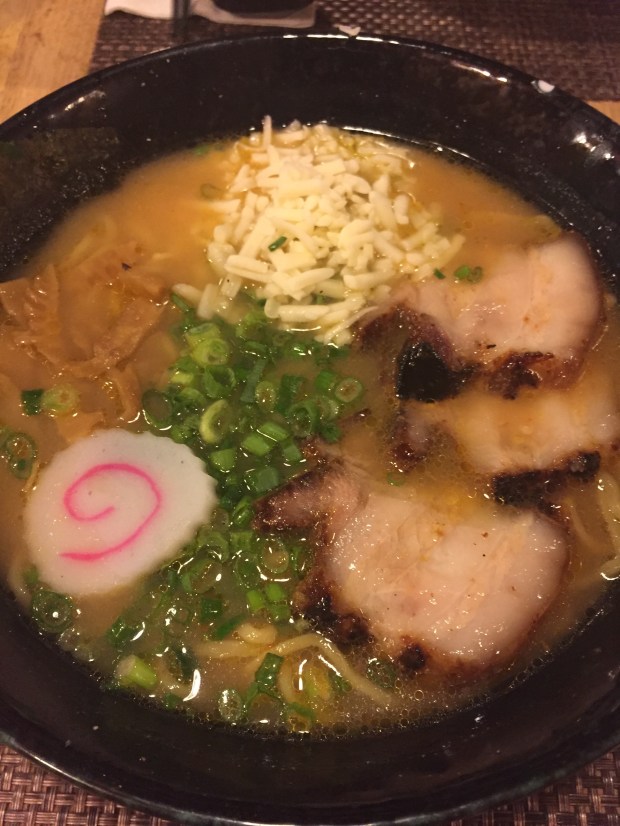
Sakuramen is perfect for anyone looking for authentic Japanese flavor with a local twist. Four o’clock on a Friday afternoon is a great time to stop by the small restaurant in Adams Morgan. It was practically empty when we arrived, and the service was friendly and efficient. There was a really fun playlist going in the background (that even the staff was jamming out to). I ordered the DC miso, which was with chashu, menma, green onion, cheese, naruto, and nori. The ramen noodles themselves were thick and curly (make sure you have lots of practice with chopsticks!) and the broth had a chicken stock and miso base. Overall the ramen was delicious, or “Oishī” in Japanese! Each bowl goes for around $12-13, which is the typical going rate for the DMV, and it’s definitely worth it.

Sakuramen is accessible by the Adams Morgan/National Zoo metro stop, and is just a short walk over the bridge. Grab some friends and some ramen and enjoy!

sakuraramen

Wabi-sabi

By Anastasia Wass

When I was a child, my mother had a Japanese clay cup. She and my father were the only ones who drank from it, as my siblings and I thought the cup was ugly. It wasn’t ugly, she explained many times. It was Wabi-sabi. It was beautiful because it was imperfect, the clay slightly dented and the glaze visibly dripping. These imperfections were where the true beauty of the piece lay. I had quite forgotten about this cup until I read about the concept of Wabi-sabi again, just a few weeks ago. The author described Wabi-sabi as a unique Japanese idea, a word that described the beauty in the everyday and the mundane, the imperfect. Only then did I recall the mug that still sat in my kitchen cabinet. And only the other day did I take out the mug to look at it again.

Now that I’m older, I feel as though I can better appreciate the Wabi-sabi of the mug. While the traditional American idea of beauty, flawless perfection and symmetry, differs greatly from what I see in the mug, I see a different kind of beauty. It’s the same beauty that is found in nature, in a flower or a sunset. Nature is imperfect, but beautiful nonetheless. If I extend the idea of nature as beautiful to the mug in my kitchen, I think I come to a better understanding of how Wabi-sabi is beautiful.

A Visit from Meiji University

By Jenny Jimenez

On the 25th of February, our Japanese class had a special visit from university students from Meiji University. We spent the day learning about Japanese calligraphy, which is known as shodo, and some students spent time making origami! Personally, I was in a group with students that taught me calligraphy. One of the students wrote tomodachi, or friend, perfectly on the calligraphy paper and proceeded to give me a sheet so I could write it as well. Although it seems simple at first, it does take practice! The brush glides on the paper easily and one false movement can make an impact on your handwriting. Although my calligraphy wasn’t perfect, it was fun to learn about Japanese calligraphy and its impact on their culture.

Later in the day, Eshita Sensei told us that we would be having conversations with the students about anything! I met Yuta, a freshman at Meiji University and we talked about American culture as well as Japanese culture and university life in Japan. To my surprise he explained that he has been learning English since middle school and that he actually has visited California last year! Since my Japanese language skills are limited to talking about family and food, we talked a lot in English. He explained that a troubling aspect of learning English is the pronunciation of “L” and “R,” because in Japanese the syllables ra, re, ri, ro, ru are said with the mixture of the sounds from “R,” “L,” and also the “D” sound. He explained that it’s a little bit difficult to notice the difference between “L” and “R” when it comes to listening but he could tell the difference when it came to reading. I found this interesting because I noticed that when Eshita Sensei said ramen in Japanese, it wasn’t pronounced in the way that American people say it. Learning from Yuta that English learners have difficulty with pronunciation was surprising because I wasn’t aware about this challenge since it comes naturally for English speakers.

I enjoyed the visit from Meiji University because I was able to connect with students like Yuta, with whom I have exchanged communication, because I want to learn about Japanese culture from a Japanese person rather than reading from a book or from watching a video of an American explaining it. I hope we have more visits from Japanese students in the future because it was an amazing experience due to the fact that both the DC students and the Japanese students were able to exchange a tiny piece of each other’s cultures!

Meiji University Jenny blog

Karuta is Intense

By Daniel Ruiz

A small group of my classmates and I traveled to Bethesda, Maryland to attend and observe a karuta competition. I was with Bryson and Priest. Priest’s actual name is Dakharai. If you are curious about why he is called that, take a look at Bryson’s blog post on the karuta event.

The actual game had a very interesting function. The basic explanation is that there is someone who reads a poem and the players must find which card has the poem. Each player has a certain amount of cards in front to them and you can remove the card from either your side, or the opponent’s. However, there is a twist! The poem is not simply read as it’s supposed to. The poem is split in two parts. The second half is read twice, then the first part will follow. The point is to remove all cards from your side, so finding the poem at your area is a good thing. In the case that you remove one from your opponent’s side, you can place a poem from your side to the other.

It looked relaxed at first, but then the pros came by and had quite the duel! You could feel the intensity of their focus, and when a card was chosen, it was not picked up gently. No one simply removes the card – you have to toss them to the side! The cards slid across the floor with such velocity and force! I was told by one of the people hosting that they do this to be as quick as possible. I am also unsure if what I’m about to say is worth any significance, but most of the hosts were female. I remember seeing one guy. Maybe it is more popular with women? I won’t complain, the competition was still interesting and fierce! Maybe one day I’ll get to participate, when I master hiragana that is. One day . . .

karuta-faceoff

Shikoku PowerPoint

By Kharan Pierce

The students from Shikoku University who, through the Kakehashi program, delighted us with a visit to our program last Saturday. Upon their arrival, some of the Japanese Plus students greeted and welcomed them with an excited “Hajimemashite” and self introduction to their group. The Kakehashi students then went into a PowerPoint presentation about their home island, Shikoku, Japan. Their presentation began with some description of Shikoku including beautiful pictures of nature, an enchanting vine bridge in Iya Valley and the view of Shikoku from high up. I love seeing the images of their home because everything is so green and luscious. Their presentation continued with some descriptions of traditions in Shikoku – one of them being a province-wide celebration of the popular Anime show.

Another tradition we learned about was the Awa Odori dance that is well known in the region. The students told us that different places have their own variations. We even got the opportunity to learn a part of the Awa Odori dance through a fitness video later in the program.

Throughout their whole presentation, it was clear that the students had rehearsed their entire presentation in detail and were very prepared. Compared to American students who will often do a class presentation without having rehearsed, the Japanese set a new standard for me personally. The flow of the presentation was much nicer than some I would see on a regular day. Maybe the next time I have a big project, I’ll use some of what I saw with the Japanese students to try and elevate the quality of my presentation.

Japanese vs. German

By Anastasia Wass

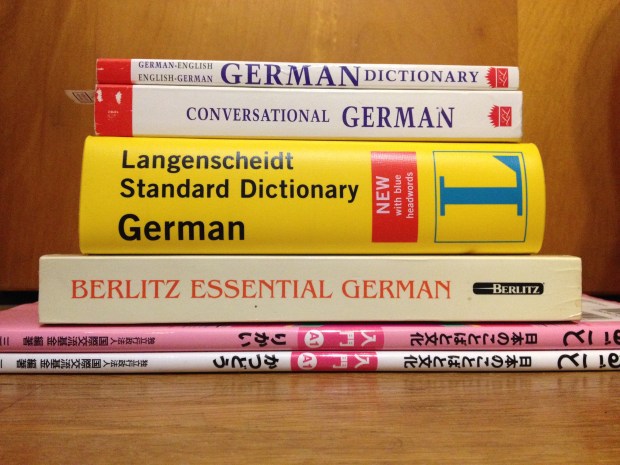
language-texts

When I learned the word for Germany in my Japanese class, it immediately caught my attention. The Japanese word for Germany, Doitsu, closely resembles Germany’s name for themselves, Deutschland. In fact, more so than any other name for Germany that I had ever heard in another language. What more, I wondered, could the two languages have in common?

Both German and Japanese are widely spoken, useful languages to learn. According to Rocket languages, in 2010, German claimed 89 million native speakers and 52 million non-native speakers. Dialects of Germany are spoken widely throughout Europe, most notably in Germany, Switzerland, Austria, Belgium, and Luxembourg. Japanese, by contrast claimed 127 million native speakers, and only 12,000 non-native speakers. Why is this?

According to the Foreign Service Institute (http://www.atlasandboots.com/foreign-service-institute-language-difficulty/), German is a Category II language, meaning it takes native English speakers about 750 hours to achieve general proficiency in speaking and reading. However, Japanese is a Category V language, which means that it takes native English speakers about 2200 hours to achieve this same proficiency. This is because of the great differences in grammatical structure between English and each language. While German is a germanic language, hailing from the same linguistic “family” as English, Japanese comes from a totally different linguistic “family.”

Both languages, though, can be intimidating for language learners. One of the reasons that both languages can be considered difficult is the writing systems. German shares the same Latin alphabet as English. It has only four extra letters (Ä, Ö, Ü, ß) and five letters with different sounds from their English counterparts (C, J, S, V, W). Japanese, by contrast, has two different syllabic writing systems (Katakana and Hiragana), and one logographic writing system (Kanji). Written Japanese alternates between these three alphabets, depending on the word’s part of speech and origin.

Though the writing system may sound complex, Japanese is in some ways a very simple language. Unlike German, it has no grammatical gender, plural forms, or articles. Verbs are not conjugated, and nouns are not inflected to show case. However, it does contain grammatical features that are not part of English or German. Japanese particles can be difficult for English speakers to become accustomed to. Particles indicate the relationship of two different words in a sentence. Different particles can indicate anything from location to possession. Particles exist in both German and English, but in neither are they such a significant aspect of the language as in Japanese.

Another reason German can be considered difficult is die Wordstellung (Word order). German follows a word order similar to English, unless conjunctions or other components indicate that there must be a change in the order of the words in the sentence. Japanese also has a set word order, but the word order is different from both German and English, which can be difficult for speakers of Germanic languages to pick up.

But Japanese and German do share some characteristics. Unlike English speakers, German and Japanese speakers indicate levels of formality with their grammar. In German, the formal pronoun ‘Sie’ is used to address others formally. In Japanese, formality is indicated not only by prefixes and suffixes (honorifics) attached to the name, but also by choice of pronoun and the components of the sentence included in a phrase.

So what do I think of each language? Well, I have been learning German for nearly two years, and Japanese for only half a year. Between the two languages, German has been much easier to both learn and practice, due to the similarity to English (my native language) and Spanish (my second language), the abundance of resources online, and the commonality of German-speakers in the western world. I have also had more occasions to use German, but only because my fluency in German is greater than my fluency in Japanese. However, Japanese is a more rewarding language to learn. It takes more work to learn grammatical principles of Japanese, but that only makes communication a greater victory.
Chinese vs. Japanese

By A’mee Barnes

The Chinese language is the number one most spoken language due to the high population in China. There are over 1.2 billion native speakers. This language dates back to 1250 BCE (over 3,000 years ago) when it was found scripted on oracle bones in the late Shang Dynasty. Oracle bones are pieces of the ox scalp and turtle plastron (outer body belly).

When the two countries met in the past there wasn’t a language set in Japan; so Japan adopted this language, and as time went on some characters started to change. Today roughly 70-80% of Japanese Kanji are traditional Chinese characters. Though they might sound different, they still express the same meaning.

Not only has China influenced Japan in languages but also religiously. The two countries showed interest in Buddhism and Confucianism. Although Japan believes is Shinto, there’s still a large number of people practicing Buddhism.

The comparison of the word:

Chinese Word: 学生 (xue sheng)

Sentence 1: 在Wilson高中我是学生。

Japanese Word: 学生 (gakusei)

Sentence 2: Wilsonここの学生です。

By looking at the two sentences you can see similar characters such as “学生;” in both languages it means student. Both sentences mean “I am a student at Wilson High School.”

I’m currently in Chinese 4, which means I have more knowledge of over 2,000 chinese characters than Japanese characters. If I see a certain Kanji written but I don’t know the Romanji (English letters) of it, I would cheat and use the Chinese keyboard to type the kanji since I’m certain they’re the same character. I sometime mix up the pronunciation of both languages. Both languages are hard to comprehend, but through practice you’ll soon understand both languages. Once you start learning a country’s language and cultural style, you start to feel more connected and you might eventually start acting upon it.