The Sackler Museum

By Chidera Obiwuma

It was an interesting and fun first experience of the Sackler Museum at the Smithsonian.

One of the most prominent artists was Japanese artist, Kitagawa Utamaro. It was interesting to me that a man could depict through his paintings what it was like to be a woman in the Edo period because, according to him, he knows women well. And indeed, he did; his painting depicted mostly the lives of Geishas and concubines within their residence. The paintings were truly beautiful and each has a unique story behind them. However, some of it did make me uncomfortable. For example, in the Geishas’ residence, seeing children running around. Also, of course life during the Edo period wasn’t all glamorous for all women. It was disheartening but also inspirational to see that Utamaro was bold enough to portray not only the good side of this time in history but also the bad side of it with the prostitution of girls and women. Many of them forced into the practice, catching diseases that led to their death, and even when they were freed, they didn’t know how to do anything else so they ended up right back in prostitution.
Geek In Japan – Chapter 5

By Skyy Genies

Something about the fifth chapter of Geek In Japan that interested me was the drastic contrast between the motivations and intentions of someone working in the United States when compared to that of someone working in Japan. According to Geek In Japan, in the United States “most people do things for their own benefit, eventually bringing prosperity to consumers and society. In Japan, on the other hand…the Japanese give their utmost in their work in order to serve consumers and society, in this way they automatically obtain benefits for the society and achieve their individual aims.” Additionally, the Japanese maintain respect for people above you at work regardless of how long you have known them or worked at that company.

These work practices in themselves perfectly exhibit the way society works in both of these countries. In the US, most people worry about making themselves successful and living good, whereas in Japan, most people worry about how they can improve their community and society. The work ethic is also very different. Here in the US work is usually only done for money, if someone is working overtime they are sure to receive overtime payment. Their motivation for doing that work is bettering their financial status. However in Japan, the motivation of their hard work is simply bettering those around them; they don’t expect to be paid if they work overtime.

In terms of the interactions between the different levels of the company, I think there is also a big difference between Japan and the United States. Here in the US, it may be seen as normal for a long-time employee to casually speak to the head of their department or even the president. That is different from Japan where regardless of how long you’ve been there, you are expected to uphold a high level of respect. I think these differences are really cool, I really want to experience what society is like when everyone is working to better each other rather than only worrying about themselves.

Creating a Keiretsu

By Rakiya Washington

When reading chapter 5 in the wonderful Geek in Japan, provided by the Japanese Plus Program, the most interesting topic that I learned about was pertaining to how the Japanese create a keiretsu in business. I thought this was interesting because it reminded me of other partnerships that had similar obligations, such as the League of Nations and the United Nations. They seemed related to me because in the passage, the keiretsu was an alliance that was responsible for the economic success of other businesses and similarly, the League of Nations and United Nations were created in order to create equal opportunity for success for each country involved. Another similarity that I noticed was how the United States was involved in both. In Japan, the United States’s role was to aid the MITI (Ministry of International Trade and Industry) control the entire Japanese industry and similarly, the United States played a leading role in the United Nations.

I am glad I was able to learn about something like this and without this program, I would not have been as knowledgeable on topics like this. I enjoy learning new things about Japanese culture and their daily lives.

My Tidal Basin Experience

Rakiya Washington

Outside of being in the classroom for the two scheduled days of the week, we have organized and participated in various outings around the city. One of the most memorable experiences for me was when we visited the Tidal Basin to see the cherry blossoms. Although we did not see as many cherry blossoms as we expected due to the weather changes, we did not cease to explore farther in the area. We walked to various other nearby memorials and monuments, such as the Korean War Memorial, the Vietnam Veterans Memorial and the Lincoln Memorial. I was extremely excited although to see the memorials, since I had never seen them before; but also because it was disappointing to see how many lives were lost during such violent events. Visiting these memorials, not only expanded my knowledge of wars in general, but it allowed me to understand how important the lives of others are and to be grateful for everything and everyone you have because they could be taken from you at anytime. I am glad I am in a program that allows me to explore and learn about such things. I could not have been happier with the experience.

Japan Bowl 2017

By Jeffrey Jenkins

Hello everyone, it’s Jeff here and today’s blog will be a little short but it was sure worth the wait. So, now to the actual story.

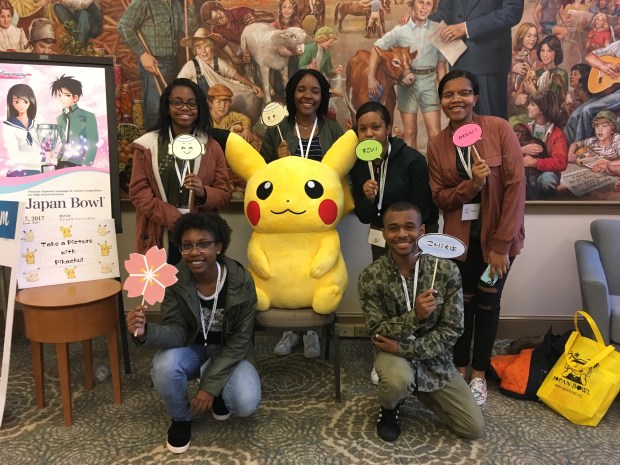
On April 6, 2017, my Japanese class was invited by the Japan America Society of Washington D.C. to attend the Japan Bowl 2017, which is a competition between schools across the country who come to compete in tournaments testing Japanese language, culture, and history knowledge.

During the first two hours of the event six or seven universities gave us presentations about what they can offer for foreigners interested in attending university in Japan for their four years of colleges or just a semester. The majority of the universities were starting programs specifically aimed at foreigners, which for me or anyone who’s about to graduate is very good, especially since these universities offer scholarships that pay for your full four years of college, so that’s potentially free colleges! – and who’s going to say no to that?

Unfortunately, I couldn’t attend the actual tournament because of school, but I was able to attend the pre-competition program that took place that same day.  The pre-competition of the Japan Bowl that I was able to stay for was the opening ceremony, which had two performances – one from a shamisen* player and another from a Japanese boy band from New York, but the shamisen (しゃみせん) was the best part about the entire opening ceremony. The boy band was meh; nothing can top the shamisen, in my opinion.

Well that just about sums up this blog, I hope everyone enjoyed the short read and if you’re learning Japanese and interested in attending the Japan Bowl, you should try and participate next year! For more information regarding the Japan Bowl, please feel free to click this link!: http://www.japanbowl.org/

またね!

* A shamisen is a traditional Japanese guitar, for those wondering.

Heisei Boom

By Bryson Torgovitsky

In the late 1980s, the Japanese economy experienced a period of rapid growth known as the Heisei Boom. Japan’s economy soared to incredible heights, and their income per capita became the highest in the world in 1990. Exports were one of the major factors in this growth, especially of cars and electronics. Those who were adults living in Tokyo during the Heisei Boom attest that they did not see any panhandlers in the city, though this could be attributed to the rising prices of real estate in the city. According to Héctor García’s guide to Japan, Geek in Japan, “the price of 900-square-foot apartments in Tokyo rose to several million dollars at today’s value” (61). The increased prices coincided with the construction of new apartment buildings and skyscrapers, and this is likely because those new living spaces were marketed as the latest and greatest place to live.

What had interested me about the Heisei Boom section of Geek in Japan was the title given to Toho Studios’ Godzilla movies that were released at that time: the Heisei series. Godzilla saw his return to the silver screen after a nine year hiatus in what came to be known as Return of Godzilla after being titled simply Gojira, and the cityscapes of the film reflected the Heisei Boom’s impact on building construction because the building sets, which have been consistently accurate models of the cities depicted, dwarf Godzilla in Return while in the most recent of its predecessor films, Terror of Mechagodzilla, Godzilla was either of an equal or greater height than the buildings around him. Below are two photos, one of Godzilla facing a man-made flying machine in Return of Godzilla, and the other of Godzilla facing the monster Titanosaurus in Terror of Mechagodzilla. From these photos, the change in building size from pre-Heisei era to post-Heisei era Japan can be seen.

君の名は (Your Name)

By Bryson Torgovitsky

About one week ago, I went to the E Street Cinema in downtown D.C. and saw the hit animated film 君の名は (Your Name) with two friends. I learned about Your Name through its interesting history with my personal favorite, Gojira. When a live-action drama bearing the title Your Name hit Japanese theaters as a live-action drama, it was the November of 1954, only a short time after Gojira’s premiere which earned over $14 million (in terms of today’s Japanese Yen to USD conversion) at the Japanese box office. It was blown out of the water by the original Your Name, which amassed a staggering $29.6 million (again, with current conversion rates) in Japan’s box office. Although the drama and the animated films have different plots, a strange coincidence occurred between the Your Name of the past and the contemporary Your Name.

The most recent Godzilla film from the studio responsible from the original film’s producers, Toho Studios, Shin Gojira, premiered in Japan last year on October 11th Unlike its own predecessor, Your Name’s animated film premiered just over one month before its kaiju rival. The head-start for income is irrelevant when the total earnings of Your Name are compared to Shin Gojira: $281 million and $76 million in worldwide sales. The new incarnation of Your Name has also become Japan’s new highest grossing animated film of all time by surpassing the famous Miyazaki film Spirited Away’s $275 million international earnings.

Personally, I still prefer Toho Studios’ Godzilla films over any of the films titled Your Name, although I must admit that the newest Your Name has become my favorite stand-alone animated film. I would highly recommend it, and Shin Gojira, to anyone interested in films of any variety, but especially to those interested in Japanese films.

Ramen-Ya

By Skyy Genies

On April 1, 2017, I had the amazing opportunity to go to a Ramen Restaurant in Adams Morgan, Washington,DC. First off, I just want to say it was SO AMAZING!

According to Cookinglight, ramen is “a Japanese noodle soup dish, with Chinese-style wheat or egg noodles served in a very rich broth along with cooked sliced pork, fresh scallions, and a maybe slightly-more-than-soft-boiled egg.” It is a very popular dish in Japan. How did this unbelievable event arise you ask? It was just another day in the Japanese Plus Program. During this meeting, our class was extremely busy preparing for our booth at the Sakura Matsuri (Japanese Cherry Blossom Festival). Out of nowhere, Ms. Schwartz announced that as a reward for our hard work and dedication to our booth, she would treat us to Ramen. I was so excited!!! I had never had traditional ramen that was actually prepared in a restaurant. I could not wait.

At the end of the class, we waited enthusiastically to leave. It was a long walk, but once we arrived and ate, it was definitely worth it! Since I wasn’t able to eat meat during the time of our visit to the restaurant, I chose a vegetarian ramen bowl that contained corn, seaweed, carrots, mushrooms, and a few other vegetables. Some of my classmates chose the Korean inspired ramen dishes with kimchi, eggs, and beef bulgogi. The aromatic scent of juicy steak made me have a negative expectation of what my ramen would taste like. But boy was I wrong. It was amazing! After having ramen on that day, I will forever look forward to my next bowl of ramen. I am so thankful to Ms. Schwartz and the other coordinators that made this amazing trip possible.

The Sakura Matsuri Experience

By Jenny Jimenez

On April 8, 2017, our Japanese class participated in the annual Sakura Matsuri, a Japanese street festival here in Washington D.C. We had our booth and we shared aspects of our classroom, as well as educating children (and some adults too) about Japanese culture. We each took shifts throughout the day, and after my shift was done I was eager to go explore the festival.

Bryson, Chi, Dakharai and I went around the festival and learned about Japan, like food, culture, and music. Bryson and I were so excited to see the anime booth because we both enjoy watching anime! We went to all types of booths, some for anime, others relating to food, but most of them were about Japanese culture. Personally, my favorite booth was the anime one because we got to see the collector’s items of our favorite anime, and I also enjoyed the clothing that was being sold. In my opinion, Japanese clothing is very unique; a lot of the fashion could be categorized as cute, so when there was the opportunity to wear a kimono, I took it! Earlier this year I discussed kimonos and yukatas in a previous blog post,  but wearing a kimono during the festival was so much fun! The booth that was arranging this allowed people to wear the kimono for a little bit and walk around.

Overall, it was a spectacular day and I hope we get more opportunities to go to festivals like this as a class. It was a great opportunity to learn about other programs in our area as well as having a chance to be a weeaboo for a little bit!

Dakharai’s Sakura Matsuri

By Dakharai Murray

WOW…talk about an amazing day! The Sakura Matsuri was one of the most entertaining events I’ve ever attended in my life. There was Anime, Anime, Karuta, FOOD, and more Anime! However, before I get to that stuff, let’s take a step back and see what was going on at our tent for Japanese Plus (clearly the best tent at the festival, I mean that’s obvious).

At our tent for the festival, we had all sorts of events for pedestrians to observe or partake in. Despite our primary focus of entertaining the masses of younger children that attended the festival, we primarily attracted citizens of the high school age, which was surprising, considering the fact that we had coloring sheets, puzzles, and a picture song. Many people came by our tent, wanting to learn more about our program, so we informed them. They left our tent with not only knowledge about our program, but with a Puni Puni sticker and the desire to join our program. However, most of the people who wanted to join Japanese Plus were past their senior year in high school, which sucked.

After my shift at the booth ended, I went to explore the festival area. A group of friends and myself attended a concert by Japanese bands, and people…went…CRAZY!!!! I wish I was that popular. Anyway, after the concert I saw this sword and I had to have the sword, but it was fake. Unfortunately, I looked in my wallet and saw that I wasn’t financially prepared for the festival. Not wanting to leave the festival without an amazing sword, I sprinted to an ATM and got money. Now I have an amazing sword that sits in a corner of my room. Later on we got some food and checked out all the Anime booths. I blew all my money on souvenirs in about 30 minutes and I got a free Naruto mask. All in all, that was an amazing day and I can’t wait for the next festival.