Cleanliness

By Katie Nguyen

In Steve John Powell and Angeles Marin Cabello’s article on cleanliness, called “What Japan can teach us about Cleanliness,” the authors talk about how Japan keeps their streets and buildings clean and it surprises me how this is their everyday norm. In Japanese schools, kids are required to clean their classrooms and empty out the trash to keep it pristine as they have no janitors to do the job. They even leave their shoes in lockers and change into trainers to avoid picking up dirt as they come into the school. Also, on Japanese streets, there are no trash bins, yet people don’t litter.

The awesome seven-minute Shinkansen train-cleaning ritual video, provided in the article, shows how workers are able to clean and check at least 400,000 passenger seats in 7 minutes. You have to watch!

Japanese football players’ supporters in the World Cup football tournament, in Brazil and Russia, even stayed to help pick up trash from the stadium.

In addition, these are some other things Japanese do to maintain a clean place: bringing portable ashtrays, wearing surgical masks to avoid spreading germs, ritual purification in shrines, and many more. Compared to the US, American schools have janitors to clean classrooms and students are able to walk in without having to change shoes. Furthermore, you can see trash on the streets and sidewalks, even though there are trash bins almost everywhere in the US. In my opinion, America should really step up their game and start picking up trash to keep our streets clean so that maybe someday people too can question how we keep our streets clean like in Japan.

Here’s a link to the original article so you can read it yourself: http://www.bbc.com/travel/story/20191006-what-japan-can-teach-us-about-cleanliness

Japanese Plus student heading to Japan for university

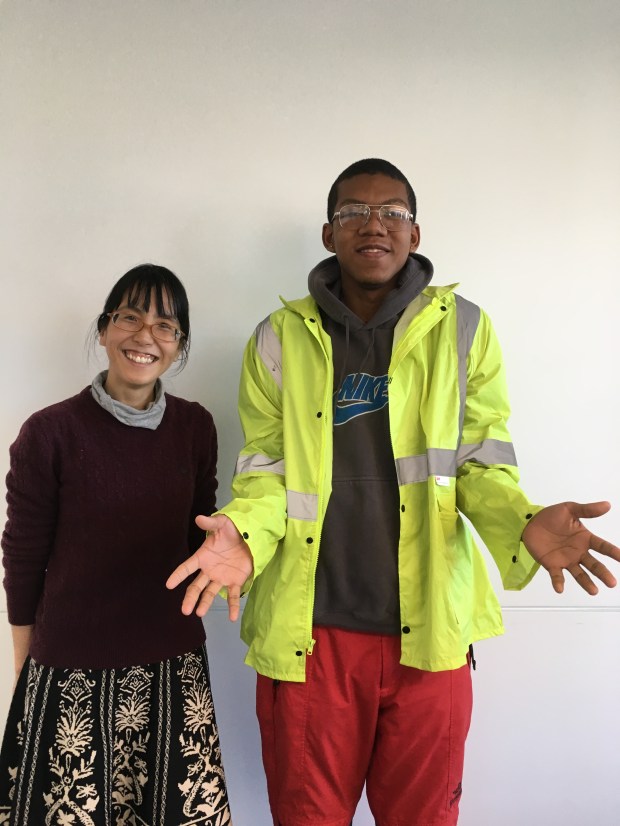
Jonah Nguyen-Conyers with Eshita-sensei after sharing the good news!

Jonah Nguyen-Conyers, a senior at DC International, has taken advantage of just about every Japan opportunity that Globalize DC has been able to offer to DC students. He first joined our Japan in DC summer program in 2017. He was a participant in our Blue Star of Life program at the Kennedy Center the following fall, and was included in our February 2018 KAKEHASHI trip to Tokyo and Gifu. He then took the very serious step of applying to our Japanese Plus afterschool program in fall 2018 as a Level 1 Japanese language student. He is currently in our Level 2 class. Jonah is a unique, joyful, and intellectually curious personality, and has been a great member of our Japan-focused community.

So it was with great excitement that we learned the wonderful news that Jonah has been accepted into Temple University, Japan Campus, to start in September 2019. We believe that pursuing his language and culture studies at a Japanese university will open doors to future career and life opportunities that have been percolating in Jonah’s imagination over the last few years with us. We are so excited for Jonah’s accomplishment. This will be the first student from Japanese Plus to make the big choice to pursue his undergraduate education in Japan. A former Japan in DC student, also from DCI, is now in her first year at TUJ.

We asked Jonah to reflect on his Japan journey, and to consider the impact that Globalize DC’s Japan programs have had on his life and future goals. Enjoy!

Ted Adams, Eshita-sensei, Jonah, and Sally at the Blue Star of Life program

Jonah’s Reflection

I think people should invest in Japanese Plus because this is just an awesome opportunity for students like myself to find motivation and a passion for their own success. Japanese Plus was able to guide me in ways that no other programs or organizations have, making sure their students experience enriching and impactful opportunities. All the things we did in the class allowed me to be more focused and passionate about my love and interest for Japan, with echoing effects that transcended the classroom and into my daily life. I really am happy I was given the opportunity to be a part of this program.

I was motivated to sign up for Japan in DC in 2017, because I had some kind of interest in anime, and the summer program was quite close to my house, and I got paid (through the DC Summer Youth Employment Program) to go. After the experience in Japan in DC, I really felt invested in the Japanese culture, and wished to learn more. So the Japanese Plus language class really was the best opportunity for me and my interests. I am beyond happy with my choice to join the afterschool Japanese language program.

The most significant aspects of Japanese Plus for me were the extensive access to very enriching opportunities that revolved around Japanese language and culture, along with great influence on the opportunities available after high school that related to college, giving me a lot of foresight of what opportunities for higher education in Japan could be for me and the other students in the class. This class allowed me to look into my future from a Japanese language student perspective and see a future I never knew I desired.

Japan in DC, Japanese Plus, and the KAKEHASHI trip to Japan were the foundations I needed to understand the way I wished my life would go in. These opportunities that I never thought I would have really just allowed me to see a future that I can work hard and be passionate about. I really just loved the whole journey that I’ve taken to get to where I am now. Without these opportunities I honestly think I would be less passionate and dedicated to my future.

I decided to apply to Temple University, Japan Campus (TUJ), as the process of getting the information from my friend and website and other means were quite efficient and fit my life during the time of applying. I was hoping to apply to other Japanese universities (and still might), but this was one of the schools I was able to apply to through the Common Application, for which I was given a lot of guidance through my school, as it is a nationwide application service. So applying to TUJ at the time was a great choice when considering my own circumstances and the other things in my life.

In the future I wish to go to college, and learn the Japanese language to the extent and fluency of a native speaker, and be able to share and communicate with Japanese people, hoping to understand their lives and culture, something I will be learning forever. I hope to go to college, get a Japanese language degree, be an English teacher or art teacher, and just have the experience of being a part of this vastly different country. After teaching I don’t know what I might do, but I would love to reach back to my Chinese and Vietnamese passions and get more invested in those parts of my identity, maybe through the Peace Corps. As long as I am learning at all points in my life, I will be happy, and that’s what this future can provide for me.

Jarid’s super inspiring visit

By Lucca Bey

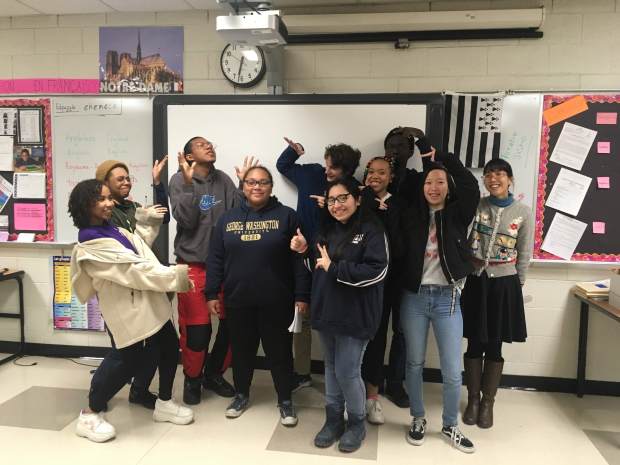
This week during Japanese Plus we actually had a very special visitor come all the way from George Washington University to talk about their experience with learning Japanese. What’s more, our visitor, Jarid, more or less started their journey into Japanese language the same way that we did (with Globalize DC and the TOMODACHI program), which I have to admit was super inspiring. As senior year seems to be approaching faster and faster every day, the more stories such as Jarid’s seem to strike a chord with me.

The fact that something as small as a Japanese class can end up guiding my career and shaping my life isn’t something that I took seriously as a possible reality until this year. Talking to Jarid and asking her questions really gave insight into the reality of studying in Japanese class in postsecondary education. While Japanese is something that’s more personal to her that she wants to pursue, she’s also studying Biology and Education, and hopes to go to Japan in order to make language accessible, as well as to understand different education concepts around the world to learn how people learn. She announced to the class that she’s going to be applying to the JET ALT Program to pursue this goal.

Having people like this, coming from the same city, program, same schools even for some of us, who come in and show us that the sort of career that we dream about is indeed achievable, is really awe-inspiring for us, making our goals seems even closer than before!

Embassy visit to our classroom

By Lucca Bey

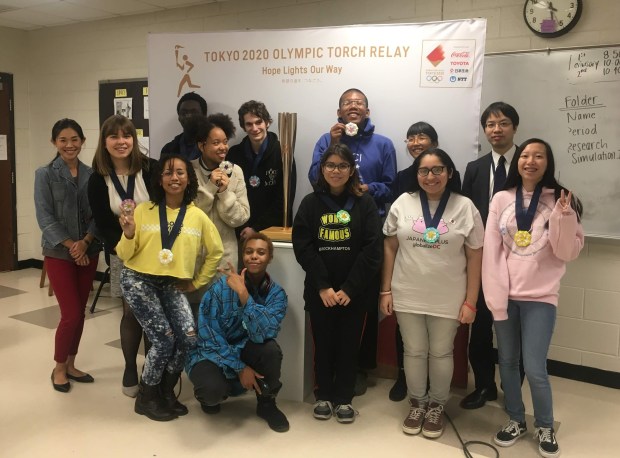
A couple classes ago, we had some very special visitors from the Embassy of Japan who gave us an interactive lesson about Japanese history, geography and culture. As they were giving the presentation and we were playing a fun game of truth or false, I was really surprised by how much we actually knew about Japan as a class. For example, they quizzed us about products that came from Japan that we see in our everyday DC, such as metro cars, cameras, and of course, video game systems. You see, when you learn something, you absorb the information, of course, but you don’t really grasp the magnitude of how much you’ve learned because of how abstract knowledge is as a concept until it’s laid out in front of you, and honestly, the visit from the Embassy of Japan did just that. Even the representatives from the Embassy of Japan were pleasantly surprised with our knowledge of things about Japan that weren’t inherently Japanese language related, and I’ve got to admit, it was definitely a boost to our confidence.

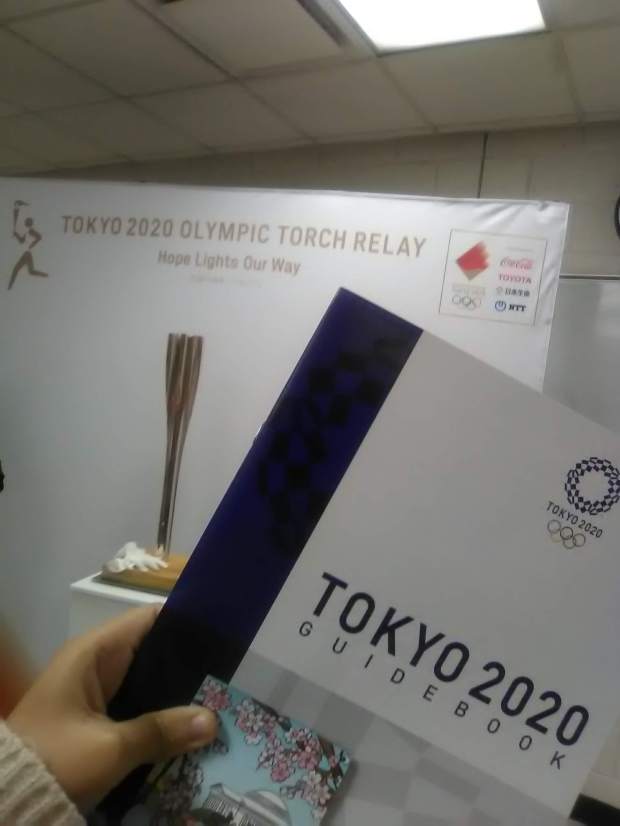
Aside from the more formal part of the Embassy’s visit, we also got to make these adorable (albeit very complicated) origami Olympic medals, to go along with the Olympic motif, since the Olympics are being held in Japan this year! We even got the privilege of seeing one of 100 models of the Japanese Olympic torch. Fun fact: If you look at it from the top side, it’s shaped like a cherry blossom, which besides being Japan’s most celebrated flower, also has ties to our very own Washington, DC! The experience within itself was such an educational, fun, and informative experience. Japanese Plus is so thankful for them taking the time out of their day for us!

Getting ready for the Tokyo Olympics

By Jonah Nguyen

When the Japan Information and Culture Center (JICC)  came to our Japanese class and gave a presentation on the coming 2020 Tokyo Olympics, we were so excited! It was a very interactive experience for the students, as we were tested on our knowledge on history and culture from Japan. During the whole experience we weren’t only tested but were also enlightened with new knowledge, and learned new things that were more specific to the Tokyo Olympics, like the 100% recycled metals that were turned into the award medals in the award ceremonies. Then we did origami, learning how to make paper medals, in theme with the 2020 Tokyo Olympics. This was a super enjoyable experience for me and my classmates, we had so much fun!

I have had past experiences with the JICC, and each time interacting with the organization I had so much fun and learned so much. I am super glad to have been able to meet and have these experiences with the JICC. All were memorable, enlightening, and so fun. I hope to see them again.

Carrying the Sun

By Lucca Bey

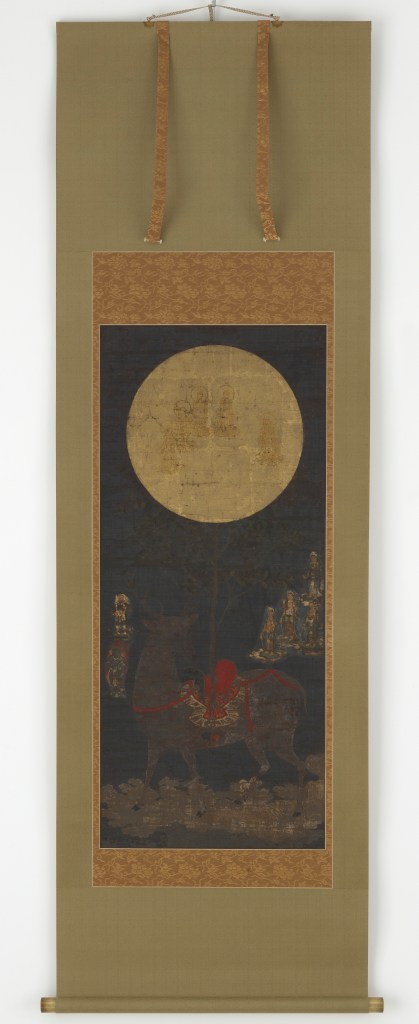
Last week, we ended up visiting the Freer|Sackler museum to expand and apply the Japanese history we’ve been studying in class about the happenings of different historical periods. Seeing how the different events affected the style and content of art during that period is way more interesting than it sounds on paper. For example, most of the artwork in the Japan exhibit was from the Kamakura period, which depicted a lot of religious symbolism as well as primarily paintings, which matches up to the events during that period. I won’t go too much into that though, I plan to talk about an art piece that in particular, caught my eye:

[Pictured: Carrying the Sun by Kasuga Mandala, courtesy National Museum of Asian Art]

For context, deer are considered messengers of the divine in the Shinto religion, and the sun above the deer is meant to symbolize the kami Amaterasu as well as the Buddha Mahavairocana. I found this piece particularly eye catching due to the symbolism of two distinct religions depicted here, and what’s more, the museum’s explanation for this was the fact that during the Nanbokucho period, both the Kasuga Grand Shrine and the Kofukuji, a Buddhist monastery, maintained close ties to each other and were sponsored by the same clan. I’d personally like to imagine the piece as a symbol of solidarity between both groups, and the gold painted onto the sun as well as the border of the scroll makes this art even more beautiful.

Tale of the Crane

By Katie Nguyen

The Tale of The Crane is a story about how a man saves a crane that was about to be killed. Soon after, a beautiful young woman comes to the man’s house for a night’s lodging. She later marries him and reveals that she was the crane who the man had saved. So she then promises him a long and prosperous life and returns to being a crane and flies away. This story illustrates how doing good deeds will be later rewarded. This handscroll was made in the Edo period in the early 17th century and was created by ink, color, gold, and silver on paper.

The reason why I decided to choose this artwork from our visit to the Freer was because it reminded me of a vocaloid song, originally by Rin Kagamine & Len Kagamine, called “Seasonal Feathers” sung by Youtubers Lyrratic and SirHamnet. The song is based on The Tale of The Crane, however, the ending is different. In the song, after the man saves the crane and gives her a place to stay, the crane falls in love with the man and was scared that the man would not love her and abandon her because she was a crane. During the summer, the man grows ill while working in the fields, but does not have enough money to buy medicine and cannot earn any more because of his illness. The crane decides to weave cloth to sell, however, she uses her own feathers to make the cloth. The two eventually died later, the crane from overworking and the man from his illness, and it is revealed that the man knew that she was a crane all along, but had still loved her for who she was.

Check out the song here: https://www.youtube.com/watch?v=y0dvRMnmN2w

A Walk Around the Tidal Basin

By Alexx Thompson

Have you ever been to the Tidal Basin in Washington DC? It’s an amazing place with strong ties to Japan! How, you might ask? Well you’re about to find out!

This time, we all met up at the Freer Sackler Gallery of Asian Art, where we headed in to enjoy their Japan collection. In the collection we all stared in awe at gorgeous paintings and pottery alike, and took in the beauty of it all. After the museum, we left off towards the Tidal Basin.

At first, I thought we were only going to view the cherry blossoms, and the stone pagoda, and the stone lantern, however there was a little bit of a twist. Once we arrived, Sally and Eshita-sensei explained the rules of the game. For the entire time touring the Tidal Basin, we could only speak in Japanese. Soo… NO ENGLISH!!! Everyone instantly became nervous, none of us thought we’d be able to speak for that long. In my case, it was as if all my Japanese had flown right out of my head! A few of us even joked about doing sign language so that we could at least try and pass the challenge.

Then, it started, and we set off. The start was a little shaky but I found myself making good conversation. I joked about eating sakura tree ramen, as someone had asked me what I was eating, as I hadn’t the faintest idea what to even say/talk about! The time flew by honestly, and we were able to convey what we were trying to say, as well as sharing new vocabulary through miming! We arrived at the stone lantern and still, not allowed to speak English, we learned about the history, and snapped a pic with it! Then we kept going on, joking around in Japanese and also playing music for unknown reasons. But the music was all really good! Soon after, we arrived at the stone pagoda, and we learned about the different levels and what element each represented. Having to translate it all into Japanese was cool, as we found we already knew most of the words and their kanji!

By the time we’d circled back around and realized we were back where we started, we couldn’t believe it! It was almost as if it’d only been thirty minutes! We all looked at each other in amazement and were really proud of ourselves! We’d managed to have fluid conversations together for an entire two hours! All in Japanese! It was really encouraging to see how far we’d come and we were all super excited! We can’t wait to do it again!

Girls Playing Kickball

By Asa Marshall

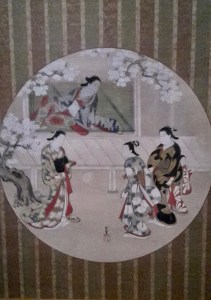
The artwork I saw at the Freer Gallery was “Girls Playing Kickball,” which portrayed a scene from the Tale of Genji, which is a great work of literature written by Murasaki Shikibu in 1008. This piece visualized the scene when the courtier, Kashiwagi, is playing kickball and he sees the Third Princess behind bamboo blinds, but in this painting the gender roles are reversed with a man watching a group of girls playing the game.

This piece was made by Kawamata Tsuneyuki in the 18th century, which is considered the Edo period of Japan. The story behind this work interested me partly because I love the Tale of Genji. The fact that the gender roles were reversed in this revisited version of artwork was interesting because I wondered why the artist made this alteration. To me it gave an impactful presence, because oftentimes women are spotted by men, but seeing the women active and engaging in sport activities, while the man being more hidden and reserved, is very different to other artworks where women would be portrayed as the more subtle character. It was a great contrast to what ideals would be considered more traditional and I like the simplicity of the artwork.

My Summer Trip to Japan

By Cyrus Johnson

This summer, I got to go to Japan. It was my first time out of the country and I was pretty excited! My aunt paid for a plane ticket and the hotel, and my mom came with me.

After a 13-hour flight, we landed at Haneda Airport in Tokyo. We got lost in the airport pretty quickly, but once we found the bus that would take us to our hotel, it was pretty easy to navigate. When we got to our room on the 20th floor and got settled, the first thing I did was look out the window. We had a great view of the Rainbow Bridge and could see both the Tokyo Skytree and Tokyo Tower from there. The next day I checked out the nearby malls, Aqua City and Diver City. Diver City was cool because they had an entire shop dedicated to Gundam, and they also had an arcade there. The arcade games are a lot more fun than the ones in a Dave & Buster to me. They had a bunch of rhythm games, a lot of crane games, and this really fun mecha piloting game, among others I wasn’t really paying attention to. I ended up playing until closing multiple times while I was there.

After that, we went to Akihabara, an area with a lot of electronics shops. We got lost almost immediately, but we found our way to a bookstore and bought some manga before we got back on the subway to go to Sensō-ji, a large Buddhist Temple. We went and got fortunes, but they were both bad, so we tied them up on the bad fortune rack, I don’t know what it was called. The next day we went to Shibuya and saw the Shibuya crossing, a famous spot surrounded by malls known for letting pedestrians cross through the middle of the intersection at the same time.. We were going to go see if we could take pictures from the top of a building, but you had to pay per picture after you paid to get up there. After we were done checking out nearby shops, we went to the Tokyo Skytree. It was cool seeing so much of Japan from so high up, but since it was pretty cloudy that day we couldn’t see too far out.

The next day my mom wanted to check out the National Museum of Modern Art in Tokyo. They had an exhibit on Takahata Isao, who worked on Grave of the Fireflies, Heidi, Girl of the Alps, and The Tale of the Princess Kaguya, which I enjoyed. Afterwards, we went to the Tokyo Imperial Palace grounds. The gardens there were pretty, but our feet got tired pretty quickly. We were only there for a week, and it was a pretty nice trip. The week went by fast, and I’d love to go back someday.

This slideshow requires JavaScript.