ā Latinā, ad Nihongam

by Bryson Torgovitsky

For the past three years, I have attended Washington Latin DC Public Charter School. In those three years, I have taken four levels of Latin class – one of which was a complete level done over summer vacation – and scored a perfect score on the National Latin Exam in my Sophomore Year. However, the techniques which allowed me to excel in Latin are less applicable in Japanese Plus.

Modern English takes multiple morphemes from Latin, which are used to form English words. For example, the word commiserate takes a prefix, root, and suffix from the Latin language. “Com” which means “with,” “misera” which means sadness, and “te” which signifies a group action. As a whole, “commiserate” means to express sympathy or sadness with others. Being able to reverse-engineer English into Latin made memorization of Latin words easier.

On the other hand, Japan is formed from Chinese so Japanese words come from different morphemes than English words. I have no background in Chinese, and over the course of centuries Chinese and Japanese have diverged so greatly that I am not sure if a Chinese language background would even be useful. Since I cannot use my “reverse-engineering” methods as I did with Latin, I have had to develop new strategies. Luckily, my uncle Steve has begun teaching me the methods that he used when he was first learning Japanese. His method involves taking an English phrase and blending the sounds of the words until it becomes the Japanese phrase you want! They do not have to be phrases with the same meanings, for example the English words “Thinking desk” can become the Japanese “Genki desu” (I am well) after some blending. I am hopeful that my uncle’s blending method will help me to excel as much in Japanese Plus as my reverse-engineering method did in my Latin class.

Japanese vs. Korean

By Skyy Genies

It was a normal day in the Japanese Plus Program, Eshita Sensei was teaching us about asking someone what they like to eat/their favorite food and how to speak about yours. Being myself (super obsessed with Japanese and Korean culture), when asked what I thought favorite/number one was in Japanese, I impulsively shouted “ichiman,” a combination of “ichi” one in Japanese and “마지막” (machimag) last in Korean. Silly, I know. However, to my surprise, that was actually correct. This situation caused me to be very curious about the similarities and differences between the Japanese and Korean languages. So I did a little research…

In terms of grammar, both Korean and Japanese use similar sentence structures and rely heavily on particles. The basic sentence structure of both languages is generally “Subject+Object+Verb.” In Korean particles such as 은,는 (eun/neun) and in Japanese は (wa) が (ga) are used to indicate the topic or subject being spoken about in the sentence. Also, many words in both Korean and Japanese have roots from the Chinese language or can be written in Chinese characters. In fact, around 70% of words in Japanese and Korean are rooted from the Chinese language. At one point, like Japanese, Korean used Chinese characters widely in their writing called “Hanja.” However, unlike in Japanese, the use of Chinese characters in Korean decreased drastically due in part to the formation of nationalistic ideas formed in 20th century Korea.

Despite these similarities, Japanese and Korean have many differences. These differences lie in the writing systems of the two languages. In Korean only one writing system is used in both Northern and Southern Korea, it is called 한굴 (Hangul). On the contrary, three writing systems are used in Japanese ひらがな (Hiragana) and カタカナ (Katakana), and Kanji – one for native words, another for foreign words, and the latter for Chinese symbols. Also in terms of the writing systems, in Japanese some of the symbols that are used have syllabic pronunciations, i.e “Ta, To, Ta, Te,” while in Korean, the symbols usually represent a single sound, i.e “B,D,R/L”; however some are pronounced “Yu, Ya, Yo”.

Cool, right? 🙂

Japanese and French

By Raven Bluford

The other language that I am currently studying is French, which I have been studying for about 3 years. Although I found French to be definitely easier to learn due to the letters being the same as the English letters, I found that I enjoyed studying Japanese more. Before joining Japanese Plus, I had no prior experience with anything Japanese, so the fact that I had no prior knowledge about Japan or Japanese culture and I have enjoyed it this much says a lot.

Studying French didn’t really help much when studying Japanese, because there are completely different components that makes up the language and culture. One similarity that I did find between the two was that Japanese and French start combining numbers using mathematical expressions to make new numbers. For example, in Japanese 11 would be the word for 1 and 10 and when you add them it’s 11. In French the word for 80 is 4 and 20, which means you would multiply 4 by 20 to get 80.

Stepping into another world

By Shawma Brown

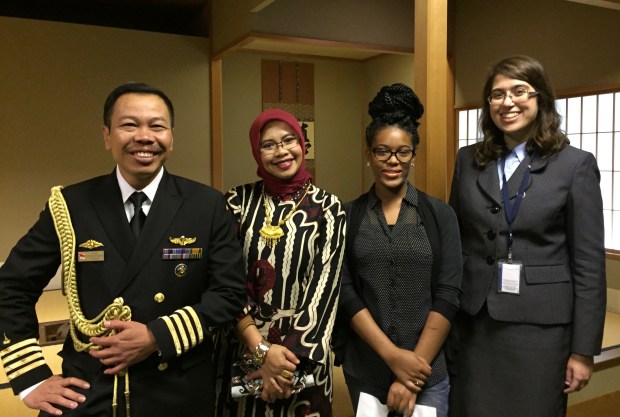
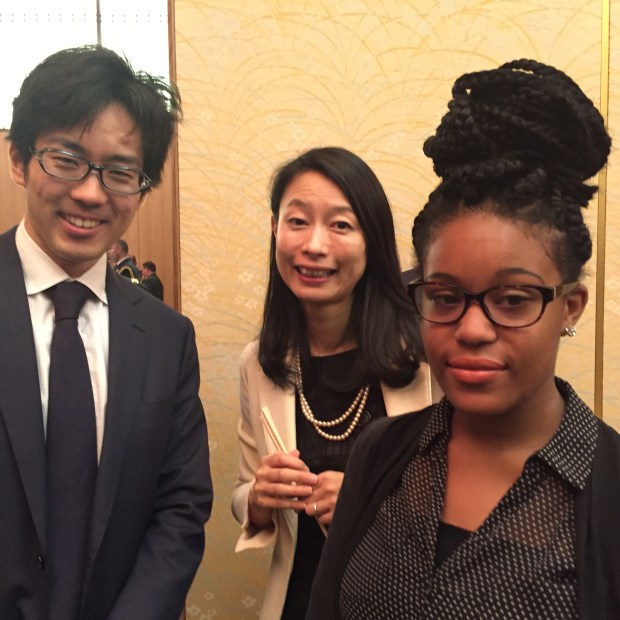
Imagine stepping into a world that made you uncomfortable, but excited at the same time. That is the only way I can describe my visit to the Japanese Embassy. I never experienced another culture upfront. I was extremely nervous. I literally felt butterflies in my stomach. Ms. Sally assured me that there was nothing to be nervous about.

When we first got there all you could see was officers in their uniforms with their wives. Everyone was dressed so elegantly. I felt like an oddball, as the only person with jeans on. It reminded me of the fairytale “Cinderella.” The part in the story where Cinderella goes to the ball and sees all people dressed so gracefully. It was like a more modern ball. I paid attention to Japanese people’s interaction, which was so formal.

The food looked really weird but it was so good. I think my favorite dish was the tempura. I met many Japanese people. I even got to use some of my Japanese I had learned. I interacted with many military officers from all over the world. The thing that struck my attention was how the military officers from different countries had ties with Japan.

I learned about the ties between Japan and the United States. After World War 2 the Japanese no longer had a military. Now the US is aiding the Japanese as if they were their military. Even though the US and Japan had a rocky start, it led to them becoming really good friends.

shawma-embassy2

shawma-embassy-staff

shawma-embassy-military

How we developed our puni-puni values

By Chi Onyeka

One faithful Saturday, Sally-sensei gave us the task of finding characteristics that we should utilize in order to make this program successful. First what we had to do was in our table groups determine our character values. Then as a whole group, we said the words that were discussed in our table groups, and we had MUCH more words than the 12 that are displayed on the website. We decided that there were too any words, so we decided to choose the strongest synonyms of each. It was a two-class process, but in the end, we came up with and try our best to follow these twelve words:

  • Open-mindedness
  • Respect
  • Patience
  • Dedication
  • Empathy
  • Collaboration
  • Responsibility
  • Honesty
  • Curiosity
  • Equity
  • Communication
  • Application

Creating a mascot

Dakharai –

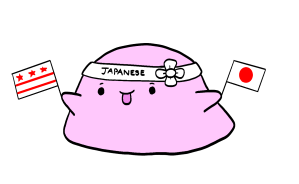
One of the first contests we had in Japanese Plus was the mascot competition. The class was divided into groups and we had to come up with a mascot design to represent the program. However, it had to display different virtues of a Japanese Plus student via a list we had made previously in class. Every group had their own contender in the battle for the best mascot. After a long debate to decide the winning mascot, which we accomplished by taking a vote, we all finally came to a consensus. Despite all the AMAZING creations that we formed from the creative juices of our minds, the winner was a totally KAWAII (very, very kawaii-desu), pink jelly holding two flags, made by Ana Nguyen.

CONGRATULATIONS!!

Ana –

puni-puni-smallerInspired by the cute mascots from Japan, jello and the Pokémon ditto, punipuni was born. I wanted to make our mascot have a “kawaii” look, similar to the mascots of Japan but also simple so that it’s easy to remember and recognizable. While doodling on homework, I sketched several nameless forms along with a few cats and punipuni was born. Punipuni is holding the DC and the Japan flag in its hand representing Japanese Plus. It’s the only program in DC that offers Japanese to students and the mascot represents how we’re integrating more Japanese culture into DC students. The pink, formless blob represents how this program can take any shape because of the students in it.

Bingata Reflection

By Raven Bluford

bingata1After meeting the Kakehashi exchange visitors, a few of us went to go to this event where we were able to make Bingata.
Bingata is an old Japanese tradition, where you dye cloth and make different patterns nature-related, using various bright vibrant colors. We were given cloth that had a template to dye the cloth. When we dyed the bingata we were given palettes that had very light colors, which kind of served as the base before we added the darker colors. After adding the light colors to the cloth, we were given the darker colors, which would be added or even covered some parts of the light colors. It was quite different from painting, because instead of actually making long strokes, you just use one brush for dotting and the other brush for rubbing in that dot. This was quite fun because it didn’t matter if it was inside the lines or not, because once the bingata dried, the paint outside the lines would be gone.

Kimono and Yukata

By Jenny Jimenez

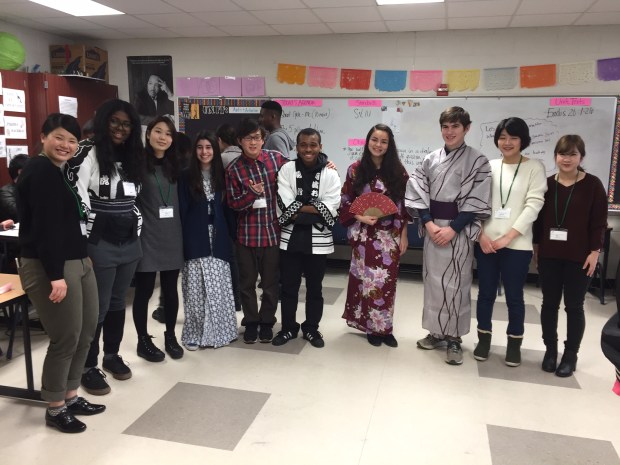
On January 28, our Japanese Plus class was honored to meet the students in the Kakehashi program! This program allows Japanese students to come to the United States in order to learn about American culture as well as practicing their English skills. Kakehashi means bridge in Japanese and the students from this program and the students from the Kakehashi program connected by sharing aspects of each others’ cultures.

The Japanese students presented many stations in which they shared important cultural traditions; my personal favorite was the kimono and yukata station! Each student was paired with a Japanese student that would put on a kimono or yukata and while we were getting dressed, an explanation would be presented by the Japanese students.

My Japanese student was Yayoi and we had a conversation about yukata! She happily explained to me that yukata are worn in the summer whereas kimonos are worn in the winter because they are made of thicker fabrics. My yukata took the longest to put on in our group, but it was so beautiful! It had purple flowers on a red background and Yayoi put a large bow on the back of my yukata and let me hold a fan! Although putting on the yukata took a while to put on, I loved learning about this traditional dress because of its importance in Japanese culture. I especially loved talking to Yayoi because she clearly explained what the yukata’s importance was in Japan, as well as asking me questions about why I am learning Japanese and why I like Japan’s culture. I am so glad to have learned about the traditional dress but furthermore I enjoyed interacting with Japanese students who were extremely nice to us!

In this photo, you can see the American students wearing kimonos and yukata beside the Japanese students who helped dress us up!

jenny-yukata-and-kimono-full

Why a mascot?

By Jeff Jenkins

We were motivated to make a mascot because of Japan’s profound love of mascots, having them for just about any and everything. They’re kind of like state flags in the United States, although these mascots have a ton of personality to them and influence quite a bit of the community. Mascots are so popular in Japan’s communities that there’s an overpopulation of them, which the Government has even stepped in to regulate! A perfect example of this epidemic would be Osaka with over 40 mascots to represent the Prefecture alone.

Not all mascots are meant to represent towns and prefectures. There are a lot of mascots that represent things such as fighting for solar power and tax reduction. Japanese mascots are meant to represent some form of uniqueness and cuteness that’s able to win the hearts of a crowd, which also determines the popularity and livelihood of these adorable creations. Domo-kun is a great example of this long-lasting popularity that keeps mascots relevant. Created in the late 90’s, he still manages to hold a spot in people’s hearts.

Also, government organizations and the military use mascots to represent current affairs, both local and national. That’s right! The Japanese Army uses these adorable creations to represent themselves, so don’t let their cute looks fool you! Furthermore, mascots are used to generate money for companies and organizations, the most iconic one being Kumamon whose economic effect raised 124.4 billion yen in the past 2 years. Kumamon was originally meant for the promotion of Kyushu Shinkansen (bullet train) in 2010 and since then, he’s grown to promote things such tissues, children’s toy’s and even clothing.

kumamon

So, although it seems like most mascots are meant for just looking kawaii on display, they are very versatile and can be used for more than just one thing. In fact, they can be used to relate an important message to people that other forms of art or social media can’t, and who knows, that may be the reason why some mascots manage to win the hearts of their supporters.

Okayama University

By Jeff Jenkins

Okayama University was introduced to me by Takayuki Yoshioka, Associate Professor of Philanthropy, Social Innovation and the DISCOVERY Program for Global Learners. He explained to us the origins of the University and the kind of environment that the college is in, which is in Tsushima-Naka in the Okayama prefecture, located in the center of West Japan. Okayama is an agriculture rich area specializing in fruit products, like Muscat grapes and white peaches. Additionally, Okayama is known for its educational history, cultural achievements and marine life.

During the presentation, Yoshioka-san told us about a program called DISCOVERY that’ll be starting very soon at the University. The DISCOVERY program is meant to bring international students to Japan in hopes of turning them into global leaders for society, through the various classes available, such as Environment and Health, Migration and Communities, Environmental Chemical Engineering and Social Innovation. Also, the classes can be taken in full English if you wish. However, it is encouraged to take Japanese as well, because it will allow you to communicate with the locals and develop a better understanding for the culture.

The University is open to accepting international students even if their GPA’s aren’t a 4.0 or their SAT scores aren’t the best. Just being able to give people the chance to chase after their dreams, even if they aren’t the best academically, is an extremely good trait for any university. It has been proven that not all successful people are geniuses! The DISCOVERY program also gives full scholarships to international students looking to study abroad in Japan, so you don’t have to worry about any big financial barriers hindering you.

My final thoughts on Okayama University is that the college is very welcoming and surrounded by a vast wealth of history and culture. I do hope to apply for the college ASAP so that I can personally experience the life of college in Japan! Well then, I hope this blog sparked your interest in Japanese universities!

Jya ne!