A Visit to “Recapturing Happiness” at the JICC


Jennifer Pineda

On March 11th, some Japanese Plus colleagues and I visited the Recapturing Happiness: The Enduring Spirit of Ishinomaki” exhibit at the Japan Information and Culture Center (JICC). The JICC holds events free to the public to learn more about Japan, Japanese culture, and Japan relations. I was informed that the exhibit was about 3/11, the earthquake that caused a tsunami in Tohoku, Japan in 2011.

When entering the exhibit I was shocked to see a lot of happy photos. Before coming to the exhibit I expected to see sad photos about the damages that were done and a small section of how they’ve rebuilt. But to my surprise that was not the case. A lot of the exhibit was different stories about how people overcame the tragedy and how they are continuing to have hope and resilience despite the damages that were done, and how they cope.

A story that stood out to me was about a couple that lost their three children. They built a playground and commemorated them in different seasons and the photos captured the bright colors to remember them in different seasons and weather conditions. They related rainbows to the spirits of the children and every time they saw a rainbow it reminded them of their children. After speaking with Ms. Shanti (Shoji) she explained further that the couple is tired of news teams interviewing them and sadly talking about their kids. They rather people realize of course they miss their kids, and see how they are doing well and see the positive side of things and that is exactly what the photographer captures in the photos. The bright colors help us see the brighter side of the story and see the happiness and progress.


I enjoyed the exhibit and seeing the happy memories within the stories, but also commemorating loved ones. The exhibition was meant to show the happiness and recovery from the tragedy and not dwell on the past.

Zion Daodu

On 11 March 2011, at 14:46 JST, an undersea earthquake occurred 72 km east of the Oshika Peninsula of the Tōhoku region in Japan. The earthquake was followed by a tsunami. In Japan, this is referred to as the “Great East Japan Earthquake.” The impact was catastrophic, resulting in widespread destruction of infrastructure, homes, and communities, and claiming the lives of over 18,000 people. Many families were torn apart while also faced with unimaginable loss and displacement, as entire towns were swept away by the tsunami’s powerful waves.

The JICC organized an exhibit titled: Recapturing Happiness: The Enduring Spirit of Ishinomaki, featuring photographs by Mr. Keisuke Hirai. It is an exhibition that conveys the resilience of the human spirit, the joy of community, and the moments of happiness that persisted in Ishinomaki following the Great East Japan Earthquake.

Photographer Keisuke Hirai (center) with staff from exhibit sponsors Japan Information and Culture Center and Sasakawa Peace Foundation.

Of the many people featured in the exhibit, the Amano family, and woodworkers Shinichi and Ryoko Endo, among others, stuck out to me, because of their incredible journey and how they overcame it. Following the tragedy, survivors faced a lengthy and difficult healing process as they attempted to come to terms with their loss, their trauma, and the major undertaking of starting over. After the tragedy, families that had been split apart have been gradually reestablishing their ties and seeking comfort and support in one another’s company. But these brittle reunions were cut short when the COVID epidemic struck, leaving many families to face a fresh round of uncertainty and loneliness. As the eldest son of the Amano family wrote, they were not always close but after the earthquake and their mother‘s death in 2020 they began to cherish the memories they were creating with each other.

The inability to be together during the pandemic brought an additional layer of grief and frustration for those who had already lost loved ones or were still looking for missing relatives from the 2011 disaster, adding to the emotional toll of both tragedies. Family members found it difficult, if not impossible, to continue their efforts to physically gather due to travel limitations, lockdowns, and health issues, but woodworkers Shinichi and Ryoko Endo made the 480-km drive from Tokyo to take their long-awaited photo with their daughter and her husband in front of the Ishinomori Manga Museum.


A source of strength, families were reminded of their ties and the value of helping one another through hardship by their common experiences of resiliency and survival following the Tōhoku tragedy. Even though there were clearly challenges brought about by the pandemic, it also brought to light the families’ steadfast endurance and inspired a fresh appreciation for the times they were able to spend together, whether in person or virtually.

Zitlaly Hernandez

When I first entered the exhibit I was kind of nervous because there were important people around and I’m not good at socializing. As I walked around I noticed before and after photos, photos from the past or the present or both depending on the story.

One story that really got to me was one about an older sister and how she had missed the times when she would spend with her sister. It also got to me because her story touched on how she was grateful for her family and how she was thankful for all the things they’ve done for her. This resonated with me because I’m really close with my family and although it’s small, we love big. This is something that Kokoro, the author of the story I’m talking about, illustrated in her story.


Felipe Lemos

What I enjoyed most about the exhibit at the JICC was the fact that it focused more on the stories of the people and how they recovered over time rather than the tragedy itself. Some of the exhibits had pictures from the time of the disaster that were taken in the same spot 10 years later. Some of the exhibits told stories of the changes and improvements in people’s lives, all of which occurred after the disaster. But the shared message that I took away is that the world didn’t end after the earthquake. People’s lives went on and they were able to create stories and memories that were passed on through the exhibit.

One of my favorites was the story of a family who took a photo of themselves in 2012 shortly after the earthquake, and then went back to the same place to take a family picture again. Seeing the people who aged, the children who were now adults, the new members of the family, the background behind them changing to be a clean, new building, it all adds to this sentiment that pushing through adversity and having a positive mindset can lead to happiness long term.

Special thanks to the staff of the JICC for offering extended viewing hours so our students could visit this moving exhibit after school. It’s wonderful to be so warmly greeted.

Dinner afterwards at Donburi in the neighborhood. It was great to be joined by Takahashi-sensei and Nishant Annu (who both lived and worked in Tohoku) and local TOMODACHI alumni Jeffrey Jenkins and Tenaj Gueory.

Remembering 3-11

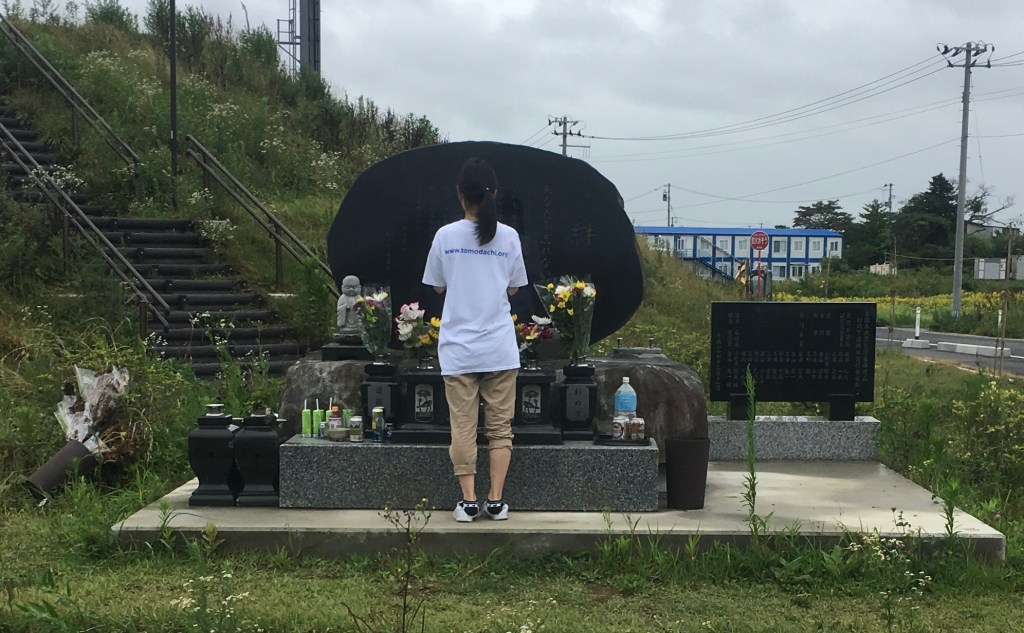
Photo from our 2018 TOMODACHI US-Japan Youth Exchange Program in Tohoku.

NOTE FROM THE PROGRAM DIRECTOR: On March 11, 2011, the Great East Japan Earthquake struck the Tohoku region of Japan, causing tremendous loss of life and widespread destruction of homes and communities. For six years Globalize DC was privileged to participate in the TOMODACHI US-Japan Youth Exchange Program, which allowed DC high school students to visit towns and cities directly affected by the earthquake, and to meet and engage with their Japanese peers in the region. These experiences have been deeply affecting and informative to all of us. So each year we take a few moments to recall the events of 3-11, to learn, and to reflect. This year our Japanese Plus students watched the emotionally riveting film, The Tsunami and the Cherry Blossom, which vividly documents the events of that day and the aftermath. These are some of our students’ reflections after viewing the film.


Chamiya

It was hard to watch the film about the tsunami that hit Tohoku on 3-11. Watching people lose their lives and witnessing survivors lose hope after experiencing a devastating tragedy was devastating to me. One guy said that he doesn’t want clothes or home, or anything material. He wanted his friend back, and that is something that I relate to. I admire these people for finding hope in the cherry blossoms. Finding something to look forward to, as something as small as watching the cherry blossoms bloom is admirable.

Zitlaly

It was hard to hear of the tragedies and how everyone had to accept the fact that the tsunami changed everything. Despite the fact that many lost what they would consider their lives/reason for living, they still continued to stay positive, to have some type of hope. I admire Japan for persevering and finding something or someone to hold onto during this hard and excruciating experience for so many. Also, I admire that many looked at the blooming of the cherry blossoms as a form of a new beginning, a remembrance, “rebirth,” hope, and a push to keep on going. Despite that, some felt envy for the blooming.

PS. May those who have not been found find serenity.

Felipe

One thing that stood out to me in the film was the man who lost his best friend. At the beginning he was distraught and at one point said that he had lost the meaning of his life and everything that was a part of it. However, once reflecting on the cherry blossoms and what they represented, he realized everybody was trying to bounce back because they were still alive and they shouldn’t give up. Another thing I found inspiring was what the woman at the end of the film was saying. She said she would photograph how the town was rebuilding but she also mentioned how the yearly blossoming of the cherry trees was giving her hope for the future. She said that the next time the trees blossomed, the town would be more rebuilt and the year after that even more. This made me reflect on how time is continuous and things will improve over time if you keep looking forward.

Mai

  • For many people in Tohoku they couldn’t believe that a tsunami was actually happening right before their eyes.
  • How easy it was for the tsunami to destroy and swallow their homes and loved ones. They could only watch, not being able to help.
  • “Nature is filled with beauty and terror but sometimes we forget about the terrors.”
  • The cherry blossoms have different meanings depending on how we feel and what memories we associate with them. They are goodbyes and new beginnings.
  • There was a tree that has lived for more than 80 years. When the Tohoku people saw the cherry blossoms, they felt healed, allowing them to have hope and motivation to rebuild their homes.
  • Cherry blossom trees have steps of growth: ichibu-zaki (which is the first step of the cherry blossoms growing) and maichiru (when the cherry blossom flowers begin to fall).
  • Sakura are yuuga (beautiful but not too showy). The Japanese people have a kanji for the concept of yuuga: 優雅

Jennifer

Although the cherry blossom trees also suffered the tsunami, they managed to strive to be alive. It became a hope to most and a reflection to those who survived. The tsunami hit them hard. Some grew from it, some resented it. The cherry blossoms give a sort of reflection on how they feel about the tsunami and what they feel about the future.

Elias

I noticed the destruction which caused the deaths of many friends and families who mourned for them after the disaster. Going through something as traumatizing as a tsunami taking your home and friends and families led people to lose everything, giving them a sense of emptiness from their tragic losses.

D’Amonie Armstrong

I believe that going through something like this is absolutely devastating and will have long-lasting impact on the people of Tohoku. To see visual evidence of such disaster and watching as people tried to get to a safe haven was very disheartening. The people showed extreme bravery for abandoning or deciding to try to salvage their belongings. Many people suffered badly. However, during this time, the cherry blossoms were also almost in bloom, and that was used to bring hope for a better future. Every year that they bloom around that time, it is seen as a reason to keep going and how with each passing year, the rebuilding gets better and better.

Zion

It was heartbreaking to see the people holding out hope that their families were still alive. Children having to watch their parents get swept away. The people that just watched knowing they could not do anything to save them. The people that were just coming out of their homes, the ones that could have died if they had waited just one second longer and the many other stories of the people who had relatives that died or were missing. I could not imagine going through what they went through and I hope that the people featured in the documentary are still alive.

Margarita

It was interesting to see how much cherry blossoms are integrated into Japanese culture and life. Many people in the film mentioned how they grew up alongside the cherry blossoms. The cherry blossoms were viewed as hope when they start blooming, not long after the disaster of March 11. The film showed how the family of one of the victims had planted their own cherry tree before the tsunami, which had started to bloom afterwards. The difference between showing solidarity compared to America is also very interesting. Unlike in Japan when natural disasters happen or any kind of devastation, in the United States the news and solidarity usually remains local. Across all of Japan people were grieving, which shows just how devastating the event was. I can’t imagine how traumatizing it must have been for everyone affected.

Mermaid of the Blue Sea – Okinawa Style


By Chamiya Carnathan

Have you ever experienced a musical in another language? On January 13th, 2024, I had the privilege to watch “The Little Mermaid” in Japanese. 

Last November, the Director of the Okinawa Prefecture Office in DC, Mr. Kazuyuki Nakazato, invited Sally Schwartz and me to attend an Okinawan performance called The Heart of Ryukyuan Dance. Then last week, Mr. Nakazato gave Sally and some Japanese Plus students another opportunity to attend a performance called “Mermaid of the Blue Sea,” located at Lisner Auditorium. Adapted from Hans Christian Andersen’s The Little Mermaid, the performance featured Okinawan traditional dance and performance styles. I absolutely loved the performance. 

In The Little Mermaid, Hans Christian Andersen introduces a young mermaid princess who falls in love with a prince she saves from drowning. Seeking a chance to be with him, she makes a pact with a sea witch and trades her voice for human legs. However, Ariel will feel constant pain and will only survive if she wins the love of the prince and marries him. Despite captivating the prince, he marries another, unaware of Ariel’s sacrifice. Heartbroken, Ariel faces an ultimatum from the sea witch: kill the prince to revert to a mermaid or face death and become seafoam. Ariel chooses not to harm the prince, embracing her fate.

The Okinawan rendition of The Little Mermaid presented a unique musical experience. Despite the language barrier, the performers’ utilization of items, such as Sensu fans, was flawless. These fans were ingeniously used to represent ocean waves and various sea animals. The musicians were amazing, playing a musical score that effectively conveyed the intended emotions. The music, which was exquisitely melancholic, created a build-up to the touching moment when the little mermaid met her end. The utilization of the bingata costumes to determine if the little mermaid was a mermaid or a human was my favorite aspect of the performance. The little mermaid had a bingata that hung down to her feet, giving the impression that she was nearly gliding across the floor. Upon turning human, she began to show her legs by wearing a bingata that hung down to her knees.

My sole critique was a desire for a longer performance and wishing that I could see more. The production was visually captivating, easily comprehensible, and conceptually exquisite. I loved the performance and I hope to see another one in the future. 

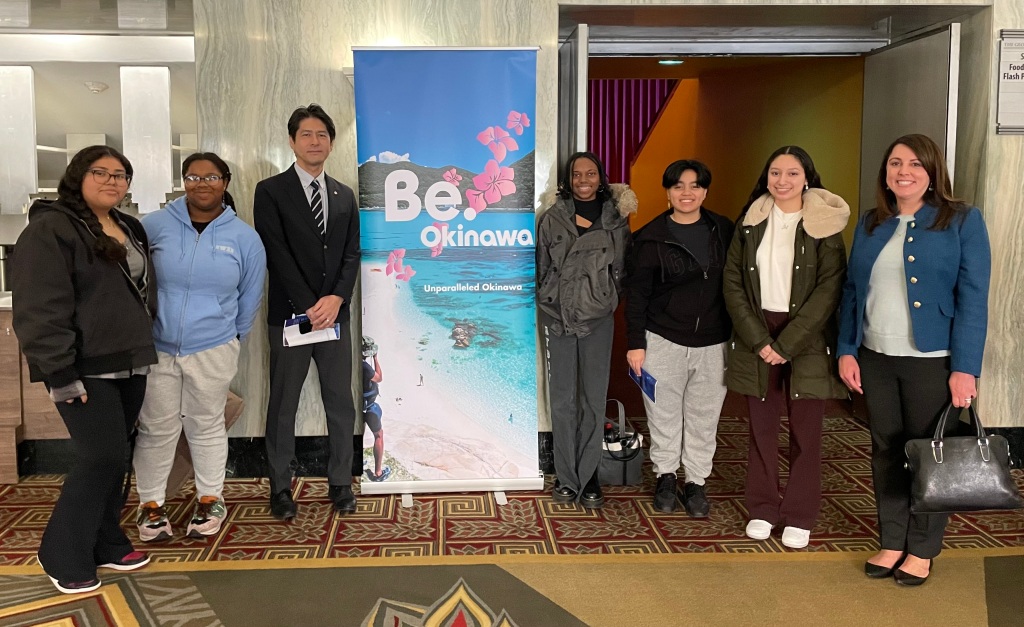
Zitlaly, D’Amonie, Chamiya, Jennifer, and Margarita with Mr. Kazuyuki Nakazato from the Okinawa Prefecture DC Office and Kristen Luck from the GWU Okinawa Collection after the performance.

Welcoming a new year


By Margarita Munoz Salazar

Nengajo (年賀状) is a traditional Japanese New Year’s greeting card. It is sent as a happy-new-year greeting to friends, family, and coworkers. Nengajo usually include drawings or pictures related to the new year, like the zodiac animal for that year, traditional Japanese symbols, or landscapes. People frequently include handwritten notes with the pictures, wishing the receiver good health, happiness, and prosperity in the upcoming year. In Japan, sending and receiving nengajo is a common tradition. It is considered respectful to exchange these cards during the New Year’s holiday. 

I was able to participate in a Nengajo contest for the Japan Information & Culture Center. Since this year is the year of the dragon, I put my drawing skills to the test and made a drawing based on the Japanese film Spirited Away by Hayao Miyazaki. I enjoyed participating in this tradition as it was a fun way to be part of the celebration of a new year. 

As something that is not very common to do in the US, Nengajo is a good way to signify that you care about someone especially if you take the time out of your day to make a drawing or include a message.  

A Lesson on Sumo

By Penelope Morris

During a recent lesson, the Japanese Plus class learned about sumo, a Japanese wrestling sport in which competitors try to force their opponent out of a ring, or into touching the ground with any part of their body other than the soles of their feet. Takahashi-sensei brought up sumo in the context of the week’s grammar lesson – describing the time and location of an event. So not only did we get to learn about the sport itself, we got to learn a bit about the culture surrounding it and how Japanese people interact with it.

Takahashi-sensei explained that many sumo tournaments occur throughout the year in Japan, usually at large halls where substantial crowds can gather, and she showed us a brief video of a sumo match. I was surprised by how quickly the match was over, and especially by how different it was from other martial arts with which I’m personally more familiar. I’m used to seeing lots of kicks, punches, and other more aggressive attacks in combat sports, but the sumo wrestlers had a very different fighting style that involved much more grappling and close contact. Overall, the lesson on sumo was very interesting and I enjoyed getting this insight into a part of Japanese culture about which I didn’t know a lot before.

My visit to the Embassy of Japan


By D’Amonie Armstrong

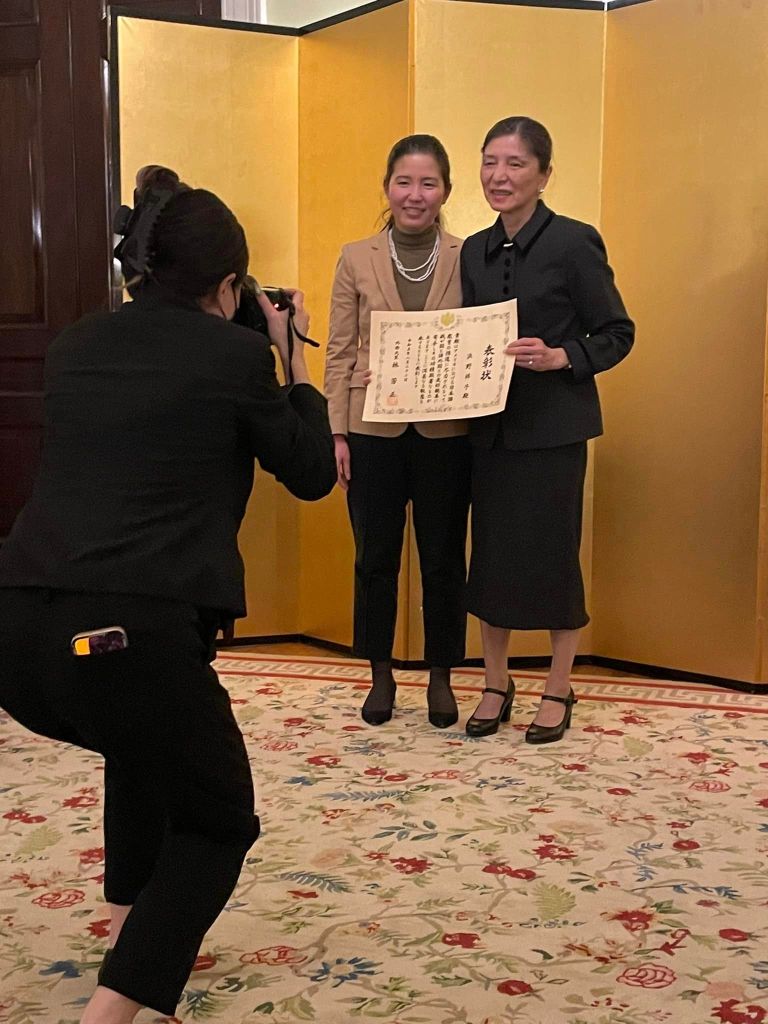
Last Tuesday, December 12, I had the privilege of being invited to the Embassy of Japan. I was very excited upon hearing about this opportunity to put myself out there. And I was beyond excited to find out that the event was to honor our level 1 Japanese teacher, Shoko Hamano-sensei, for her endeavors and dedication working to draw connections within the Japan-D.C. world. We had the pleasure of having Hamano-sensei teach us virtually from California last year. Although virtual, she had an impact on us as she was this cohort’s start into this program. We learned hiragana and our names in katakana from Hamano-sensei, so she’s a big deal to us. Starting Japanese 2, we’ve missed her and it saddened us that we wouldn’t be able to meet her in person. So, I also felt honored to be the first to see and personally greet her on behalf of my cohort.  


Getting to see her accept her award, I couldn’t help but think how she’s inspired many people, as the room was filled with other Japanese teachers, former students of hers from college, and myself being the youngest in the room. 

I was a bit nervous upon getting to the building. The path leading up to the building, beyond the gate, was tiny stone squares. Guests were coming in alongside us, so I was afraid of stumbling, and of taking pictures. I didn’t want to look like I didn’t belong. Essentially, the fear went away because everyone was very nice. I introduced myself to the people Sally knew and connected with others I had met before. I was also excited to see our other sensei from last year, Tsujioka-sensei. The inside of the prestigious building was bright. I liked the small and flashy vibe it gave. 


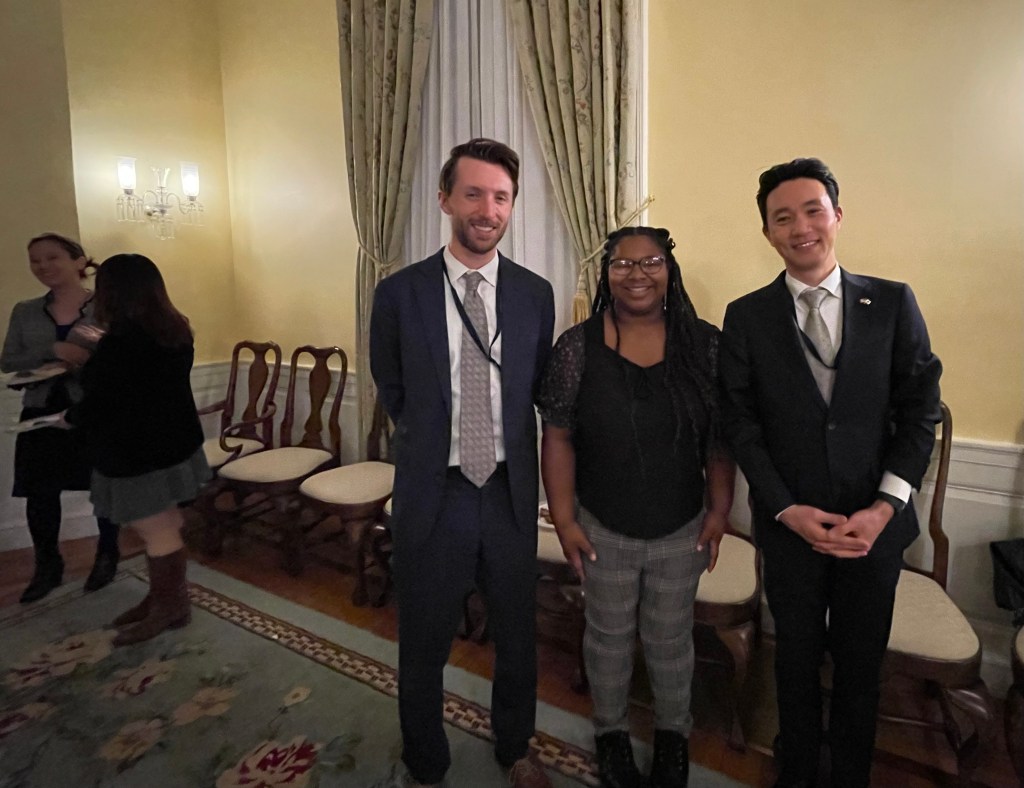
When Sally had mentioned the food, I was of course more ecstatic as I would have a chance to see what was there and extend my palate. I ate well and spoke with ever greater people who were interested in my future plans (college, path regarding Japan and US relations). Being the youngest no longer intimidated me, as I could speak and hear from others who had the same goals as me, to have an impact on the Japan-DC world. I shared that I would take the opportunity to study in Japan whether directly or through studying abroad. My area of study would be linguistics with concentrations in specific languages. I also want to look into the JET program so I was able to speak with Tim Folsom from the Embassy’s Education Department, who did the program. All in all, I had fun and the evening will be remembered as one of the greatest events I’ve ever attended.  


I’m glad I was able to be present and represent high school students and myself. My hope is that high school students can have the opportunity to visit these embassies. I am incredibly grateful to have been invited, and I hope this is one of many events I will attend. A huge congratulations to Hamano-sensei for her active service in international relationships, someone I strive to be.

じゃんけん (Janken)


By Chamiya Carnathan

In October, our Japanese teacher dropped some knowledge bombs and initiated us into the arts of the Japanese Rock-Paper-Scissors. Otherwise, known as じゃんけん (Janken)! Although it is called different names in different places, the rules of the game are generally the same in every country. 

グー (Guu) = Rock
チョキ(Choki) = Scissors 
パー (Paa) = Paper

To start the game, players show their fists at the same time. Players will say “じゃんけんぽん” (Jankenpon) which is a phrase to be chanted by the players together. Players are to show their hands at the same time when they say “ぽん”(pon). To make it more chaotic, in class, everyone battled against the teacher. The students were standing tall and ready to defeat the teacher, “せんせい,” in the game, while the teacher was positioned in the front with her hands ready. Victory belonged to the last person standing, the one who outsmarted せんせい. And if no one could beat her, せんせい emerged as the champion.

After the class played a round of じゃんけん against our teacher, せんせい taught the class a different version of じゃんけん. The game starts generally the same where players would show their fists at the same time. “じゃんけんぽん” is chanted at the same time and players would show their hands at “ぽん”. This is where the fun begins to play out. In this version, グー, チョキ, and パー represented different numbers. 

グー (Guu) = 1
チョキ(Choki) = 2
パー (Paa) = 5

Picture this, players unveiled their hands and a thrilling race begins. The challenge? Lightning-fast mental math. Here’s the twist: quickly announce the total in Japanese after adding up the numbers displayed on both hands! For example, player one has グー and player two has パー. The added number is 六 (6). The first person to yell out “六” wins the game. 

I personally love this version of じゃんけん. The more players in the mix, the crazier the number-crunching ride becomes. The pressure to add, convert to Japanese, and blurt it out first is super stressful but also really exciting. It’s also a great practice for learning numbers in Japanese. Whenever I play Rock-Paper-Scissors with my friends or family, I teach them the Japanese version. It’s so fun for both me and them because they learned a different version of じゃんけん and I’m excited to teach them about it.

Telling the untold story


By D’Amonie Armstrong

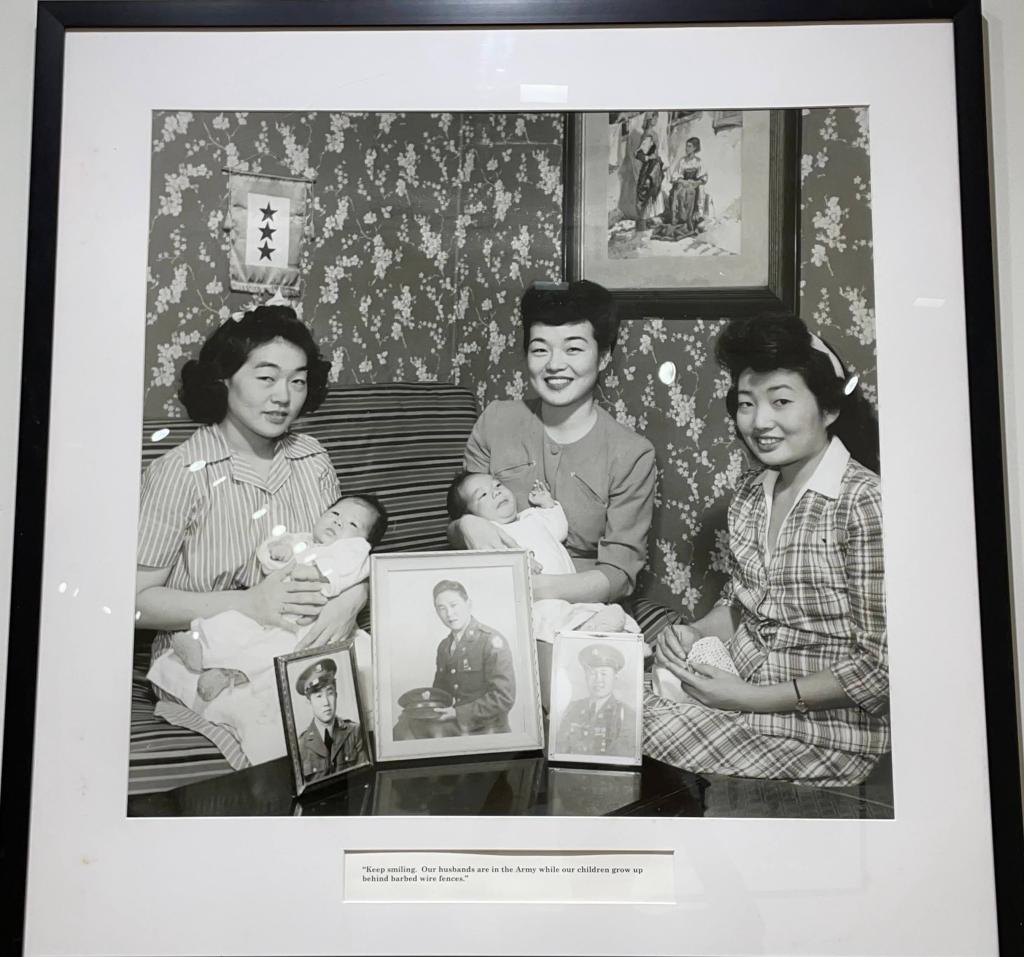
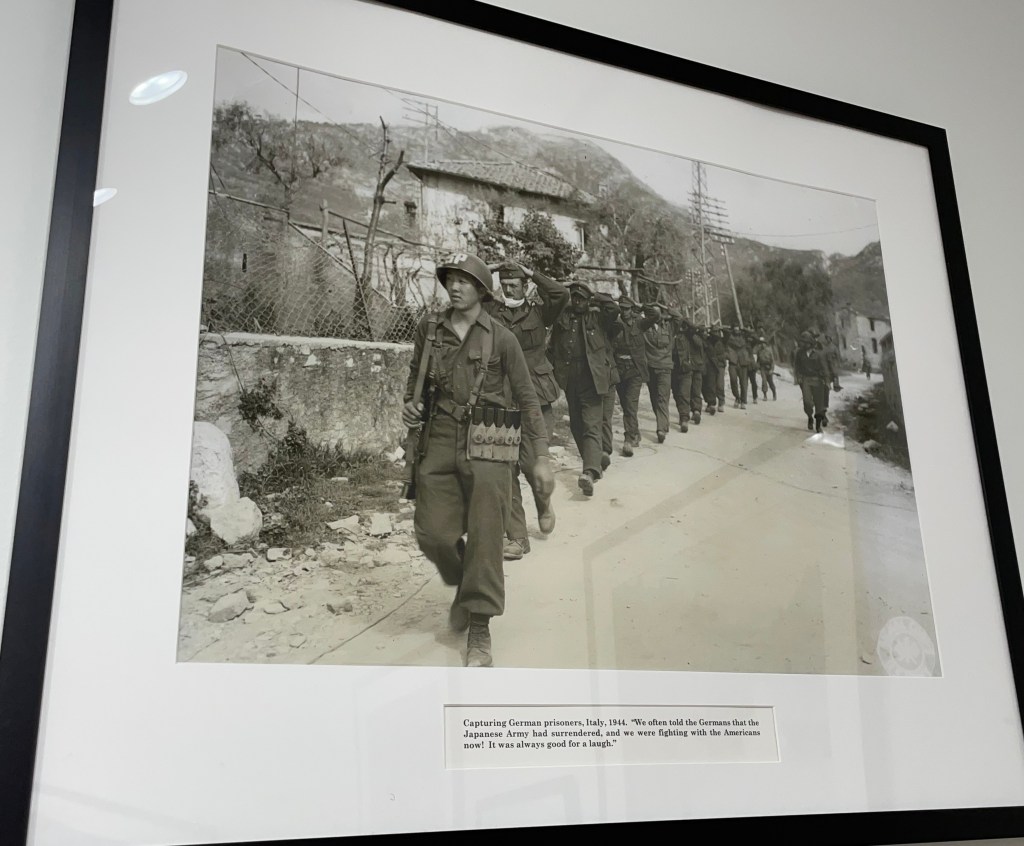
When we went to the JICC in December for Pearl Harbor Day, they had this exhibit featuring photos of Japanese and Japanese-American soldiers during that tough time.

The photo above is one of soldiers’ wives, two holding their newborn children, and all with photos of their husbands before them. It’s captioned “Keep smiling. Our husbands are in the Army while our children grow up behind barbed wire fences.” This stood out to me very much as I agree the emotions and the points of views of the soldiers are valid, but it is really the only story that gets told. It’s very interesting to hear about how others, like the soldiers’ families, think and feel as this also impacts them, especially if they have wives and children. 

The caption implies that the wives have to just keep smiling and not show pain as they raise their children alone, because their husbands are away battling in a war. It feels like they’re obligated to hold up this face, while they are directly impacted. And although the children in this photo are newborns, I can’t help but think about the many other families that had children old enough to know and understand that their fathers can’t be around because they are in the Army fighting for their country. In all, this was a time of deep despair and we have the day December 7th to commemorate the soldiers, and strong families that had to hold down the homes while their husbands, dads, brothers, sons strove to protect the country that held their homes and hearts. 

Human Amusement


By Margarita Muñoz Salazar

While our class was visiting the current JICC exhibit, there was a picture that really captured my attention. The picture had enemy soldiers lined up being taken somewhere while being escorted by Japanese-American soldiers. What stood out is that instead of being a tragic or upsetting description, it was humorous. After capturing German soldiers, the Japanese-Americans are able to make jokes of the situation and their situation by saying that the Japanese Army surrendered and confusing the enemy. Seeing that even these soldiers are able to have fun and stay somewhat positive made me feel happy for them, knowing that after all the hostility they have received, they are still willing to fight for their country and stay optimistic. This gives me a new perspective on the way I should see life. What these soldiers are telling everyone is that it’s okay to have fun during depressing times because we are human and it’s in our nature to look for distraction.

At the JICC


By Chamiya Carnathan

This picture features General Frank D. Merrill with interpreters Herbert Miyasaki and Akiji Yoshimura. The photo represents a fraction of the 14 Japanese American linguists and infantrymen who were part of “Merrill’s Marauders,” which fought in the Asia theater after Pearl Harbor. This picture specifically intrigues me because the men are smiling at something behind the lens. Regardless of the cause of their smile, it’s heartwarming and comforting to me. These men of different ethnicities have worked with each other. They collaborate with a shared objective in mind. They are enjoying each other’s company. In a strange sense, it gives me comfort to know that anyone can enjoy each other’s company if these men, of different ethnic backgrounds, can.