Free Lunch

By Theo Greiff

Last weekend my group finally went out for ramen with Sally and Eshita-sensei after we got the greatest combined score last Unit and, overall, it was a very fun experience. We had initially planned to go to Daikaya, which I am told is the best ramen in town, but due to the hour long wait, we went to the nearby Bantam King. It was the first time I had eaten ramen so I was excited and the Shoyu Ramen I tried definitely delivered on that excitement as it was absolutely delicious. Unfortunately, my lack of an appetite meant that I couldn’t eat the whole thing so they gave me the remainders to go. We then had dessert which was also delicious (I had some vanilla soft serve ice cream served with honeydew soda) and left, only for me to realize that I had forgotten my leftovers at the restaurant. It was too bad that I wasn’t in time to get them back, but it didn’t diminish the experience in the slightest and I went home very much satisfied.

New Alphabet: Hiragana

By Maria Garcia

Lately in class we have been busy, but what else is new? Every day we learn something, and well after our midterm, a break was needed. I love the class and the energy from my new group. (Oh yeah, I forgot to mention we have new groups!) This group is funny and stays on track with everything, so getting work done won’t be difficult. Either way, a couple of classes ago, we started this new alphabet called Hiragana.

Hiragana is composed of forty-six characters, just like in katakana. The only difference would be in the appearance of the characters, and when they are used. From my understandings, it is used as particles in the typical sentence structure. Katakana is used to make foreign words legible for Japanese people, while Hiragana is used as the standard form of writing system. Children first learn Hiragana and then move on to Katakana and Kanji. Unlike Katakana, I think this alphabet will be a little more difficult for me to grasp. Hiragana is commonly used with kanji to make words. Studying will be crucial if I want to stay on track with the program and my new group. But it will be fun learning alongside new people and friends.

Hiragana

By Angel Njoku

Recently, we took our mastery test for hiragana and I didn’t pass it the first time but I will try my best to pass when I take it again. I can honestly say that learning katakana was easier for me than hiragana. Hiragana is harder for me, because I can easily get confused with some of the symbols and, unlike others, I don’t really learn exactly from sound like say ka ki ku ke ko, but instead I learn it by the order that I put it in. I feel like katakana was easier for me, because it was the first system we learned, but mostly because the characters aren’t similar to each other so I didn’t get confused a lot.

Hiragana, for me, takes more studying, because now I can say that I studied more hiragana than I studied for katakana. I feel like learning both systems in the language is fun, but it can be hard at times, especially when there are things that I don’t understand. The harder things for me would also be writing out the romanji of the hiragana, because I can easily confuse characters, but there are some characters that I don’t know enough.

Katakana vs. Hiragana

By Jonah Nguyen-Conyers

In my Japanese Plus class, I was able to learn both of the alphabets that would allow me to read and decipher a lot of words I was not able to before. However learning katakana was easier than hiragana. When I was first placed in this Japanese class, I would be studying katakana, the alphabet that would be used for English loan words. Learning this first alphabet was easier than anticipated, probably because I was able to find a way to memorize in my own manner that allowed me to efficiently store the characters in my head. Also there was no knowledge of Japanese characters in my head that would confuse me, like when I was studying hiragana.

When it came to learning hiragana it proved to be a more difficult task than I expected, as hiragana was quite easy. However, we were taught in a different manner than before which made it harder for me to study and try to retain the information being shared in class. This first method of teaching that I learned to study with was going in alphabetical order, and when we did not do the same for hiragana, but rather went into it by learning of the more important characters first, this would pose difficulty for my already established study method. Also having the katakana characters in my head made things harder, as I would often confuse the characters from that alphabet with the ones I saw in hiragana. I did not really have a proper approach to study hiragana, and so a lot of the time it fell to the wayside and did not get done, and this would make my process of learning hiragana a lot harder than I expected.

Recognizing the difference helped me progress in hiragana learning, and I currently know all of the characters that are in both hiragana and katakana.

J-Live in Retrospect

By Gabe Mogzec

J-Live was an event that I attended November 11th, 2018. J-Live is a speech competition for college students to showcase their proficiency in the language. For me, only studying Japanese for a little over a month, I was left with an extreme language gap between me and the contestants presenting. I was very surprised at how much I did pick up. I could pick out certain phrases and certain words, and though not able to understand completely, I was able to pick up what the subject of their speech was. J-Live also had many other ways of experiencing Japanese culture, all of them being captivating in their own way.

From when I’m writing this, it has been just under two months since J-Live has happened, and during that time, my progress in learning Japanese has advanced. I’m proficient in Katakana and I’ve learned many new phrases and words. I know for a fact that if I went to J-Live now, I would be able to pick up much more. As, I continue to learn and study Japanese, I’m curious in attending J-Live 2019.

Beyond The Wall

By Lucca Bey

Recently, through Japanese Plus, I got an amazing opportunity to see the opportunities that learning a different language can bring someone. We attended a community screening of the documentary, Beyond the Wall, at Roosevelt Senior High School. The film is about a group of kids learning Chinese who got to experience Chinese Culture and a language immersion environment firsthand.

In truth, I wasn’t terribly excited to sit in a theatre for an hour, watching a film after a school day and lessons, but it turned out to be one of the most eye-opening experiences that I’ve had in Japanese Plus. The film was around an hour long, and it was crazy inspiring in my eyes. I’d have to say, some of my favorite parts were that the four main kids inside of the documentary were so open to new experiences, really embodying the concept of a global thinker.

I, myself have been learning Chinese for around 9 years now, and so, understandably, this film struck a chord with me. I saw a lot of some of the things I wanted to go on to do in the kids in the film. They were all high school students, just like us, who sought out language learning activities, which again, made me think of our Japanese Plus class.

This also led me to dwell about the different pathways that learning Japanese will have on my career later on, and how it’ll open many doors in life for just about anything that I choose to pursue. A prime example is the addition of cultures you’re familiar with, people you get to meet, and language specific experiences that you can relate to. Language, as I’ve realized in this class, is intricately tied to culture. You can’t separate one from the other, which is why it’s so very important to learn and understand both.

While it can seem a bit overdramatic to say that the film we watched caused me to have some sort of life changing revelation, seeing other high schoolers my age using language to participate in a foreign culture was definitely key to some of the aforementioned introspective thinking. With the school year unfortunately coming to a close, I’m excited for what else this class has in store.

Haiku

By Chetachukwu Obiwuma

During the Japanese Plus program, many opportunities are given to us to learn about or pursue our interest in Japanese culture outside of class. One of these opportunities was a haiku competition, sponsored by the Golden Triangle Business Improvement District, that was meant to serve as a celebration of “Spring in the City.”

Here’s the announcement: https://goldentriangledc.com/initiative/golden-haiku/

The competition piqued my interest as writing is a hobby of mine. However, before I could even think about competing in the program, I first needed to learn more about haikus.

Haiku is a form of Japanese poetry in which 17 syllables are organized in lines of 5-7-5. Haiku originates from the hokku which is the opening part of renga, another Japanese writing style that was delivered orally and typically had about 100 stanzas. 1 Haiku gained popularity in the Western Hemisphere as European authors began to translate Japanese works.

Many famous Japanese haiku writers like Issa, Basho and Buson have developed the writing style to become more distinct 1. With these popular artist, haiku became even more prolific in word choice and diction. The translation of their works have given us insight into the literary richness ingrained in this writing style. The subtle talks of nature or the ability to create ominous moods using five syllables only furthers the great impact that haiku has had on western literature.

For me, haikus are quite peculiar. As poetry is a way to express yourself, it seems that sometimes you can’t stop sharing and sometimes you have nothing to say at all. Through me trying to enter a haiku competition, I’ve found the use of the 17 syllable limitation to be quite freeing. It stops the problem of oversharing or having nothing to talk about at all. It gives you a set limit and does not make you want to drag on your feelings. The format of a haiku gives a form of freedom through its selected format.

This is a short haiku written by me.

Bringing Shivers
Shivers down my spine
Aching all time while your
Eyes send out shivers

Citation:

1“Haiku (or Hokku).” Poetry Foundation, Poetry Foundation, www.poetryfoundation.org/learn/glossary-terms/haiku-or-hokku.

A New, New Year’s

By Asa Marshall

Anticipation had the best of me the whole week before this glorious event of sounds, tastes, smells, and sights all combined into this congregation of culture. The coldest winter air couldn’t stop me from attending, as if this moment alone would change everything forever. In a way it did. It opened my eyes and ears to a new world unfamiliar to mines that was special and intriguing. The food caught my eye right away through the crowds of people, many of whom I’ve never seen before, all together as a single heartbeat. A mass array of faces that showed pride in who they were. The beats the taiko drummers molded echoed through my body as crashing waves on a rock in the sea. It was all so beautiful. If I ever get the chance I would go again, forever wanting to be a part of something new, appreciating everything I learn.

This year the Japanese New Year’s Celebration in Washington hosted by the Japan Commerce Association of Washington D.C was held at the Marriott at Woodley Park on the 27th of January. It was a joy filled all day event from 11am to 3pm, and I enjoyed every bit of it. It is held in DC every year, but this was my first time attending. There was a lot to do and I was grateful for the tickets purchased for us by Japanese Plus. I brought my cousin along because he also wanted to experience Japanese culture. There were many stands full of snacks and toys and novelties to buy the moment you stepped in. It was also considerably cheap and well managed.

I’ve never seen so many Japanese people in the D.C area, and it was such a welcoming atmosphere. There were sections for activities, some of which you had to buy tickets for, and it was so fun to do calligraphy and play with kendamas. There was one part I would never forget and that was seeing the Shinto shrine set up to offer prayers for a good year to come. Though it wasn’t big, it was very beautiful, and recently learning about how to pray at the shrines in class was very exciting for me, knowing that I know how to do it properly.

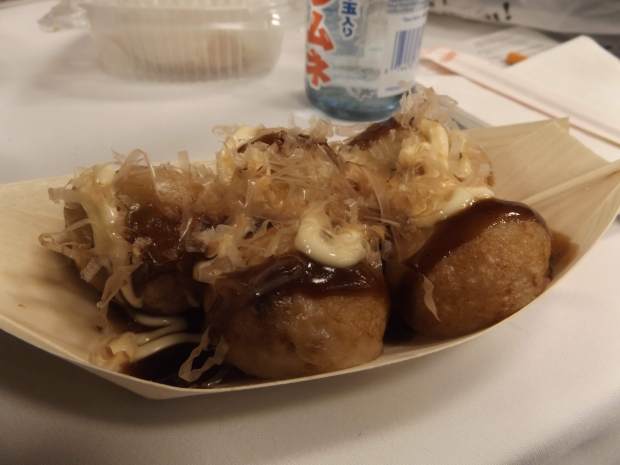
My favorite part of the whole event was of course the food and it was so packed, and the lines were so long it made me anticipate the food even more. I had gyudon, which is a rice bowl with beef; taiyaki, a red bean paste filled fish shaped treat; takoyaki, a ball filled with octopus; nikuman, which was a pork bun; and a refreshing bottle of ramune to top it off. It was such a feast and I wanted to keep going back for more, but my wallet said no. It is such an amazing event and I hope to go again next year!

Swag blog

By Alexx Thompson

Last Sunday, a few people from the class and I attended the Japanese New Years Celebration hosted by the Japan Commerce Association of Washington, DC (JCAW). There were numerous events, such as taiko performances, to countless food stalls and games. There was even a shrine to pray/wish at, and receive your omikuji (fortune slip)!

It was a very family oriented event, and there were mainly Japanese families attending. I was really overwhelmed to hear all the Japanese around me, it felt as if I’d gone to Japan almost. I could understand it mostly, but when I was waiting in line, a lady came up to me and asked me if I was waiting for the line, in Japanese of course, and I blanked out immediately and just kept stuttering. I was really embarrassed that my Japanese wasn’t as good as it was in class. I want to work harder to be able to respond more readily and engage in conversation easier. Coming to this event really helped me think about my future as a translator, and kind of scared me a little, as I thought that I wouldn’t be able to keep up, but of course I want to continue, so I’ll try my best again next year.

The one time I did use my Japanese well, or responded easily, was when I was playing karuta with Kenny, Luis, Maria, and two girls who were at the celebration. One of the girls was only six, but spoke mostly Japanese to the girl who was teaching us how to play. I wanted to get pictures for the blog, so I asked the older girl if it was okay in English and she said sure. But then the little girl asked me what I was doing, so I asked if it was okay that I take her picture in Japanese, and she said yes. I was really proud of myself for being able to respond so readily. Although afterwards she asked what the picture was of, and I didn’t understand until the older one answered for me. I think I still have to learn and work on informal questions in that case then!

Overall, from the food, to the games, I really enjoyed karuta the most, even though it was the easy version. I played it multiple times because I really liked it and I won twice! The event was really eye opening for me and really helped put a perspective on things for me, and I want to come back again next year.

Kendama


By Maria Garcia

Blick, blick, blick….Ahhhh……so close! As we stood in a circle, laughter and friendships grew… Kendama is a Japanese hand eye coordination game that can be played by all age ranges. Ken means hand and tama means ball.

While other cultures have similar versions of kendama, the Japanese kendama is more complicated. By this I mean in Mexico and other Latin countries, we have a toy that goes by Balero. Both of these would be played. The object of these games is similar and the player must put the ball on the side or inside of the handle…

On Sunday January 27, 2019 some of the students from Japanese Plus (Inu) class decided to attend the JCAW Japanese New Year Celebration in Washington, DC. Many fun activities could be found at the event and the food well… that’s another story for another time (was amazing just being honest!).

To continue, we are all gathered in a circle with the kendama toy in our hands trying to go for different tasks that can be performed. My goal was to try to get on all the levels. Each level was different, where on one side the kendama was slightly bigger, on the other side it was slightly smaller, and on the very top was this knob for the tama to land on and stay. It was fun to watch all my friends try to get to the different levels as well. But as we concentrated on our task, all that could be heard was plip-plip-ploop-plip-plip-plip-ploop… then the pace picked up and some of the plips with some of the ploops were jumping over each other.

Our attention turned to a couple of skilled people, and as we watched, the game got interesting. It was intriguing to be a beginner at something and have someone skilled to show us what can be accomplished with time and patience. Just like in class, when we were at this event the learning did not stop just because it was a new day. Rather, because it was a new day, we were exposed to a new learning environment, one in which we were vulnerable from the second we stepped in and had to get moving to understand what was truly going on. So, as the plip-plip-ploop-plip-plip-plip-ploop went on, we continued to give each other advice on how to get through each level.

I was very proud of this because it was difficult to get on the hardest level! That’s all for now. Thank you for reading and make sure to comment about what you enjoyed from my day off and in the New Year Celebration here in Washington, DC.