Katakana Study Tips

By Raven Bluford

Learning Katakana proved to be quite difficult because almost none of the symbols looked the same and those that looked the same proved difficult to distinguish. One thing that really helped me was to relate the symbol to an action in English that made the same sound or a very similar sound.

For example, for “su,” the action I had for that symbol was a person opening their mouth to eat soup and the soup had gone down the mouth. The sound sou in “soup” sounds the same as “su,” so that is how I remembered it. I remembered another symbol in relation to this concept for the symbol for “nu.” The action I had for “nu” was someone with their mouth open eating a noodle and the noodle was on its way down the mouth. The sound noo in “noodle” sounds the same as “nu” and that is how I remembered this symbol.

Onigiri

By Jenny Jimenez

On November 30th, our Japanese class went to Youth For Understanding’s headquarters to participate in the World Food Day Campaign by Table for Two! Youth For Understanding is an international organization that sends students in exchange programs all over the world and they allowed our Japanese + class to make onigiri in their kitchen!

Onigiri is the Japanese word for rice ball and we learned that our class would participate in creating these rice balls and that if we posted an image of our onigiri creations on social media with the hashtag #OnigiriAction, food would be provided to other people in African countries with our support. Onigiri was chosen because, as research shows, Japanese food is healthy and rice is a product that fills you up when you eat it. We learned about how to form the rice ball as well as the toppings that can go on the onigiri. The most popular topping was nori or seaweed; personally I liked eating my onigiri with tuna! Our teacher also mentioned that a popular topping in Japan was pickled plums. A couple students, including myself, tried eating the pickled plums, only to find that they were really sour, yet they had honey in them!

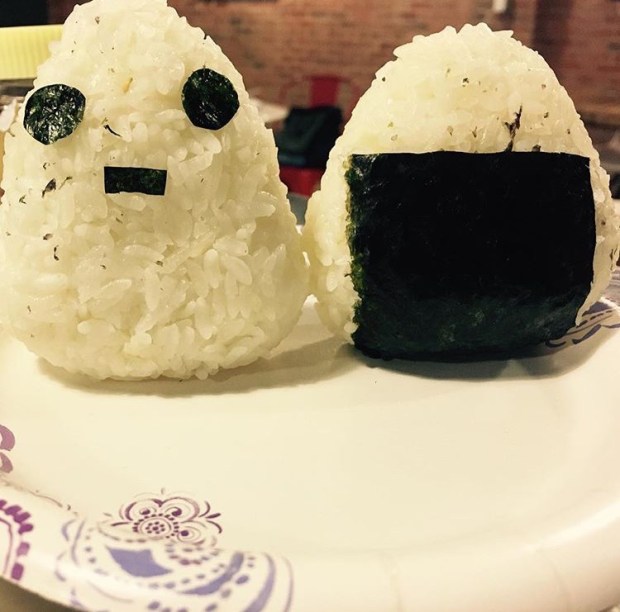
Some of the more creative students made onigiri with designs like cats, pandas and other animals or characters. Two students, Skyy and Amee, won the “Most Creative Onigiri Award” with onigiri that looked like the character Pucca and also a crying man!

A lot of students loved our onigiri making day because we were able to express our creativity as well as learning about Japanese food!

Below are images of our winners Skyy and Amee with their onigiri as well as my own onigiri! Congratulations to them for winning the award!!

onigiri-amee-skyy

onigiri-jenny

Our First Open House!

By Charity Chukwu

After the first few weeks of studying katakana, practicing our conversational skills, and learning about Japanese culture, we felt that it was about time to show off what we had gained to the public in our first Japanese Plus open house, and what better way to show what we’ve been learning than through acting!

About two weeks prior to the showcase, the class split up into groups, each writing their own skit that they would perform. At least half of the dialogue had to use Japanese vocabulary from class and the script had to be memorized. Plot for each script varied from a family dinner to a bank robbery, but all were very entertaining. You could tell a lot of time was put into making the event the best possible.

We invited friends and family to ask questions and comment about the program. Our audience was very impressed and applauded as we bowed at the end of our presentations. Personally, I think the whole thing was a success, and with all of the things we’ve learned in the few months since then, I really want to do more in the future.