Women in the Japanese Workplace

By Bryson Torgovitsky

Given the current scandals surrounding women’s treatment in the American workplace, I was refreshed to hear that Shinzō Abe had plans to institute a greater number of women in Japanese jobs. Unfortunately, such a transition could never be instantaneous, and there has yet to be major headway. Although some women, like Yukiko Koyama, are finding work in traditionally male environments (she works as a lumberjack in Nagano prefecture), women still face challenges, especially when motherhood begins. Yuko Ogata, who is a member of the Kumamoto City Assembly in Kumamoto prefecture, was removed from a meeting after bringing her infant son on the grounds that “guests” were not permitted entry. The interesting part of this story is that Ogata-san’s son was nondisruptive to the meeting. I do support Shinzō Abe’s idea of women becoming a greater part of the Japanese workforce, but nothing is so simple that it can be accomplished by words alone. Individuals must adjust their (potentially long-held) views so progress can be made.

https://www.npr.org/sections/parallels/2014/12/03/368143686/is-womenomics-the-answer-to-japans-economic-woes

https://www.npr.org/sections/parallels/2017/11/24/566367004/japanese-lawmakers-baby-gets-booted-from-the-floor

Trump in Japan

By Skyy Genies

For many people in America today, President Trump’s foreign endeavors are a very sensitive and for some, infuriating topic to discuss. Of course, I am one of those people, and today when I read an article titled “Trump Tells Japan It Can Protect Itself by Buying U.S. Arms” from the New York Times, I was in utter disbelief. The article discussed President Trump’s recent visit to Japan; his opinions about the imbalance of trade, his attempts to persuade Japan to purchase U.S. arms, and in my opinion, the worst of all, his racist and ignorant remarks about Japanese society. Trump referred to the people of Japan as “samurai warriors” and painted them as weak for not retaliating against North Korea for their missile projects. Reading this article brought to my attention the fact that It is a common trend among many youth in this country to hate our President, even if for many, it is just a matter of riding the wave. Besides learning new facts about U.S. and Japan relations or Trump’s methods in foreign policy,

I learned a very valuable lesson from this experience. If one doesn’t know much about politics (or any topic), like me in some ways, taking the time to actually do a little research and read about the different perspectives of a phenomenon can help you back up your opinions with actual evidence and even help you become a more well-rounded and in a way open-minded person.

Emperor Akihito’s Abdication

By Charity Chukwu

During one of J-Plus’ Saturday classes (Dec.2), we read an article from BBC about the announcement of the official abdication date of Japan’s current emperor, Emperor Akihito. It was decided that he would step down next year on April 30 and that his son, Crown Prince Naruhito, would inherit the throne the following day. While rereading the article a few days after class, I flipped to the last page and noticed a sentence that I had not seen before: “It is a one-off piece of legislation, and does not allow Naruhito or his successors to abdicate.”

Reading this felt like finding the fine print within a document. “Why wouldn’t the same right be given to his successors?” I thought and have been thinking about this ever since then. Perhaps it is because it has been centuries since an emperor has abdicated and the Japanese government does not want it to become a habit. Why not, though? From the information I have read from various news sites, Emperor Akihito does not seem particularly eager to relinquish the throne; he almost seems reluctant. In a national address he gave last year, he expressed his concern for the effect his declining health may have on his responsibilities. Who’s to say that future emperors (or maybe empresses *quadruple fingers crossed*) will not feel the same way? During the same speech, Emperor Akihito even said that he did not want to fill his family and Japan as a whole with strife in the case that he dies while still on the throne. Shouldn’t that kind of selfless thought be encouraged? I doubt they would give up the throne over anything that does not mean a lot to them, so I think abdication at a certain age, maybe around 80 years old, should become a regular occurrence, but I still need more information. So far, I haven’t found any other arguments that oppose my own or relating to this particular condition in the legislation, but I will continue my search.

Do you think that abdication should just happen this once, or be available, or even mandatory, for future successors? Feel free to leave a comment explaining why!

http://www.bbc.com/news/world-asia-42191096
US and Japan gun laws

By Raven Bluford

About two weeks ago, we read articles that discussed the relationship between the United States and Japan in relation to President Trump. The article that I really enjoyed reading the most was the article about the shooting in Texas and how the number shot was much bigger than the amount of shootings that occurred in Japan within the past five years. The article really went into detail about the difference between the United States and Japan’s gun laws. It even went as far as to criticize American gun laws by making the assertion that getting a gun in America is as easy as getting chopsticks in Japan. Although the author of the article heavily critiques the United States, it doesn’t take away the fact that it makes a great point about the U.S. needing to look at the way that Japan does its laws and why their way is successful. I hope in the future our government reconsiders our current gun laws to hopefully prevent another tragic mass murder.

https://www.thedailybeast.com/texas-church-shooter-killed-more-than-japans-total-gun-homicides-for-5-years

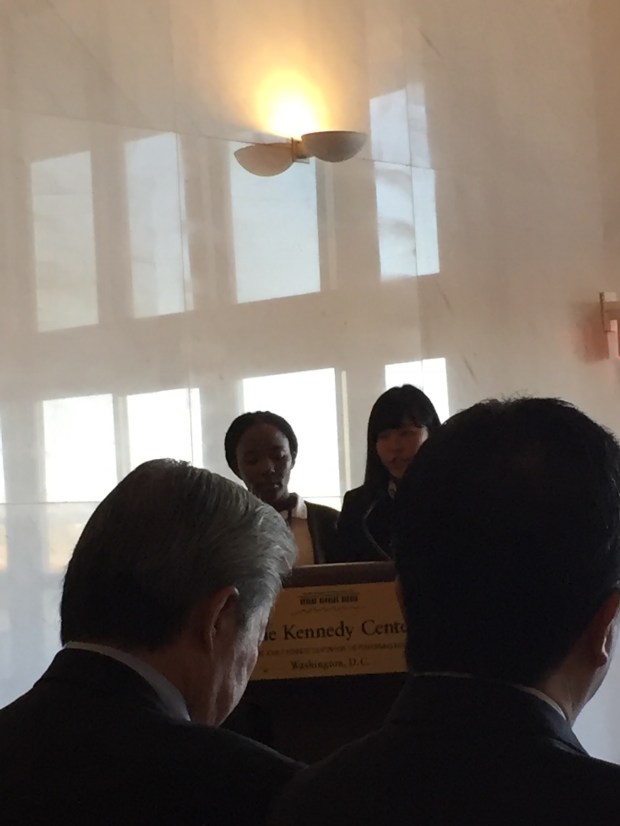
Bryson’s Photo: Hope for the Future through Students

I took this photo of Chidera Obiwuma and Ui Onomi during the Blue Star of Life event at the Kennedy Center on October 31st. They were the MCs of the presentation, and worked together fantastically.

To me, this photo represents hope for the United States and Japan. Here, we see two students of these two nations – who had never met previously – working towards stronger bonds between their home countries. Each of them used the knowledge that they gained from their studies at school so they could cooperate effectively. As an attendee of the Blue Star of Life event, I could clearly see how their compiled energy and understanding of each other contributed to the success of the program.

As an American student who is studying Japanese, Chidera and Ui’s cooperation embodies my hope for Japan and the United States. I want to see the bonds between these two countries grow as I age, and I would love to contribute to that increase. I worked behind the scenes for this program, planning the activities with a Japanese university student named Matsuki Koh, and it was excellent practice for the future I plan to have with Japanese environmentalists. Every student shone at the Blue Star of Life, and I look forward to future opportunities for collaboration with Japanese citizens, be it through Globalize D.C. or opportunities later in life.

Bryson Torgovitsky

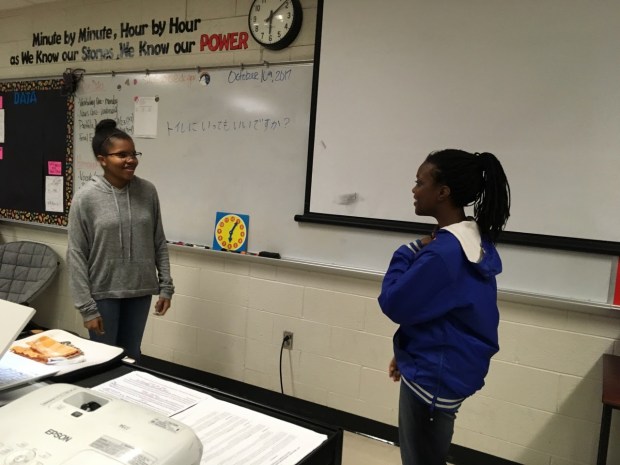
Rakiya’s Photo

In this picture, Skyy Genies and Chidera Onyeka are presenting a short skit. The short skit focuses on invitations, as well as the months and days in Japanese. This photo symbolizes our hard work as Japanese students who dedicate our time and efforts into learning and making progress through this program. Although performing skits is not my favorite thing to do, I continue to be appreciative because they aid me to become better with speaking Japanese.

Rakiya Washington

Raven’s Photo

Cha Cha Slide

This picture shows our Japanese Plus group teaching a popular American line dance to a group of Japanese exchange students that were with the Kakehashi program. My favorite part of the Japanese Plus Program is that we are able to utilize the Japanese learned in class with native speakers that are closer to our age. But more than that, our work with the Kakehashi program has raised our cultural awareness and understanding of Japan.

Raven Bluford

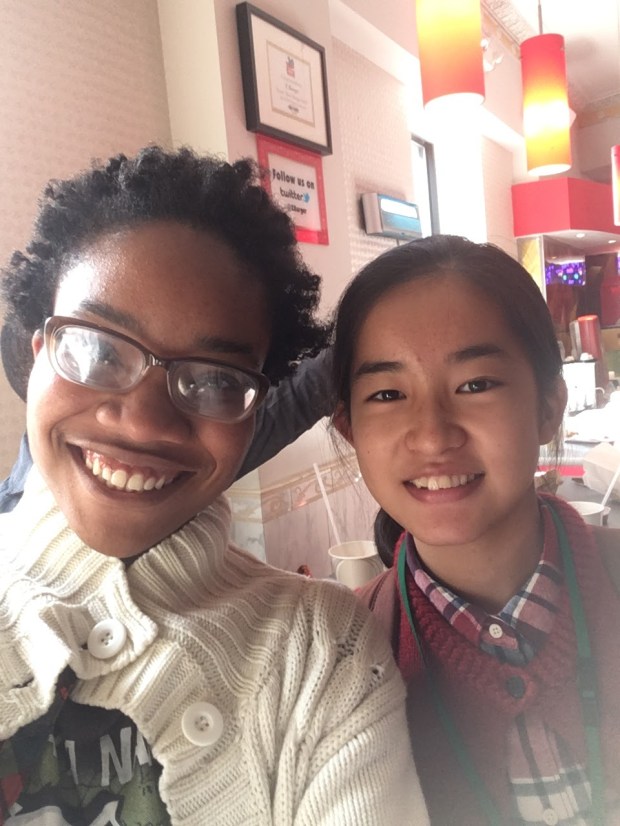
Charity’s Photo

This is a photo of Shiori – one of the visiting students from Okinawa – and me at the end of the Kakehashi visit on Nov. 4. We were both pretty nervous at first, but we bonded through our interests and ended up having a lot of fun while learning about each other’s home country. I chose this photo because it shows the connections we create at Japanese Plus by enjoying the similarities and appreciating the differences. I look forward to getting to know more people in the future.

Charity Chukwu

Chi’s Photo

In this image, the class is singing “Otanjobi Omedeto” which means “Happy Birthday” to Bryson, whose birthday was on the first day of Japanese Plus year 2. This image displays our unity and love for each other. Togetherness is a prevalent aspect of Japanese Plus that I value.

Chi Onyeka

Skyy’s Photo

This picture perfectly depicts the intimate and fun environment in which we learn new things about Japan from culture to language, and exchange ideas about current events facing our own country and Japan. Japanese language can be hard sometimes, but with the diversity of our skills and knowledge, we help and support each other to get past our obstacles.

Skyy Genies