Chinese and Japanese

By Jonah Nguyen-Conyers

For as long as I can remember, learning Chinese has been a great love of mine. My involvement with Mandarin and Chinese culture has afforded me opportunities to explore more of the world. My Mandarin Chinese language journey helped me discover the enjoyment of learning a foreign language and the appreciation of the benefits of being able to converse in a language shared by 1.3 billion people. When I was first introduced to Chinese in the 1st grade, it was extremely difficult in the early years. Despite the initial hardship of learning such a complicated language, I was motivated to continue my studies out of a sincere desire to connect with people from the other side of the world in their own language!

The years devoted to learning Chinese really helped me find my love for languages and cultures, and would ultimately lead me to embrace the Japanese language and culture. As I have grown up with the skills to learn difficult languages, I find that my Japanese class has been easier than my Chinese classes. Each and every time I go to Japanese class, I am excited and ready to learn, knowing that I am building the language skills needed to connect to a whole nation of people who speak Japanese.

Although Japanese and Chinese are completely unique languages, there are some important similarities between the two that make studying a completely new language like Japanese a lot more manageable. Both languages rely on the memorizations of many characters, a skill that I have developed from my background in Chinese. The use of Kanji characters or Chinese characters would give me a head start, and provide me the opportunity to bridge my previous language knowledge with a new language that I embrace with eagerness. What I’ve learned about these Kanji characters are that they are written the same and have the same meaning most of the time, however are spoken differently to fit alongside the other alphabet pronunciation. I was intimidated with the nearly hundred characters that I would have to remember. It seemed intimidating as I knew that English only has twenty-six letters and, therefore, estimated it would be four times harder than English. Chinese gave me the ability to memorize characters and that skill really helped me in more ways than I had not anticipated.

My Japanese Plus class is taught in a different manner than what I am used to. The classroom environment seems more friendly and less pressure-filled than my Chinese classes. At Yu Ying and DCI, the Chinese language is taught in an immersion model where they exclusively speak only Chinese. Because my Japanese class is not conducted in an immersion model, my Japanese class environment is allowing the students to learn in a more stress-free manner as the teacher makes sure that studies are not so intensive and uses both English and Japanese in classroom instruction. Learning Japanese this way makes it more accessible and allows the students to build up their foundational language basics so that we can progress together as a class.
Honne and Tatemae

By Kenny Nguyen

Honne and tatemae are Japanese behavior. Honne is the true feelings you have and wish to express but tatemae is the obligation to withhold your opinion in order to seem respectful. An example of this is in a Japanese work place, when you are at work you would want to be as respectful as possible and withhold any negative comments about a co-worker or boss. This is tatemae, when you do have a problem, but can’t express it since you are trying to hold social obligations. A way that the Japanese would then express their true opinions is whenever there is a nomikai (party), and coworkers would go to an izakaya (Japanese traditional bar). These occasions are where you are able to let loose and talk about all the troubles you’ve had at work or at home, honne. This is also because of the beer and drinking, which lets them let loose.

I find the honne and tatemae concept very different from American society. In America we can say and express whatever we want and not care about what others think, or how they would feel. Whereas the Japanese are withholding their true feelings in order to maintain social obligations. At an American workplace or school, we would complain if there is anything that upsets us. For example, at my school, whenever there is a project and someone isn’t really doing work, we would complain and criticize him or her, while the Japanese would have concealed this truth and would have just tried encouraging them to pick up the pace of their work.

Before joining this program, I never thought that such a concept would exist. I always thought that people would just express whatever they want in order to have people understand them. But now I know just how different America can be from not only Japan but from other countries as well. I look forward to learning more about the different aspects of the Japanese culture and just how different we are compared to them. Jyaa nee!

Shanti

By Arjernae Miller

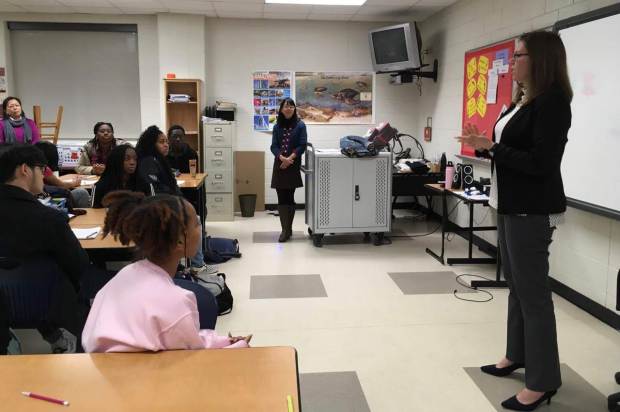
On Wednesday night, November 28, I had the pleasure of being able to sit and listen to Ms. Shanti Shoji who talked about her connections with Japanese culture and the Japan Information and Culture Center (Embassy of Japan). She mentioned that she grew up around a lot of Japanese culture in Portland, Oregon; it felt like Japan was next door. She spoke really good Japanese, even after saying she was “rusty” at it. I wish there were more Japanese culture throughout DC, like it was where she grew up. Even with all of the valuable information she gave us revolving around her connections and programs, there were a few tips that I felt spoke to the class as a whole most.

“Follow your heart and keep knocking on doors” to me means I have a chance to accomplish opportunities that come my way. Always find chances and never give up, especially when you knew from the start that you could do what you put your mind to.

Another useful phrase that Ms. Shanti said in her speech was to “take risk.” Which in other terms means to jump at any and all things coming your way. Not to be afraid of doing things you really want and know you can do.

It’s amazing what words can do and how people don’t realize how words can impact a person’s life. Her words are quotes that I feel can change someone’s day in just a few seconds. I was glad that she left her information for us to contact her for opportunities in DC related to Japan. That way we can celebrate the culture more than we do now.

Skit Preparation

By Theo Greiff

On December 12th, our class will be holding an open house to display the Japanese we’ve learned in the last month. During this open house, each group will perform a skit in which they must demonstrate all the Japanese they have been taught. Preparations have, of course, already begun.

As of now, my group and I have started on our script, been given feedback, applied said feedback, and are beginning memorization. The process has been amusing to me as, though we have learned a good amount, most of what we know is phrases which limits what we can do. To fix this, small amounts of English are allowed and Eshita-sensei has offered to provide us certain words. Overall, being someone with some experience in other languages, I am pleasantly surprised at how quickly the class has moved on to such a large assignment and am eager to see how it turns out.


Learning how to walk in Japanese

By Chetachukwu Obiwuma

This past class, we met a wonderful woman named Shanti Shoji. Shanti was there to talk to us about her non-profit, Kizuna Across Cultures, which she co-founded based on her interest in Japanese in her younger years. Kizuna Across Cultures is a program that connects Japanese classes with American classes in order to facilitate cross cultural interactions and support language learning. The program lasts for six months and the bridges built create more ingenuity on understanding Japanese language. For more on the organization, please refer to this URL: https://kacultures.org/.

I was not really interested starting out, but as Shanti gave us background of how she got into the organization, I was astounded. There were so many references to Japanese resources which still exist today, that we can use in our pursuits within the Japanese language. She mentioned the JET program, which is an exchange program where English speakers can teach English in Japanese schools for a year; the JICC, the cultural center for the Japanese Embassy in the U.S.; and her gap year in college to intern with another Japanese organization. The instances she gave us to show her journey in the Japanese language showed us the level to aspire for in our own individual pursuits of mastery in Japanese.

Meeting with Shanti is something that I feel like was very important for people studying Japanese, because it gives something to look forward to. All the opportunities that came for Shanti that were associated with her abilities in the Japanese language give hope to some people who don’t feel that pursuing language studies is solid enough for a career. Even if it has nothing to do with language careers, Shanti stands to serve as a way of telling people to become more serious about things like your communal environment.

Shanti talked about growing up in a community that had a significant Japanese population and how it became entrenched in her before she even started studying Japanese. She sets a precedent about language studies that more students need to be aware of. How can your studies serve as a potential bridge in the community? This does not require that you be the pillar of engagement in your community but that as an individual, you become more aware of the impact you can have in community. Become a more uniting force through the Japanese language. Take what you have learned out into the world and link more people together in order to promote unifying diversity. Let our differences make us allies and not enemies. Join with your two hands and fortify it so that it never breaks apart. Be like Shanti and learn to be an impactful individual through cultural immersion studies, such as the Japanese Plus program.

Finding the right way with katakana

By Angel Njoku

There are people who are able to understand a language easier than others, while others need to put in the extra work to be able to understand it. I think that I’m in the middle, because I can understand it but it’s harder to memorize. In the beginning, katakana was very hard for me, because I didn’t really have a good study system. It was hard to keep track with katakana since we were moving quickly with it. I personally felt that in the beginning, I was stronger in speaking, like saying my introduction and family members, instead of learning katakana. I tried using the traditional flashcard method to study, but it really didn’t help me, because I would put the cards back in the order of the way that we learned them.

I used the websites that Maria gave me, which actually helped me a lot. I feel like those websites helped me out a lot because you were able to customize what you need to work on and it gives it to you in random order, so it wouldn’t be in the original order. I feel like the best way to find your learning skills is to use the process of elimination, which means try different study techniques until you find one that you believe is suitable for you. Once I used the websites, I felt more confident in katakana, especially with the ones that I know that I didn’t properly study at all. The websites that I used will be linked below, and I encourage anyone to use these websites, especially if you like the Japanese language.

https://www.tanoshiijapanese.com/practice/

https://www.sporcle.com/games/bazmerelda/katakana

https://www.sporcle.com/games/CommodoreAmazing/Katakana

Man-Woman Relations in Japan

By Elena Encarnacion

In class, we like to learn about the culture as much as the language. We often turn to A Geek in Japan by Héctor García for cultural comparisons. A section that I really enjoyed reading about is called “Man-Woman Relations in Japan.”

I was not surprised when reading the part that talked about the past and the different family roles that men and women had. However, I was a little surprised when reading about “omiai” marriages. An omiai marriage is an arranged marriage. Although people are no longer forced to marry others, people’s parents often get involved when a person is looking for someone to marry. I found this quite strange since in the States, parents don’t normally set their children up with the purpose of marriage. Parents normally have less involvement in who their in-laws are.

I was also surprised by the “Men-Women Separation” part. Apparently, Japanese people tend to separate by gender in the workplace. For example, the women will go out for lunch together, and the men will go out for lunch together separately. This was interesting to me because it’s not something that I’ve heard of here in the U.S. People just tend to spend time with whoever they want, despite gender.

Reading about the Man-Woman Relations in Japan was really enlightening. I hope to continue learning about the interesting ways that our cultures differ.

Group Scoring Grid

By Cyrus Johnson

To be honest, when I was told I was enrolling in a “challenging Japanese class,” I somehow didn’t expect a grade. So I enrolled thinking it wouldn’t be anything too serious. Then, after I was accepted into the class, we were told that we were expected to write blogs. This, believe it or not, worried me greatly. I never liked talking about myself or my experiences, or even writing essays. I kinda figured I’d lay low and see what I could pick up after a while. It worked, somewhat, until we were given the Group Scoring Grid.

On the Group Scoring Grid, it shows us our minimum and maximum for an aspect of the class, such as attendance, homework, our katakana, and, of course, how many blogs we write. According to the Grid, we are each supposed to have done at least two blog posts by December 12th. I, attempting to avoid my least favorite part, have done none at that point. The Grid also says that we could get extra credit by writing more than two, but I won’t bother writing a third. I already have enough homework from school!

Samurai Cooking! . . . Makes Me Hungry

By Alexx Thompson

On November 11th J-LIVE was held at George Washington University, and my classmates and I went to go see it. I stayed the entire time and the competition was really interesting. It’s a Japanese speaking presentation contest between college students. I studied outside of our class, but even still I couldn’t understand a lot of what was said. I only really understood the general idea of it. But nonetheless, I was still really interested and I hope to one day be able to speak as well as the contestants.

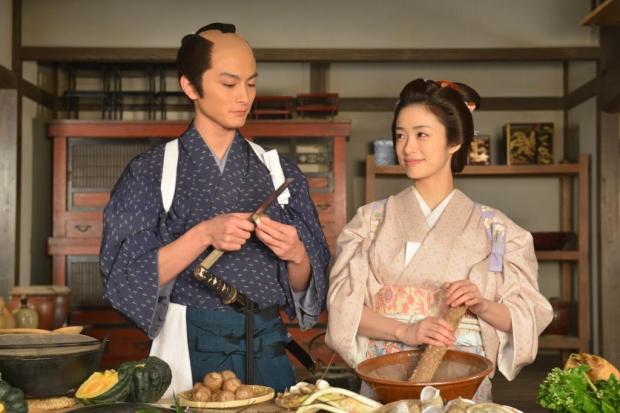
After the competition ended and the results were announced, they had a small movie showing. The movie was called A Tale of Samurai Cooking: A True Love Story. It was a really interesting movie mainly revolving around the story of a samurai (Yasunobu) who was the son of a kitchen samurai (similar to what we’d call a cook or a chef), and his wife. His wife, Haru, was a really good cook and she was asked to marry him so he can become a better cook.

I was really interested, because the movie displayed the  gender roles in that era of Japan. Haru was considered undesirable, because she’d been married before and divorced and I found that interesting. I also found the succession of family roles intriguing, because in the movie Yasunobu has to succeed his father as kitchen samurai. Not a major spoiler but another character, Sayo, is the daughter of a dojo owner. But unlike Haru, whoever marries her will succeed her father, since she’s the only daughter and therefore she doesn’t have to move into her husband’s house.

Overall I found the movie really interesting and I even showed it to my family over Thanksgiving break. I really liked Haru’s character and how Yasunobu changed over the course of the movie. It really showed how much Japan values food and cooking. And how much they pay attention to detail when preparing the food. If you have the chance, please watch A Tale of Samurai Cooking: A True Love Story.

J-Live

By Jonah Nguyen-Conyers

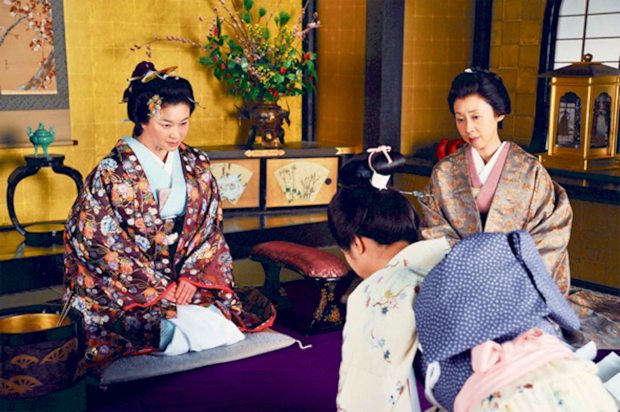
George Washington University held the annual J-Live event which other Japanese Plus classmates and I attended. J-Live is a Japanese language competition for college students, where contestants would make their own presentation on a topic of choice and then share it to an audience all in Japanese. There are also categories for contestants as not all are at the same Japanese proficiency level. This event allowed me to talk and listen to so many people in Japanese and in English, allowing me to be more aware of what opportunities lie ahead if I keep on learning Japanese. Even though there were only a very few things I could understand with the one and a half months of Japanese under my belt, I still had a blast!

This event ingrained hope into the language that I already loved and set more goals that I wish to reach. I have never attended an event like this before, and it was really an eye-opening experience being able to see the connections being made and the fruits of those who are studying Japanese for a while. J-Live allowed me to see a new barrier broken with the wide range of backgrounds and ethnicities present at this event, and really allowed me to know what Japanese can do to connect people and be the bridge to create a more united world.