Interns in DC from Japan with Maki Sofia Tello and Yodai Tanaka

By Angel Njoku

Today, we had two Japanese guests in our very small class for the day. Our guests were Maki Sofia Tello and Yodai Tanaka, who are currently participating in an exchange program called Japan Internship for the Development of Young Leaders. They are both undergraduate seniors at their universities in Japan. Maki goes to a private university and she is from Kamakura, Yodai goes to a public university – Hokkaido University. Maki’s major in university is mass communications and Yodai’s major is law. Maki is a public relations student intern at the US Department of Agriculture. Yodai is an intern at Sojitz Corporation of America. After getting to know a little bit about them, we were able to ask them questions.

Their opinions about the difference between US universities and Japanese universities were very fascinating to me. Between my classmates and I, we already know that the tuition in Japan isn’t as high as it is here in the US. They told us that in Japan, the hardest part is taking the entrance exam, because students study for a year or more just because of the test. Yodai told us that he spent his summer studying for his entrance exam from 5am-8pm every day and he started studying in his junior/senior year of high school. We even learned from them that after students get into college, some of them just go to a lot of parties. Something surprising to me was when they said that in Japanese colleges, they don’t take attendance and students only need to pass the final exam to graduate. They know that tuition for American schools is already very high, but they told us some big differences, like how teachers try to interact with their students here while in Japan most teachers won’t do that. They also said that from what they know, US colleges take attendance and students have work that they turn in when given deadlines like reports and essays. With all of the work that US students do, it’s harder for them to graduate, because there is so much more than just a final exam that says if you pass or fail.

Maki also told us that she was half Japanese and half Peruvian and we were able to know how it is different, especially since Japan is a homogenous society. She told us that now it is more accepted, but it wasn’t like that when she was younger. The good thing is that she was never bullied because of it, but since her full name is Maki Sofia Tello, when she was younger her teachers didn’t really say it properly, so you can see the cultural difference there. But she took being half Japanese as an advantage. Something that surprised us all was when she said that her dad never taught her Spanish, because he wanted her to be Japanese. Just knowing this it shows that Japan is slowly changing and accepting more things.

Overall, we had a lot of fun with Yodai and Maki, and it would be great to have them come visit us again. They even participated in our walk and talk speaking exercise, since today was the introduction into our new lesson on lifestyle. So we asked around saying “what do you usually do on the weekend” in Japanese. Some of us were able to talk to them during the activity. I wasn’t one of them but it was really fun having them join us.

Why you should consider ICU

By Chetachukwu Obiwuma

Today, a Japanese university visited us. Now, this didn’t really pique my interest as I had already shot down the idea of going to a college in any other country besides the United States. However, the International Christian University (ICU) made a really powerful presentation to me that sparked my interest in what is outside colleges in the US.

First, the tuition! America’s tuition rates are enough to make anyone cry, but ICU blew me away. When they announced that they were a private university, I expected ~$40,000. I first saw the value in yen and shook with horror until they converted it to US dollars. Tuition is about 12,900! That’s less than half the tuition of most of the colleges that I want to go to. There obviously are other fees like living costs and a matriculation fee, but financial aid is offered to curb tuition fees so that you can pay these other fees.

Then came the student activities. One thing I am very passionate about is being your own advocate. I love when students are given the opportunity to show their responsibility and that is exactly when ICU does. All of their clubs were completely established by students and they offer a wide range of clubs from athletics to things like Large Jazz Ensemble. I saw that they didn’t have a volleyball club and I do hope that someone in the future starts one. But the idea of having student led clubs allows for people to interact more as you don’t have to be good to get in, you only have to be interested.

Finally, when they talked about what happens after students graduate, I was in awe. Employment in Japan is pretty much guaranteed as the government has established a well organized system that works with companies to help students find jobs after college. In America, many people don’t know what to do after college and are left to fend for themselves. This system of aid ensured that about 75% of the graduating class in 2017 were already employed as they left college. This system makes you very hopeful as you have to worry less about if you will have any future successes in finding a job as they allow you to find something that correlates with your degree.

These three things stood out to me very much, but there were also small things like universal healthcare that is offered to international students and the diverse religious denominations that ensure that the ‘Christian’ in ICU does not dictate the school’s stance on what your practicing religion should be. It showed me that there are better options outside American schooling that should be looked into.

For the organization that spoke to us, the Japan ICU Foundation, they can be found at www.jicuf.org. They offer a scholarship that offers full tuition to ICU and I hope that more people are inclined to sign up. As for me, it is not an option for personal reasons, but I still would love to know that other people will be educated about this opportunity after reading this blog.

My wabi sabi life

By Maria Garcia

Hmph…… sitting in class I questioned how is wabi sabi in my life. I have addressed wabi sabi before, but times have changed. I guess the solution just comes and goes as one grows up. Wabi sabi as previously mentioned is when one values the imperfections in an object. But for this, I am the object. So, basically this blog is about my wabi sabi life.

Sigh….Times do change and people grow. Today (March 2) may not have been one of the best days for me growing older. But it is one that I won’t forget. This is because it did not start like my typical Saturday, where I wake up around 6am and get ready for Japanese Plus class to learn new words or facts, and then head over to something called the lab. Side note: the lab is a place for my team, 1915 McKinley Firebirds, to work on our robot.

Either way, today I was struggling from the very beginning. You see I woke up at 7am (an hour late) and went to class. Fortunately, I was a couple minutes early but had to hurry to get myself ready for class. In class we went over language and did something called speed dating. This is a fun activity to get us moving and thinking (I actually really enjoy it). Then we did a mini test and were allowed to leave. Today my group had to record ourselves going to McDonald’s and well, this was not in my typical Saturday schedule, but it was fun. When we finished, we said goodbye to one another and did our own thing.

This is where calling it a day should have been my next step since it was already a lot for me. But I had promised my mentor to help finish the robot. And so I went to the lab, and on my way I found an old friend. I enter the lab and immediately ask, “what can I help with/what needs to be done?” the way I always do. The task I was given was simple enough to get done and leave like on any other day. But I have been under so much stress lately that I was not thinking straight. One minute I’m fine and trying to make the last inch block I needed to build a plate. And the next minute…. well I’m running to the sink calling out to one of three mentors. Turns out in the midst of not having a clear mind and moving too quickly, in short terms, I hurt myself. It’s not the first time I hurt myself and it won’t be the last time either.

Growing up was never easy but I managed to grow up and learn from my mistakes.

Competitive Karuta

By Theo Greiff

Karuta is a kind of Japanese memory/reaction game in which there are two sides, with each side having a certain number of cards in front of them. On each of these cards is the second half of a poem and your job is to slap the card that corresponds with whatever poem a designated reciter is saying. The reciter says the poem in full so if you know the first part of the poem, you can slap the card with the second part before the reciter even says it. This means that while karuta can be a fun reactionary game for children or someone like me who doesn’t know the poems and can only respond to the second part, it changes into a memory game for people who put in the time and effort to learn all 100 poems in a full karuta deck.

Of course, people do put in that time and effort and the result is the wonderful world of Competitive Karuta. Competitive karuta is highly ordered and, like other competitive games originating in Japan, ranks individuals by dan to determine opponents. In karuta, for example, individual matches can range from classes A-E with E being for beginners and A being for only those who have achieved 4-Dan or above. As someone who has played the most amateur of karuta and watched it at the highest level, the most striking difference is speed. It seems obvious that higher level players would be faster than those at lower levels, but to succeed in karuta it isn’t enough to simply memorize the poems, or even to memorize their positions on the playing field, as your opponent has most likely done so as well. To succeed in karuta, players must move with the utmost speed, throwing away restraint. As a result, while in my amateur games we would tap our cards so as to avoid a mess, in competitive karuta, players violently slap cards away, leaving the playing field crooked and requiring reorganizing and thus physical endurance becomes just as necessary as memorization.

All in all, competitive karuta, despite the simplicity of the game, is surprisingly intense and overall rather fun to watch. Indeed karuta itself, though admittedly difficult to get your hands on in the US, is rather fun to play at both an amateur level and a more advanced one (or so I’d assume as I have not taken the time to practice karuta that much), while also being a good study tool for the Japanese language system hiragana, which the poems are written in.

Karuta Game Vibes

On Sunday, March 3, Japanese Plus students participated in the Washington DC Inishie Karuta Club’s annual Karuta Competition. Our students competed in the Genpei-sen (team match) – Japanese Learners Division (for non-Japanese and children in 2nd grade or younger). Special thanks to Mutsumi Stone for the special invitation!

By Maria Garcia

Karuta! All week I have been listening to my mentors try and recruit more players. We had a total of about six kids who volunteered to go out and play. But as of yesterday’s class that number dropped to four kids. Our team names were given to us and I was on team Japanese Plus! So in the end, Jonah, Theo, Kenny, and I went to the karuta event. Ms. Sally came along to help us get registered. Oh, and before we were given our table number, we were allowed to get a gift. I got the okonomiyaki souvenir! It reminded me of when my host mother in Gifu, Japan made it for me the night I was allowed to stay with her.

My team was made up of Kenny and myself, while the other team was named Puni Puni which was composed of Jonah and Theo. As I said before, I knew little to nothing about karuta, since the only thing I knew was the hiragana I had been learning in class. Kenny and I started the game as instructed and the little confidence I had grew. First, we had to mix the cards and collect seventeen cards to put into our section. When the first couple of letters were called, I looked for them and put my fingers over it. The young lady who was at our station said I was right and I was so happy. But then as the game progressed, finding the cards became more difficult. This is because we didn’t have a set order for our cards. The reader kept calling the letters and we couldn’t find the letters in time. When it was over… let’s just say we lost by a lot to like six year olds!

Then, we moved on to our next round. Kenny suggested that we should put the cards in order from the first upper left letter they had. Which was smart because we had to start reading the cards from the upper left hand corner. We also told ourselves that we weren’t going to lose again or at least not by all the cards. By putting our cards in order we were able to play and quickly read the cards. This time we were also able to play until the end, which got really challenging since the less cards on the table means that you have to move more quickly.

Oh! Yeah it’s a nice time to mention that I could only play with one hand due to an injury in the other. Things really got intense when Japanese Plus had to go up against Puni Puni. Our mini battle was well worth it, and even though Japanese Plus lost this (by one card), it was well worth a Sunday.

(The kid in the background is the way I felt after a long and exciting day).

ISO “Japan in DC” Co-Teachers for 2019 Program

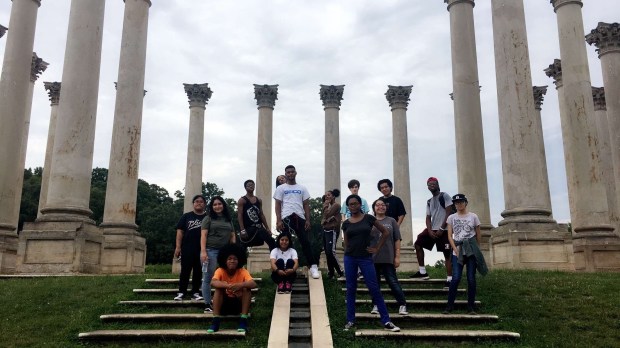
Arboretum columns

Globalize DC is now recruiting staff for our summer 2019 “Japan in DC” Program.

Introduced in 2017, “Japan in DC” gives interested DC public high school students the opportunity to explore and document the presence of Japan in their own city – through its individuals, institutions, and landmarks. This fun and educational four-week program is scheduled to run Monday-Friday, July 1- 26, 2019, 9 am – 3 pm.

We are now seeking two qualified and energetic teachers or international educators to lead this summer program. Graduate students, with appropriate experience and interests, are encouraged to apply. These are paid, part-time positions. We hope to select these individuals by early April.

Click here for more details and information on how to apply: 2019-Japan-in-DC-Teacher-Recruitment

Any questions? Contact sally@globalizedc.org.


Japanese Food Unit

By Jazmin Angel-Guzman

In our Japanese Plus 1-Inu class, we are wrapping up unit two – food! My group and I are the usagi group. The members of my group are Alexx, Kenny, and Angel. Our final task for the food unit is to make a video with our group of what we usually eat, or foods pertaining to specifically DC, and even American food. We decided to show breakfast, lunch, and dinner in the video to show the foods we eat at different times of day.

As for breakfast we went to IHOP, and we had our scripts with us. In addition, one member of my group and I had to share pancakes. It took several cuts to make the “cut,” because we wanted to get good scenes, so that it’ll show up in our video. For lunch we made spaghetti tacos. As for this idea, when we were thinking about lunch ideas, I remember mentioning spaghetti tacos from Icarly, a TV show on Nickelodeon, and boom, next thing you know we were going to make spaghetti tacos, at one of our member’s house. As for dinner we went to Boli’s Pizza to get a jumbo slice pizza after class on a Wednesday.

Initially, I was reluctant to even do this video project, because I’m not really good in videos, and because we had to speak in Japanese. Having a camera in front of me is not a beautiful picture. But seeing my group members with me, they encouraged me. For example, the video we have now wouldn’t have happened if it wasn’t for the amount of retakes we took. I consider myself playing a role in messing up, but simultaneously I was having fun.

One of the successful things that happened in the making of this video was that we finished earlier than the due date because we thought we only had like three days to do it. So we kind of did it consistently without many gaps in the process making.

One of the things this video project has taught me is that group work is important and that by working together you can produce something amazing that can blow your mind like it did mine.

Amezaiku Candies

By Katie Nguyen

Amezaiku is a Japanese candy craft artistry made from a sugar that is made from rice or potato starch. It is heated to about 90 degrees Celsius or 200 degrees Fahrenheit. The artist must then put their hands in the mixture, the mixture must not be too soft or too hard, and the artist must bear the heat it gives off. The artist then shapes the mixture onto a stick and can use tools such as traditional Japanese scissors, called “Wa-Basami” or “Nigiri-Basami,” paint brushes, and food coloring to shape and paint the candy into a figure. Amezaiku candies are usually formed into an animal so that they can appeal to children.

Here are some people making Amezaiku:

https://youtu.be/g6FosltlFoo

https://youtu.be/SfyBMG0XSk0

https://youtu.be/wkLKb2Ebvdw

Amezaiku was first introduced during the Heian period as an offering for temples in Kyoto; in the Edo period, it became widely available. However, although it has been passed down for many generations, it has started to be in decline. One of the artists, Shinri Tezuka, at 27 years old, is one of the youngest people still practicing making amezaiku. He was self-taught and makes lots of animal amezaikus, like gold fishes, frogs, octopuses, and many more, hoping to inspire the next generation of candy crafter to keep the tradition alive. This makes me feel really disappointed that such a beautiful piece of artwork is in decline, because not a lot of people want to make amezaiku, although they are so fascinated about it. If you are ever in Japan and want some amezaiku, please go to his store in Tokyo, Japan. You can also do workshops that teach you how to make amezaiku.

If you want some more information about this go to the website http://www.ame-shin.com/en/.

Hiragana

By Jazmin Angel-Guzman

It’s the time of year where we switched alphabet gears and moved on to Hiragana. Hiragana is the Japanese writing system for non-foreign words. As a class, we have mastered Katakana, the Japanese writing system for foreign loan words. Since we learned Katakana first, which is written with straight lines and is more angular, learning Hiragana now is a little bit more difficult for me. The reason being is that the Hiragana alphabet is more curvy, not really straight, and some of the characters look like Katakana characters which sometimes can be tricky to differentiate. For example, the Katakana character for “se” is セ but the Hiragana character for it is せ.

The ways that help me learn Hiragana is through quizlet, because it allows me to review the characters and it helps me get familiar with them. Another thing that helps me learn Hiragana is the amazing packet my Japanese teacher, Eshita Sensei, provides for us. Not only does it have a whole table of all of the Hiragana characters, but also it has sentences and exceptions within the Hiragana alphabet system that should be taken into consideration. I need to use more of my Katakana and Hiragana pink book as a resource, because I’m not exploiting its use. The book is called Japanese Hiragana & Katakana for Beginners by Timothy G. Stout. Hopefully, I’m really looking forward to mastering Hiragana as well, if I study more and practice writing them. But again, it is all about the process of learning it!

Learning Hiragana


By Kenny Nguyen

After mastering Katakana, one of the three writing systems Japan uses along with Hiragana and Kanji, we jumped straight into learning Hiragana. At first I was struggling with memorizing the characters, because I was still used to the Katakana characters, and Hiragana seems to have a lot of characters that resembles each other. For example A (あ) O (お) Wa (わ) are just examples of some of the characters that resembles each other. But thankfully, Sally and Eshita-sensei provided us with a Hiragana and Katakana book that provided us with extra practice writing Hiragana and Katakana at home. Along with a quizlet that my fellow classmate, Lucca Bey, created, so that we can have an extra way of studying.

Once we master Hiragana and Katakana, there is going to be a karuta competition on March 3rd which hopefully I will be able to attend once I have memorized the new Hiragana characters. Another advantage of mastering Hiragana is that we will finally be able to write and read anything in Japanese, since Katakana are used to represent loanwords and Hiragana for everything else. So I am very excited to master both Katakana and Hiragana, even though it is very challenging. If you ever decide to learn these writing systems, I would recommend writing the characters over and over so that you can get the feel of doing the strokes and your hand will get used to it. But also after mastering hiragana, we will move into Kanji, which I am very excited for. But in the meantime, I will continue to practice my Katakana and Hiragana.