During a recent lesson, the Japanese Plus class learned about sumo, a Japanese wrestling sport in which competitors try to force their opponent out of a ring, or into touching the ground with any part of their body other than the soles of their feet. Takahashi-sensei brought up sumo in the context of the week’s grammar lesson – describing the time and location of an event. So not only did we get to learn about the sport itself, we got to learn a bit about the culture surrounding it and how Japanese people interact with it.
Takahashi-sensei explained that many sumo tournaments occur throughout the year in Japan, usually at large halls where substantial crowds can gather, and she showed us a brief video of a sumo match. I was surprised by how quickly the match was over, and especially by how different it was from other martial arts with which I’m personally more familiar. I’m used to seeing lots of kicks, punches, and other more aggressive attacks in combat sports, but the sumo wrestlers had a very different fighting style that involved much more grappling and close contact. Overall, the lesson on sumo was very interesting and I enjoyed getting this insight into a part of Japanese culture about which I didn’t know a lot before.
Although I unfortunately was not able to attend the Pearl Harbor memorial event, I was deeply moved looking through the pictures taken by the class. One that especially touched me was this one, showing Japanese soldiers recruited by the United States army to fight in the Second World War– it’s hard to imagine what they must have been feeling at that moment. On one hand, they were Americans, and I’ve heard many accounts of Japanese Americans who were proud to fight for the U.S. On the other hand, fighting against one’s homeland must be a difficult thing to do no matter if one was born there or not. Additionally, this photo was taken just a few months after the United States government began imprisoning Japanese Americans in internment camps, so this likely complicated the new soldiers’ feelings as well. Though at first glance this photo seems somewhat impersonal, all the layers to the soldiers’ predicament make the image a very touching one.
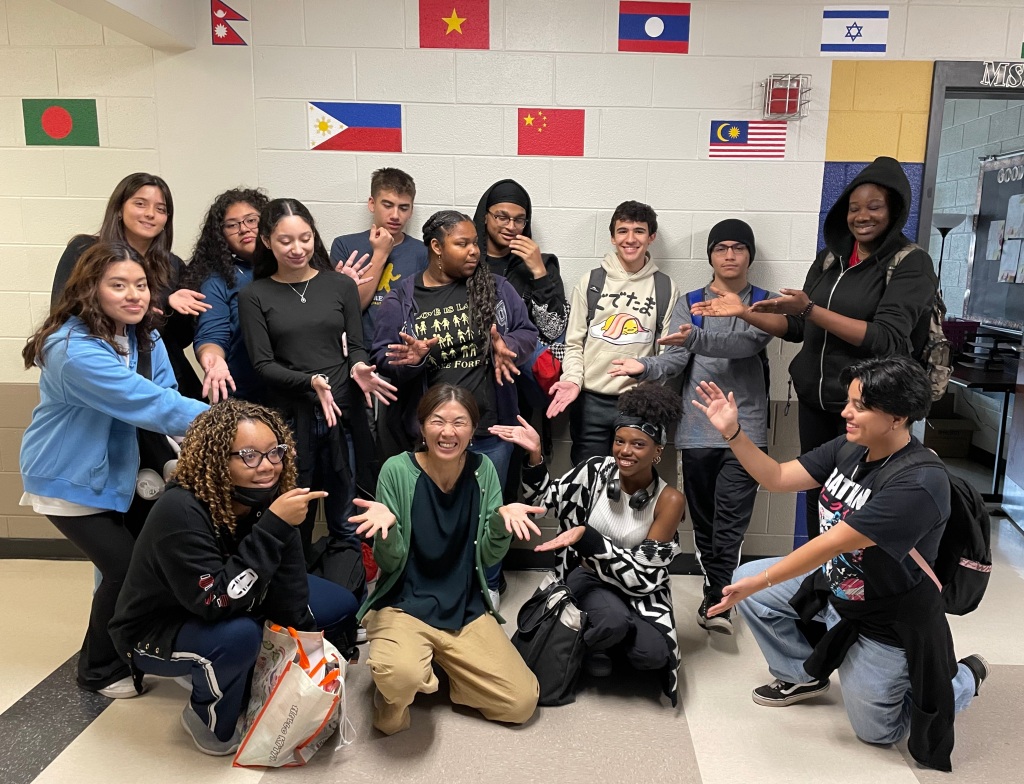
Saturday, September 30 was a happy day for us! The second year of our citywide afterschool program, Japanese Plus, launched at Columbia Heights Education Campus, with 14 returning students and a new Japanese teacher, Chihiro Takahashi. These super-dedicated DC public high school students will be meeting twice a week from now through the end of May – studying Japanese; exploring Japanese culture, history, and potential college/career pathways; and engaging in cultural exchange with peers and others in the US-Japan space. In other words, soaking up all things Japanese. Excitement is the operative word.
So what were they thinking on this first day back?
D’Amonie
In this present moment, I am very excited to be back. I have looked forward to this time again. I still love learning languages and I’ve been very proud of my Japanese learning journey thus far. Being able to go places and read the hiragana and katakana on Japanese products is so exciting for me, but there’s more to learn, which is why I am back. I am confident that I will get to my goal of natural conversational Japanese this year. I can’t wait to go to the next level. I can’t wait for more exchanges and interactions. And I can’t wait to go out and explore firsthand.
Zitlaly
As I was going through the metal detector here at CHEC, it hadn’t hit me that I’d soon be sitting in my Japanese class. I guess you can say it felt surreal. I’ve always been hesitant to push myself beyond limits, especially with languages. Though due to my past year experience, I feel as I can finally reach my language goals in Japanese. So I’m not as nervous nor scared to admit when I need help. I wish myself the best of luck this year especially because I’m a senior and REALLY BUSY!!
Elias
It’s the start of Japanese learning level 2 and honestly I feel good. I’m not particularly nervous. It’s more of a joyful, can’t wait type of feeling. But now that I’m also thinking about my senior year, that sorta does slow me down a little bit but I can manage. Learning through all the challenges and going to places relating to Japanese and Japanese culture keeps me motivated. And because of that, I’ll continue to push through in order to learn Japanese and experience the culture and more.
Aaron
I’m very excited for this year of Japanese Plus. I’ve gotten to see some friends from the class that I’ve missed. I hope to find a way to incorporate my knowledge and learning of the Japanese language into my college courses next year. My dream is to be able to tour my music in Japan or the UK one day.
Kori
I am looking forward to learn more about Japanese culture as well as being able to extend my language. I feel confident that I’ll learn more than I did before, and meet new people, like how I met a Congressman, and traveled to the Embassy of Japan during the summer, which helped me learn more on the history of the persons and embassy. I want to be able to experience more than what I’ve done like the tea ceremony, and being able to try on a traditional outfit.
Aitana
I’m looking forward to the new possibilities year two has to offer to our Japanese class this semester. After my time in Japan these last four months, I am excited to share all about my experiences with my classmates and hopefully inspire them to want to study abroad too. Overall, my goals this year are to maintain my Japanese skills, stay connected with the Japanese community in DC, and seek out new exciting opportunities.
Zion
Coming back to Japanese Plus is like remembering the first time I walked through the doors of our room for Japanese 1. I was late for my first class on Japanese, remembering my first teacher, our first exchange program with Japanese students where we all got to practice our Japanese with native Japanese speakers. It is sort of like going from middle school to high school, with all that I have learned from Japanese 1. I plan to take that knowledge with me to Japanese 2 to further expand my knowledge.
Mai
I am feeling really excited and happy coming into my 2nd year at Japanese Plus, to improve my Japanese skills that obtained last year. This year I am looking forward to learning and understanding daily life Japanese conversations, such as being able to talk about our day and things we like. I also look forward to building complex sentences using kanji. Outside the language aspect of the program, I hope to engage with the Japanese culture such as learning to play taiko drums, Japanese festival, and host again a Japanese high school exchange program.
Felipe
I’m now a level 2 Japanese student which makes me happy but nervous at the same time. I feel like I came out of last year with a good understanding of the language but I think level 2 will ramp up the pace a lot quicker and I’m gonna have to keep up. Luckily I went to Japan over the summer for 3 weeks which definitely helped with keeping my Japanese memorized. I was able to get some speaking and reading practice in as well as just being surrounded by language. This year I’m looking forward to hopefully get to a basic conversational level of Japanese and start learning some kanji.
Chamiya
My main goal for the year is to converse and meet Japanese students. While I was in Japan over the summer, I had the opportunity to practice and learn more Japanese. However, I wasn’t able to talk to students who were my age except for my host sister. Talking in a different language to converse with someone from a different culture was super fun and exciting to me. I learned so many different aspects of their culture and I was able to teach my own culture. There were similarities too and I wish to do it again. That is my goal for this year – to converse with a Japanese student and learn about their culture.
Margarita
Glad to be back!!! Seeing my friends and using Japanese again is making me feel so excited. Although I need to review some things, I am glad I get to do it with a new teacher. Hopefully this year we all grow closer as a class now that we will spend more time in person, and expand our knowledge of Japanese language and culture. I am excited to see how much Kanji we can learn this year and hopefully be able to use it with more Japanese people.
Jennifer
Coming into my second year of Japanese Plus I feel a bit nervous and excited. I feel nervous because I think my Japanese skills aren’t good enough but then I reflect on where I started. I knew nothing but here I am having small conversations and I know how to introduce myself. I am excited to continue learning. I aspire to be fluent so that it may better prepare me for college. I hope to study abroad and this program helped me seek opportunities in which I can. I also hope to get a better understanding of Japanese culture, the language, making connections, and growing with my peers.
Penelope
Although it’s been a while since our last Japanese class, I’m looking forward to picking up where we left off and advancing our language skills even further. I hope that this year we can go to more events around DC to experience Japanese culture, because I enjoyed so many of the ones we attended last year, like Sakura Matsuri and the exhibit at the JICC. I’m also looking forward to learning more kanji, and, of course, working with our new teacher!
Tristan
When I first came back to the program I was surprised by how my peers had changed over the past five months. Along with this I felt a bit awkward initially re-entering the program. I hadn’t many opportunities to practice Japanese over the break, so I felt a bit rusty almost as if I were lagging behind. With that said it would be a lie to say that I didn’t miss the program.
On June 1, a few students from Japanese Plus got the amazing opportunity to attend the NAFSA Conference, a huge gathering of study abroad programs and universities at the Convention Center in DC. We spent an entire morning in the section dedicated to Japan, and there was a lot to take in: so many different universities from all over Japan with varying class structures, opportunities, and programs. One university that particularly stood out to me, however, was the Kyoto University of Foreign Studies. As someone considering a career in International studies, I found this institution very appealing because it is in a large city with many opportunities to learn about diverse international cultures, and specializes in many different languages. The University also emphasizes community engagement, which I find very important in today’s world because individuals and enterprises are becoming more and more interconnected. I was happy to see a university that aligned so neatly with my career goals at NAFSA, and am looking forward to exploring study abroad further!
Current student D’Amonie, alumnus Carlos Ramirez, our teacher Tsujioka-sensei, and Tomoyuki Watanabe visiting from US-Japan Foundation.
By Penelope Morris
One of the first things that comes to mind when one thinks about Japan, especially as it relates to DC, is the cherry blossom tree. This tree and its blossoms feature heavily in Japanese culture and symbolize the fleetingness of beauty. They also symbolize the relationship between the US and Japan, as the several thousand trees that grace the banks of the city’s Tidal Basin were a gift from Japan to the US to symbolize the friendship between the two countries. Now, DC celebrates the blooming of the flowers each year with the National Cherry Blossom Festival. The part of this weeks-long festival that is most exciting to us is the Sakura Matsuri, a two-day street festival on Pennsylvania Avenue organized by the Japan America Society of Washington DC. The students of Japanese Plus were able to experience the festivities up close from our own booth.
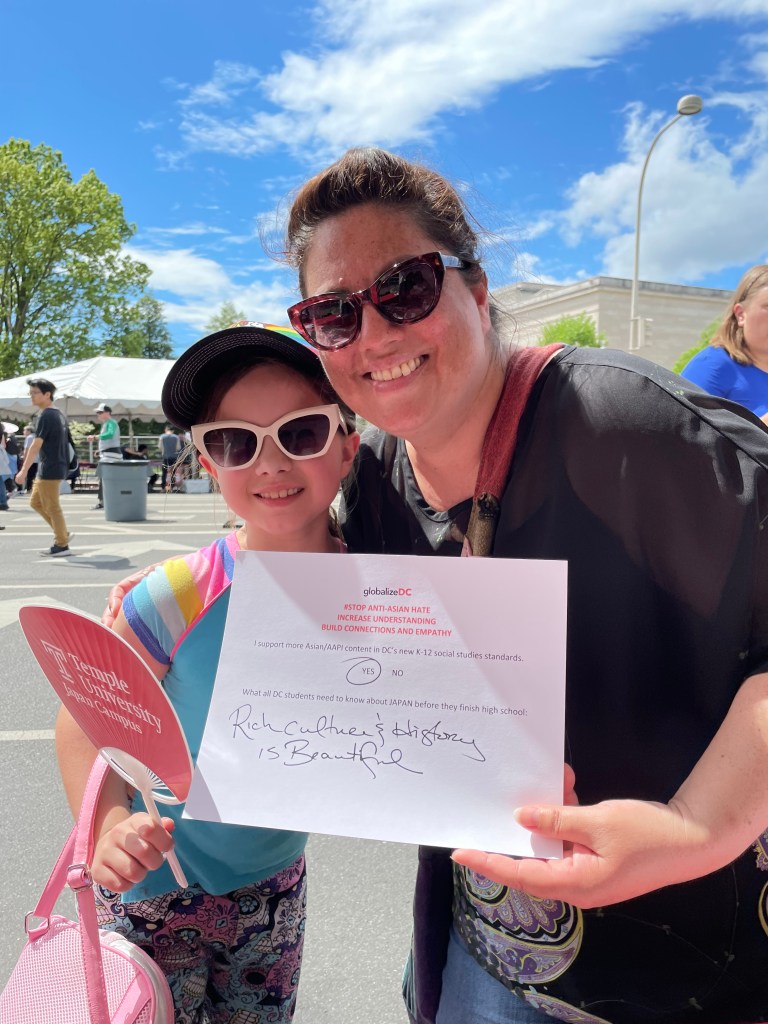
Planning for the festival was chaotic, because we wanted to share so much with the public: what our program is about, what we’ve been learning, how we reach out to the community, and even our anti-Asian hate project. Eventually, we decided to feature the anti-Asian hate project, a children’s coloring station, and an activity where passersby could create quilt panels around the theme of DC loves Japan. We also sold copies of a book created by students in Globalize DC’s summer Japan in DC program.
When we weren’t at our own booth, we had a lot of fun wandering around the festival and taking in everything there was to see. There were arts and crafts, food, educational organizations, and so much more. Not only was it fun to experience the Japanese culture, but there were opportunities to use the language that we had learned in class as well!
The Sakura Matsuri was an amazing experience for all of the Japanese Plus students. We had such a fun time organizing and running the booth, and sharing our program with other people who are passionate about the relationship between Japan and DC.
We are DC high school students who have been studying Japanese with Globalize DC since summer 2021. Back in 2021, in the depths of the pandemic, a group of students from our online Japanese program (including the two of us) advocated for the new DC social studies standards, which were soon to be updated, to be more inclusive of Asians and Asian Americans. During and after the pandemic, anti-Asian hate crimes rose substantially. In order to combat anti-Asian hate and violence, we concluded that people need to be taught about Asia, Asians, and AAPI content in order to feel compassion and understanding for these communities.
In June 2021, Penelope, alongside other students from Globalize DC, testified before the DC State Board of Education (SBOE) to discuss the improvements that the new standards needed. In December 2022, the Office of the State Superintendent of Education (OSSE) released the first draft of the new standards. We were extremely unsatisfied with the draft, because OSSE did not respond to our suggestions at all. In fact, the standards regressed in the amount of content for Asia, Asians, and Asian Americans. After we discussed what could be improved, the two of us (now in Globalize DC’s afterschool Japanese Plus program) testified before SBOE in January 2023 to again demand that the standards include more Asians and Asian Americans. We advocated for standards that include specific AAPI and Asian content and the introduction of Asian/AAPI content in earlier grades. After a very strenuous rewriting process, OSSE released a revised draft of the new social studies standards on March 29th, 2023, and we were deeply pleased by the outcome.
After reading this latest draft, we compiled a list of all the standards that explicitly mentioned Asia, Asians, and Asian Americans. We were especially happy about the specificity and amount of this content. In grade 6, OSSE revised the standards to analyze cultural elements of a country located in Asia and its significance for and influence on other societies. Although the standards analyze cultural elements of only one country located in Asia, it is a very important step to add cultural aspects of Asia. We were also pleased to see that OSSE modified the standards to name some specific elements of Asian culture, such as Sikhism and the philosophical writings of Wang Yangming, compared to the vague nature of the previous draft.
In World History 2, OSSE included a lot more standards that discuss a variety of countries such as South Korea, Japan, the Philippines, China, Cambodia, and many more. More people related to Asia are also discussed such as Ibn Battuta, Marco Polo, and Zheng He. In Government and Civics, United States v. Bhagat Singh Thind, United States v. Wong Kim Ark, and Korematsu v. United States are included, which are cases that helped shape America. Overall, OSSE has most definitely added a lot more countries and specific people to the social studies standards.
Instantly, we recognized that OSSE fulfilled our suggestion of introducing Asian/AAPI content in earlier grades. In grade 1, the standards introduce Asian communities as well as other communities to explain how they have shaped and defined Washington, DC. The standards also introduce specific community leaders, including Lee Yick and Liliʻuokalani. In grade 2, OSSE expanded Asian history in the periods between 1100 and 1400. In grade 3, OSSE included greater representation of AAPI history in Washington, DC. In grade 5, OSSE included all Asian immigration during this time period, as well as additional standards about the impact of the Chinese Exclusion Act.
In conclusion, these new standards are what we wanted to be included. They highlight the impact that AAPI communities have had on Washington, DC, as well as expanding Asian history, which will build understanding and compassion among the younger children. Our greatest hope is that teachers will make great use of these standards and incorporate field trips and create other opportunities for children to learn about Asian/AAPI communities firsthand. These standards pair well with excursions to learn about many different communities that make up our city and nation.
We want to give special thanks to Dr. Sohyun An, a professor of social studies education at Kennesaw State University and an expert reviewer for these new standards, for using her expertise to advocate, alongside Globalize DC, for the inclusion of Asia, Asian, and Asian American content. We would also like to thank the members of the State Board of Education and OSSE for listening to our suggestions and taking them seriously.
You can find the latest full draft of the K-12 social studies, along with other background information on the revision process, here.
On Saturday, February 11, Japanese Plus students went to the Hirshhorn Museum to view an exhibit on Japanese artist Yayoi Kusama. For me personally, it was the second time I’d seen Kusama’s work, and it was an amazing experience to revisit.
Upon walking into the gallery, visitors are greeted with several panels of information about Kusama’s life – from her psychological condition, to her time in the United States, to her current global recognition. Then, you enter a room dominated by a gigantic yellow pumpkin covered in black polka dots – one of Kusama’s most well-known works. Visitors are allowed to walk around the pumpkin and observe the intricate work up close.
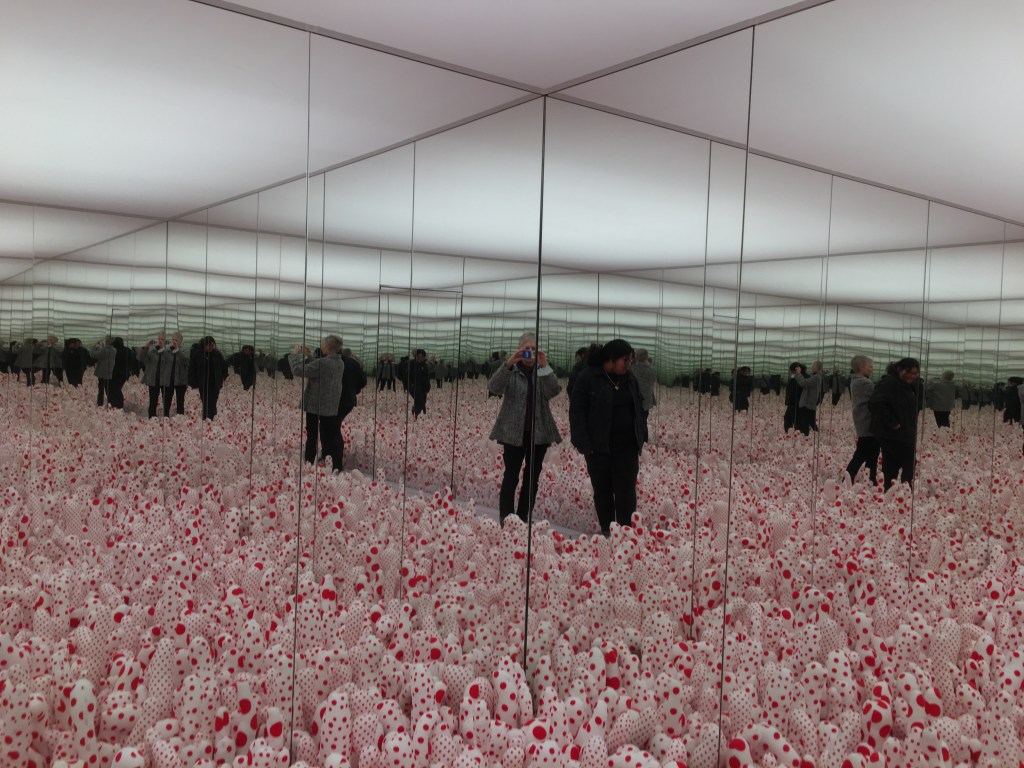
One of the most amazing parts of the exhibit for me were Kusama’s two mirror rooms. Although these chambers appear small from the outside, when you enter the space seems to go on forever, thanks to the mirrors covering all four walls plus the ceilings and floors. The first room is reminiscent of a psychedelic garden, with the floor covered in white-with-red-dots abstract cloth forms. The second room reminded me of a spacescape into which Kusama had again incorporated her signature polka dots – this time in the form of luminescent neon circles on spheres of varying sizes floating in an otherwise pitch-dark room.
Exiting the exhibit, I felt calm, despite the bright, busy nature of Kusama’s work. I found that her use of space and recurring patterns lulls the mind into a trance. It was a pleasure to experience the work of this amazing artist again.
Last Saturday, Japanese Plus students went to the Japanese New Year celebration at the Metro Center Marriott to celebrate the beginning of the Year of the Rabbit. At first, I was a little nervous about the festival because I knew there would be lots of people speaking Japanese and my language abilities aren’t yet at the level where I can make conversation easily. However, once we arrived at the venue, the festive spirit dispelled my anxiety and I began to explore the activities: there were lots of different things to do, like calligraphy, Japanese card games, and mochi-making.
One aspect of the festival that stood out to me was the food. Attendees had access to a wide variety of delicious Japanese food, like takoyaki (spheres of octopus), Ramune (a Japanese soda), yaki udon (noodles), and onigiri (filled balls of rice). My personal favorite was dango, which are rice flour dumplings served on a skewer and coated in a mixture of soy sauce and sugar. They were a perfect snack as we explored the festival and immersed ourselves in Japanese culture. The celebration was a great opportunity to learn more about how Japanese people celebrate New Year, and to practice the Japanese we’ve been learning in class!
Yesterday, Japanese Plus students got to meet Japanese high schoolers participating in the Kakehashi exchange program. The two groups met up for lunch at Z-Burger in Tenleytown, then went to All Souls Church in Columbia Heights, where we got to view images created by Japanese schoolchildren after the atomic bombs were dropped on Japan during World War II.
Before the exchange, I was a little nervous to interact with Japanese high schoolers because I wasn’t sure if my Japanese would be good enough to communicate with them. We were able to communicate just fine though, and we bonded over topics ranging from food to school to extracurriculars. It was really fun to be able to learn what life is like as a Japanese teenager! The students were able to communicate well in English, and one girl that I talked to said she had been studying the language at school for eight years, which I found really impressive considering I’ve only been learning Japanese for a few!
Another highlight of the exchange was being able to see drawings created by Japanese schoolchildren in the aftermath of the atomic bombs dropped during World War II. The images were created using art supplies sent by the All Souls Church community to schools in Japan, and seeing the images was a deeply moving experience. It was hard for me to imagine how these Japanese children could have created such beautiful art following such a terrible event. But as I looked at the pictures, I saw that the children were using art as a medium to express their hope for a better future. At first I was surprised by the hopeful aura of the pictures: many of them depicted children playing, sunny days, and people going about everyday life, which was likely not the reality of most of the young artists. However, as I continued looking it became clear that the students weren’t necessarily drawing what was around them, but what they hoped would eventually grow back.
I really liked the program and it was amazing to meet Japanese teenagers. I hope we will keep in touch in the future!
Learning Japanese isn’t easy. Listen to our Japanese Plus students to get an idea of what it’s like – the ups, the downs, the triumphs, and the challenges.
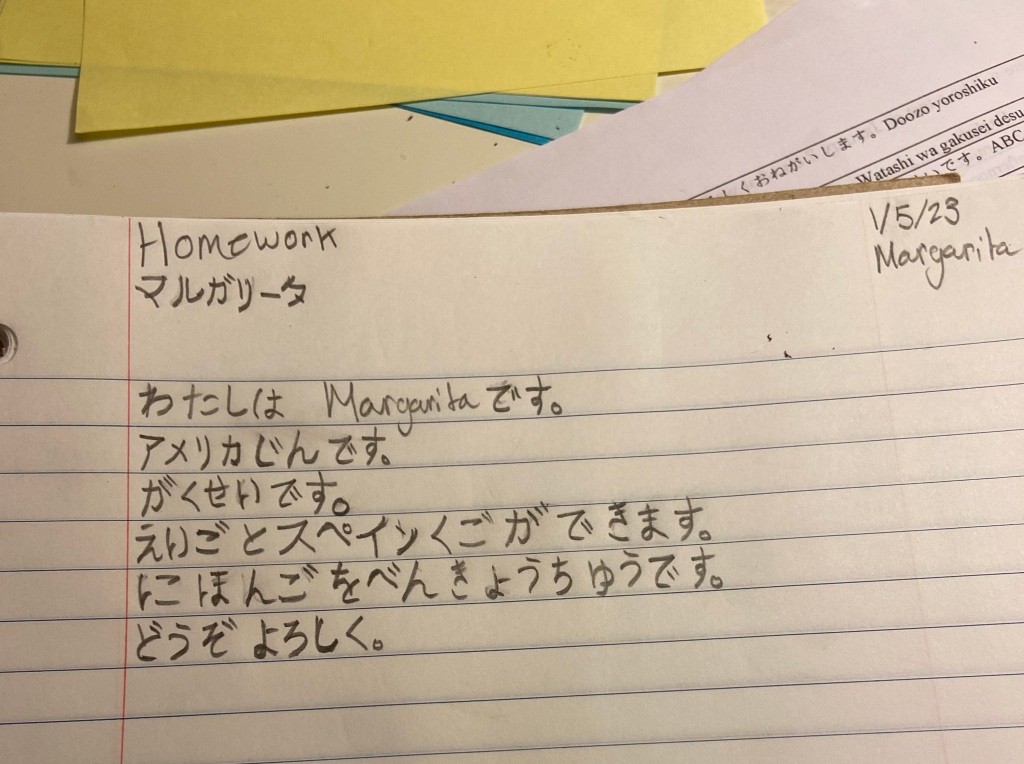
By Margarita:
Hiragana. One of the three Japanese alphabets. I thought it would take me years to learn it, but I was wrong. Hiragana actually sounds a lot like Spanish, so it was easy to remember the pronunciation. Every time we would learn a new character, it felt like art class, drawing the long and curvy lines actually felt calming. Writing the simplest word in Hiragana made me feel like I was making a masterpiece though I’m still memorizing some characters, it will never not be fun.
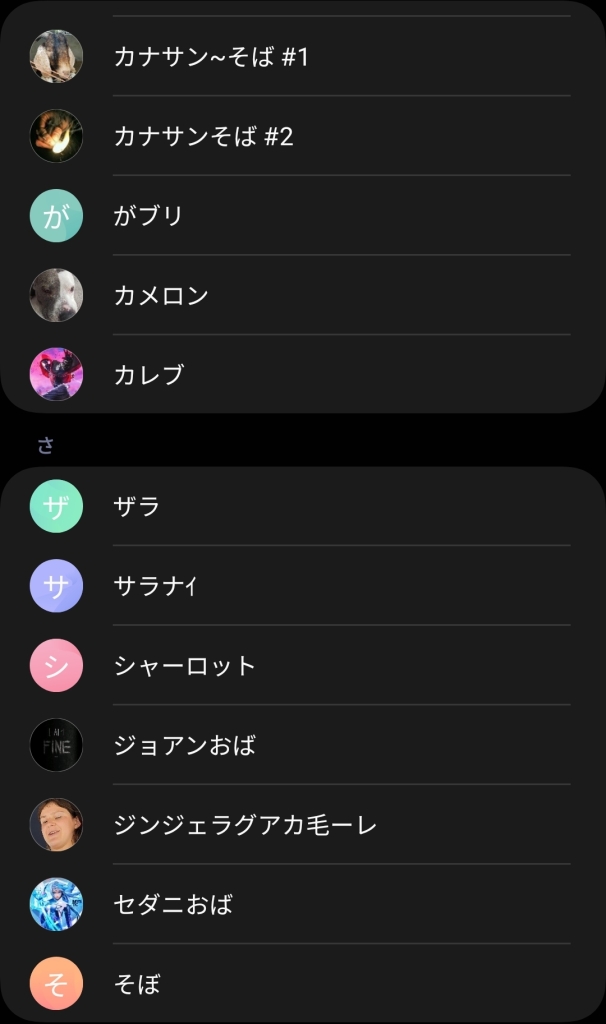
By Chamiya
I have always wanted to travel to anywhere and everywhere ever since I traveled to Thailand. And of course, Japan is on my bucket list. But ever since I started learning Japanese, I’ve been wanting to go more. I like the aspect of learning a new language and immersing myself in a completely different culture from my own. And I especially like converting names to katakana. If you look on my phone contacts, half of the contacts are in Japanese. Katakana is so cool to look at, to read, and to figure out what the word is in English. My own family can’t figure out what the words mean but once I say it to them, they can understand it completely fine. It’s really cool immersing myself in another language and I can’t wait to travel to Japan one day.
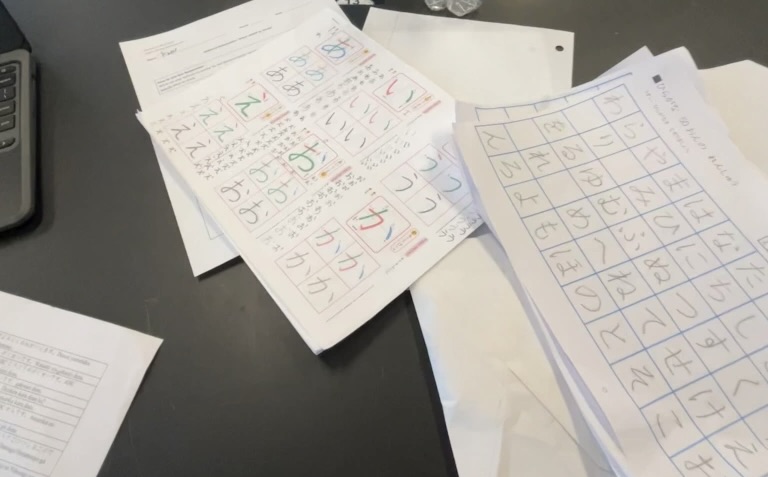
By Thalia
For me learning Japanese has been such a fun experience. I’ve met new people who I can connect to. I think trying to learn all the Hiragana at once has been a struggle because some letters look similar. I was having a hard time with M-N but once I got it, it was so easy and made it easier to read.
By Penelope
I’m still really enjoying Japanese class. Recently, we started learning about family and kinship terms, and I like this because it’s fun to be able to ask about other peoples’ lives and to have longer conversations. Something I find particularly interesting is that there are different words for your own relatives and for others’. This is because politeness is very important in Japan, so you have to use a more respectful term if you’re inquiring about someone else’s family. I find it interesting how language and culture are intertwined and how they affect each other, and this is a cool example of that.
By Zitlaly
Japanese . . . is a whole obstacle course you have to go through these hurdles just to go through the same hurdle, and another one and . . . another one. But through time you start to comprehend and memorize the hurdle and get through them way easier than the time before. But if you don’t adjust, you’ll only start to get tired and stressed from how many times you keep falling/failing.
By Mei
During these last few months of being in Japanese class I learned so many things about the Japanese language. One of the things that stood out to me is the different terms to have a conversation with someone. Having a conversation or even addressing someone depends on your relationship with that person and if that person is older than you. In English, people almost always talk in a casual way to their friends, teachers, family, and even to strangers. But in Japan, this shifts into a formal manner when addressing someone older than you. For example, in English we only have one way to thank someone no matter their age or status and that’s by saying “thank you.” But in Japan when thanking someone close like a friend or family they will say “arigoto,” but when thanking a teacher, co-worker, boss, stranger, or just someone older they will say “arigato gozaimasu.”










 GLOBALIZE DC: JAPAN