
Reflections from a new JET

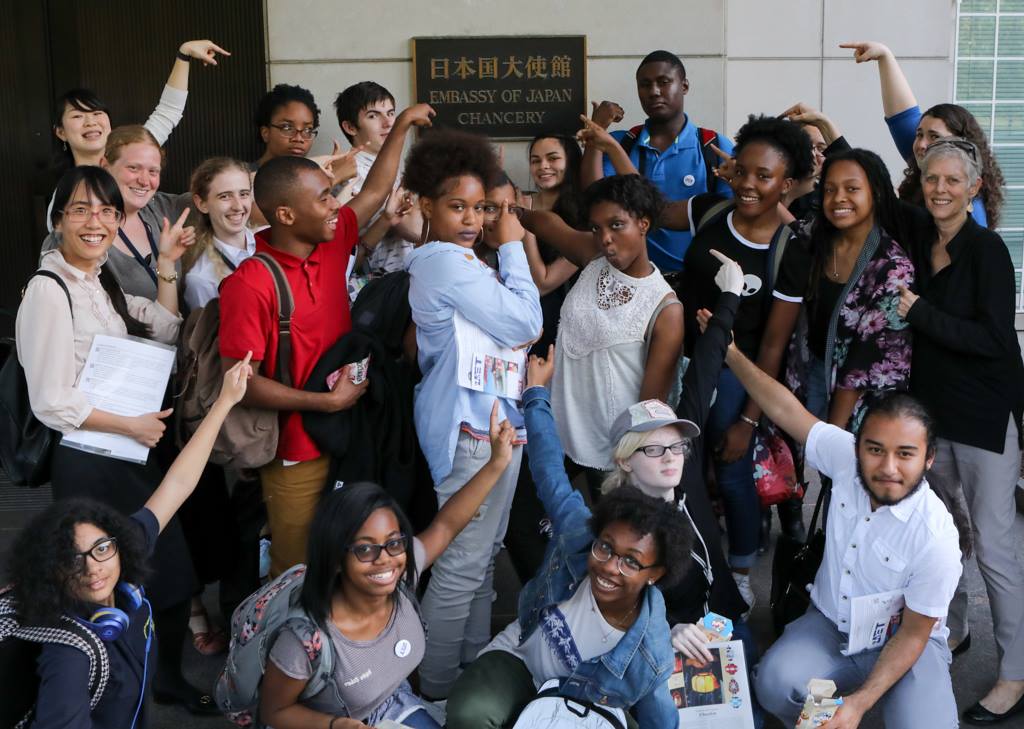
There I am as a high school junior – on the right, middle row, in the pink flowered top.

By Kharan Pierce

The day I’ve been waiting for not just for the past four months, but for the past nine years, is finally this week. I will never not tell the story of how I knew I’d be embarking on the JET Program: when my Japanese Plus class visited the Japanese Embassy my junior year of high school, we got information on so many programs and opportunities, and the one that stuck with me was JET. I said to myself that day “I’m going to be in that program one day.” It is surreal, humbling, and satisfying that that day is here.

I went into the application process expecting to be re-applying next year, but at every step of matriculation, I kept getting through! I felt my interest in Japanese history and pop culture, food, environmental practices, and the pockets of Japanese culture I’ve experienced in DC only scratched the surface of what would make a great JET candidate. However, betting on myself in this process clearly paid off because JET was looking for someone just like me to send on the program. The application process has enhanced my confidence and reaffirmed my caliber of character as a global citizen.

As I’m only just beginning my journey in Japan, I’m excited to tap into my courage by living in another country, make new and hopefully lifelong connections and impacts, but most of all, learn all I can. Having studied Anthropology in college, I know that being immersed in this country will be the best way to absorb the ins and outs of Japanese culture. I’m also recommitting to my Japanese language studies and striving to pass the N4 level JLPT. Outside of these goals, I’m just excited for Japan to surprise me. I can’t wait to report back all the ways which it does. 

All my best from Tokyo,

Kharan

Chotto

By Kharan Pierce

As read in A Geek in Japan, the word chotto is used by the Japanese on a daily basis as an alternative for saying no. In America, it’s absolutely no problem to tell someone “no, I don’t want to eat salad,” but in Japan, the abruptness of simply saying no is rude and almost only used in tense situations. Along with chotto is a slight tilt of the head, which indicates that someone wants to say no or is disagreeing with whatever situation. I think that if someone were to use chotto in America, they’d be thought of as extremely shy and would eventually be pushed to share their opinion directly. On one hand, stating exactly how you feel isn’t bad, but this is coming from someone who was raised to do so. In a culture completely involved in avoiding confrontation and being direct and therefore terse, something like chotto is perfectly okay.

What do you think?

How We Start Our Class

By Kharan Pierce

At the beginning of each class session, the students in Japanese Plus mimic traditional Japanese schools by performing a series of actions, triggered by command words, that show respect for the teacher and the rest of the class. Our sensei selects a student at the beginning of class to be the class leader. This student will stand to indicate they’re ready to lead the commands. They then say “kiritsu” which calls for the rest of the class to stand. Then, they say “kyotsuke” which calls for the class to stand with good posture facing the teacher. They then say “rei” which calls for the class to bow and greet the teacher by saying either good morning, good afternoon, or good evening, in which the teacher responds accordingly. Finally, the leader says “chakuseki,” which calls for the class to sit down and prepare for the lesson.

By doing this before every class, it is sort of a call for focus and a shift from our days at school into the program.

Shikoku PowerPoint

By Kharan Pierce

The students from Shikoku University who, through the Kakehashi program, delighted us with a visit to our program last Saturday. Upon their arrival, some of the Japanese Plus students greeted and welcomed them with an excited “Hajimemashite” and self introduction to their group. The Kakehashi students then went into a PowerPoint presentation about their home island, Shikoku, Japan. Their presentation began with some description of Shikoku including beautiful pictures of nature, an enchanting vine bridge in Iya Valley and the view of Shikoku from high up. I love seeing the images of their home because everything is so green and luscious. Their presentation continued with some descriptions of traditions in Shikoku – one of them being a province-wide celebration of the popular Anime show.

Another tradition we learned about was the Awa Odori dance that is well known in the region. The students told us that different places have their own variations. We even got the opportunity to learn a part of the Awa Odori dance through a fitness video later in the program.

Throughout their whole presentation, it was clear that the students had rehearsed their entire presentation in detail and were very prepared. Compared to American students who will often do a class presentation without having rehearsed, the Japanese set a new standard for me personally. The flow of the presentation was much nicer than some I would see on a regular day. Maybe the next time I have a big project, I’ll use some of what I saw with the Japanese students to try and elevate the quality of my presentation.