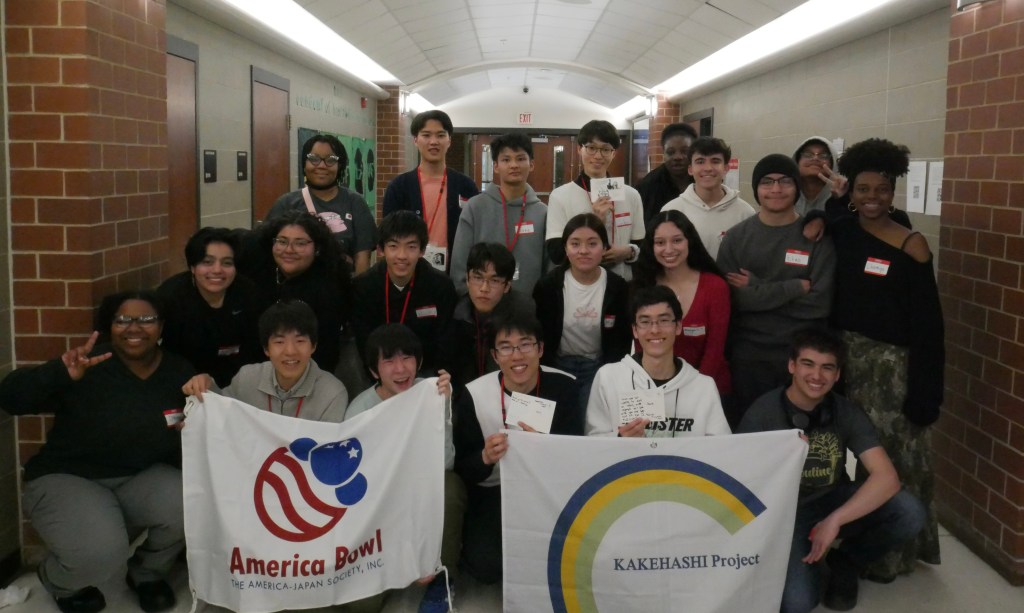
On the last Wednesday of March, our group had our first Japanese student exchange of Tora year 2. It was a group of nine boys from three different schools that had won the America Bowl – equivalent to our version of the Japan Bowl or Math Bowl. We had the honor of hosting this group of charismatic, lively boys.
We’d been excited to get word that we were getting the chance to interact with more Japanese students, as last year’s KAKEHASHI exchanges were hits! It’s something we all, hands down, looked forward to. The studying and preparation to make sure we’re the best hosts is always our favorite. This exchange we created presentations to present to the students.
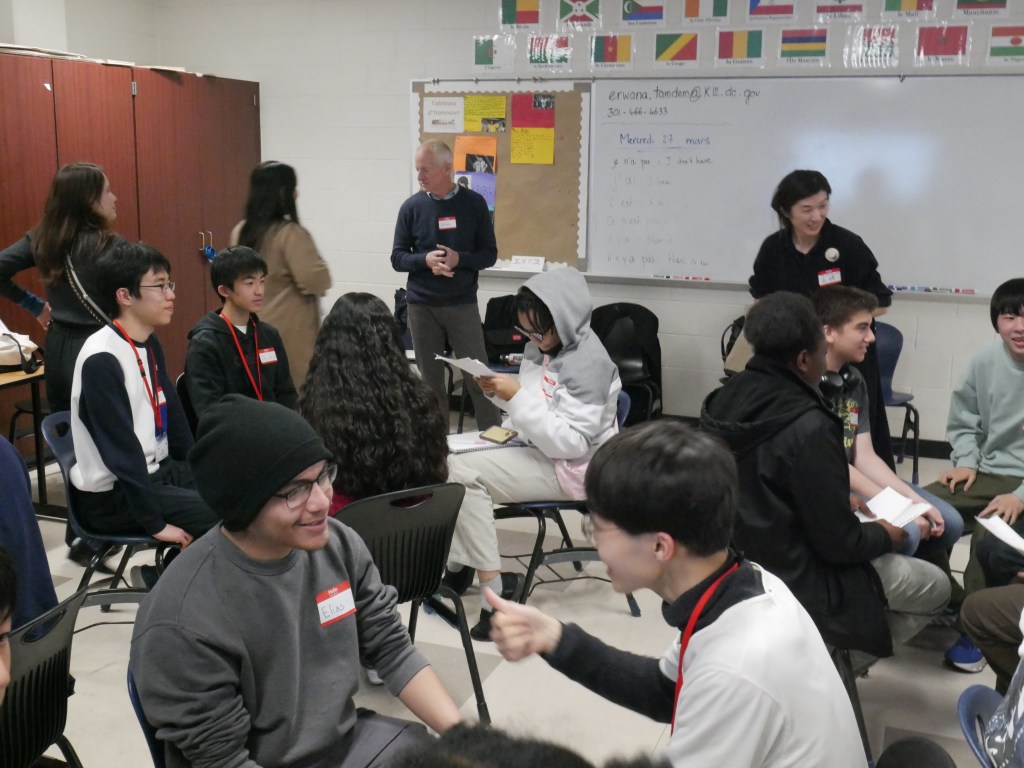
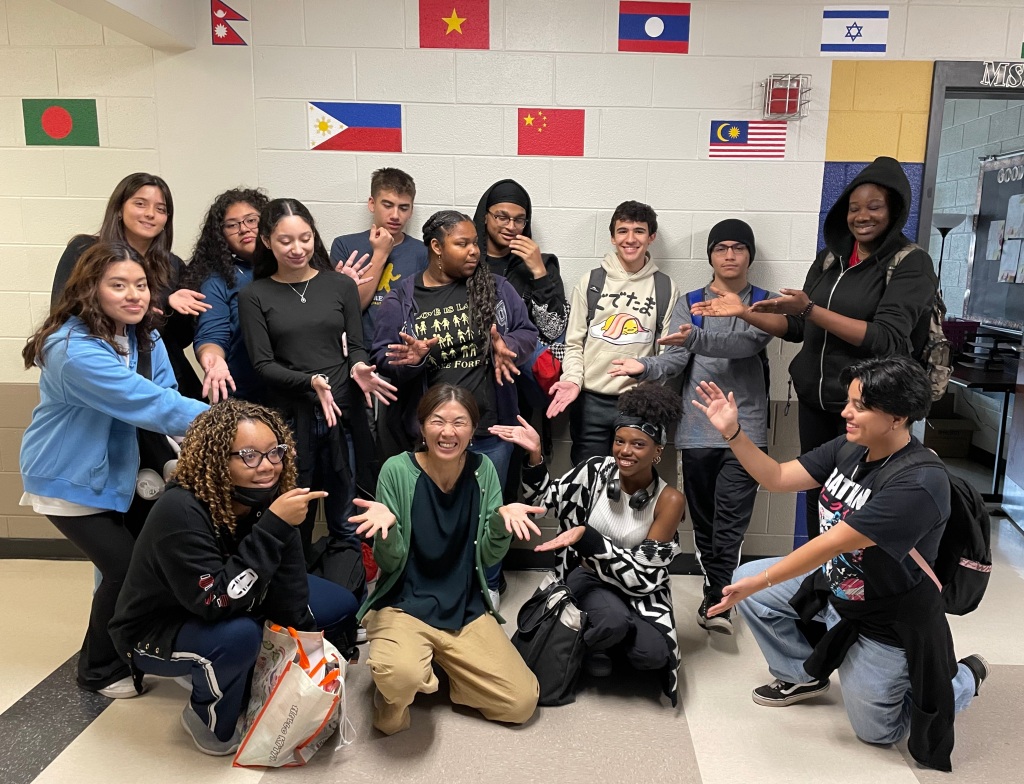
We scrambled around with excitement even down to the second they came into the room. We had gifts and snacks prepared, alongside them bringing sweet treats for us as well. We began by engaging in small group discussion, in Japanese, where we got to put the phrases we learned into use. We discussed our ages, hobbies, and the things we liked, which mainly included sports. In my small group, I distinctly remember bonding with one of the students over our enjoyment of badminton. I hadn’t heard anyone say they played badminton, so I was excited.
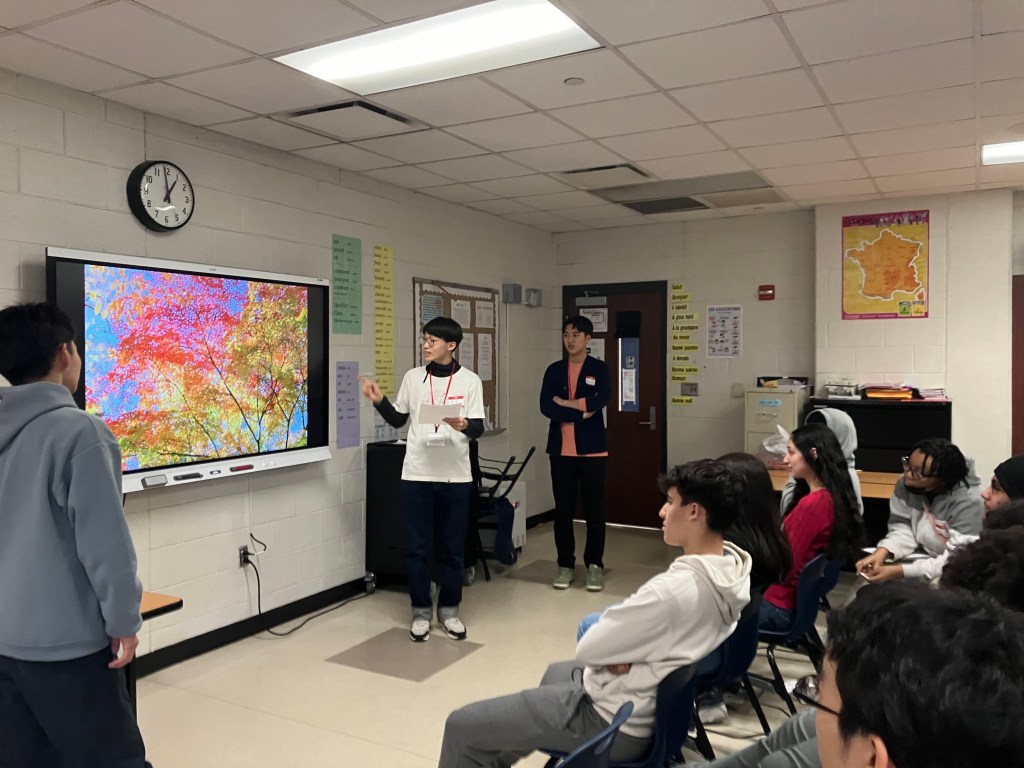
Afterwards, we both presented our presentations. Our class had spent prior class time preparing presentations of places in D.C. we thought showed the real D.C. to us D.C. natives. I appreciated how very lively they were for our presentations; they had fun reactions which helped with our nervousness. Through my group’s presentation we were able to show them Go Go music – D.C.’s music, and Rock Creek Park – D.C.’s biggest park.
I enjoyed their presentations because they were very interactive. We learned about the importance of certain castle properties, what keeps the people inside safe and what puts them in jeopardy; the deep meaning of sakura and how it has been perceived throughout the years; and origami, something I struggle with heavily, but with their help, I made the tiny sailor hat!
The two hours we spent together flew by devastatingly quick. But of course, we had to make time to teach them the Cha Cha slide – a very popular choreographed American dance that we do at all the parties and events. I love being able to share our culture through something as expressive as dancing. We had a good time and laugh, they are naturals! There was one boy, though, that came up to me and told me he had enjoyed dancing but wanted advice on how to learn dances. That moment was very special to me, as I felt honored that he had asked me for that advice.
Then before we knew it, we were signing cards from comic book cut out cards that the boys individually chose, and escorting them back outside to their bus. I remember staying outside waving to them inside the bus until they pulled off.
But that wasn’t the end. They weren’t heading back home until Saturday morning, so we decided to hang out with them again Friday after school. They had stayed with the DCI students from our group all week (you can read other blog posts about that), so once they finished up there, they traveled to the National Museum of American History, where I met them with sports equipment.
Playing sports with them, even if it was only for fifteen minutes, was the highlight for the few of us that could go. There was a soccer ball, a football, some frisbees, and racquets and birdies for badminton. Some played frisbee, while others were having a soccer match. I engaged in a 2 versus 2 badminton game. In the end, we all participated in a huge soccer game, with even some local kids joining us for a bit.
In essence, we were very grateful to have had this experience and hope that we can one day meet them again with better Japanese. We will work hard!
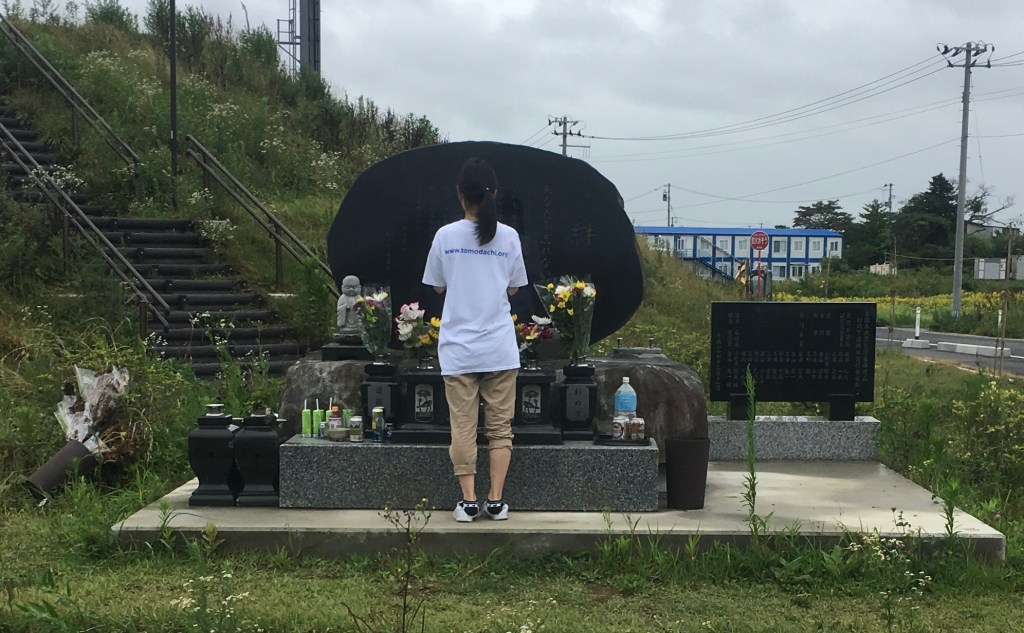
Photo from our 2018 TOMODACHI US-Japan Youth Exchange Program in Tohoku.
NOTE FROM THE PROGRAM DIRECTOR: On March 11, 2011, the Great East Japan Earthquake struck the Tohoku region of Japan, causing tremendous loss of life and widespread destruction of homes and communities. For six years Globalize DC was privileged to participate in the TOMODACHI US-Japan Youth Exchange Program, which allowed DC high school students to visit towns and cities directly affected by the earthquake, and to meet and engage with their Japanese peers in the region. These experiences have been deeply affecting and informative to all of us. So each year we take a few moments to recall the events of 3-11, to learn, and to reflect. This year our Japanese Plus students watched the emotionally riveting film, The Tsunami and the Cherry Blossom, which vividly documents the events of that day and the aftermath. These are some of our students’ reflections after viewing the film.
Chamiya
It was hard to watch the film about the tsunami that hit Tohoku on 3-11. Watching people lose their lives and witnessing survivors lose hope after experiencing a devastating tragedy was devastating to me. One guy said that he doesn’t want clothes or home, or anything material. He wanted his friend back, and that is something that I relate to. I admire these people for finding hope in the cherry blossoms. Finding something to look forward to, as something as small as watching the cherry blossoms bloom is admirable.
Zitlaly
It was hard to hear of the tragedies and how everyone had to accept the fact that the tsunami changed everything. Despite the fact that many lost what they would consider their lives/reason for living, they still continued to stay positive, to have some type of hope. I admire Japan for persevering and finding something or someone to hold onto during this hard and excruciating experience for so many. Also, I admire that many looked at the blooming of the cherry blossoms as a form of a new beginning, a remembrance, “rebirth,” hope, and a push to keep on going. Despite that, some felt envy for the blooming.
PS. May those who have not been found find serenity.
Felipe
One thing that stood out to me in the film was the man who lost his best friend. At the beginning he was distraught and at one point said that he had lost the meaning of his life and everything that was a part of it. However, once reflecting on the cherry blossoms and what they represented, he realized everybody was trying to bounce back because they were still alive and they shouldn’t give up. Another thing I found inspiring was what the woman at the end of the film was saying. She said she would photograph how the town was rebuilding but she also mentioned how the yearly blossoming of the cherry trees was giving her hope for the future. She said that the next time the trees blossomed, the town would be more rebuilt and the year after that even more. This made me reflect on how time is continuous and things will improve over time if you keep looking forward.
Mai
For many people in Tohoku they couldn’t believe that a tsunami was actually happening right before their eyes.
How easy it was for the tsunami to destroy and swallow their homes and loved ones. They could only watch, not being able to help.
“Nature is filled with beauty and terror but sometimes we forget about the terrors.”
The cherry blossoms have different meanings depending on how we feel and what memories we associate with them. They are goodbyes and new beginnings.
There was a tree that has lived for more than 80 years. When the Tohoku people saw the cherry blossoms, they felt healed, allowing them to have hope and motivation to rebuild their homes.
Cherry blossom trees have steps of growth: ichibu-zaki (which is the first step of the cherry blossoms growing) and maichiru (when the cherry blossom flowers begin to fall).
Sakura are yuuga (beautiful but not too showy). The Japanese people have a kanji for the concept of yuuga: 優雅
Jennifer
Although the cherry blossom trees also suffered the tsunami, they managed to strive to be alive. It became a hope to most and a reflection to those who survived. The tsunami hit them hard. Some grew from it, some resented it. The cherry blossoms give a sort of reflection on how they feel about the tsunami and what they feel about the future.
Elias
I noticed the destruction which caused the deaths of many friends and families who mourned for them after the disaster. Going through something as traumatizing as a tsunami taking your home and friends and families led people to lose everything, giving them a sense of emptiness from their tragic losses.
D’Amonie Armstrong
I believe that going through something like this is absolutely devastating and will have long-lasting impact on the people of Tohoku. To see visual evidence of such disaster and watching as people tried to get to a safe haven was very disheartening. The people showed extreme bravery for abandoning or deciding to try to salvage their belongings. Many people suffered badly. However, during this time, the cherry blossoms were also almost in bloom, and that was used to bring hope for a better future. Every year that they bloom around that time, it is seen as a reason to keep going and how with each passing year, the rebuilding gets better and better.
Zion
It was heartbreaking to see the people holding out hope that their families were still alive. Children having to watch their parents get swept away. The people that just watched knowing they could not do anything to save them. The people that were just coming out of their homes, the ones that could have died if they had waited just one second longer and the many other stories of the people who had relatives that died or were missing. I could not imagine going through what they went through and I hope that the people featured in the documentary are still alive.
Margarita
It was interesting to see how much cherry blossoms are integrated into Japanese culture and life. Many people in the film mentioned how they grew up alongside the cherry blossoms. The cherry blossoms were viewed as hope when they start blooming, not long after the disaster of March 11. The film showed how the family of one of the victims had planted their own cherry tree before the tsunami, which had started to bloom afterwards. The difference between showing solidarity compared to America is also very interesting. Unlike in Japan when natural disasters happen or any kind of devastation, in the United States the news and solidarity usually remains local. Across all of Japan people were grieving, which shows just how devastating the event was. I can’t imagine how traumatizing it must have been for everyone affected.
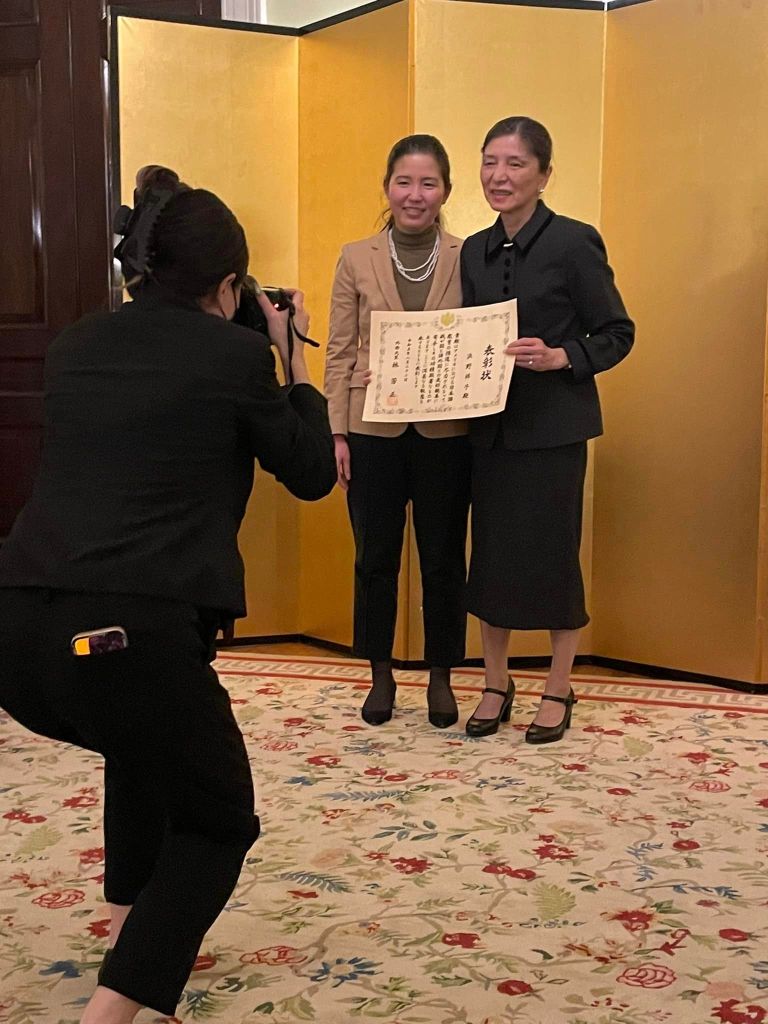
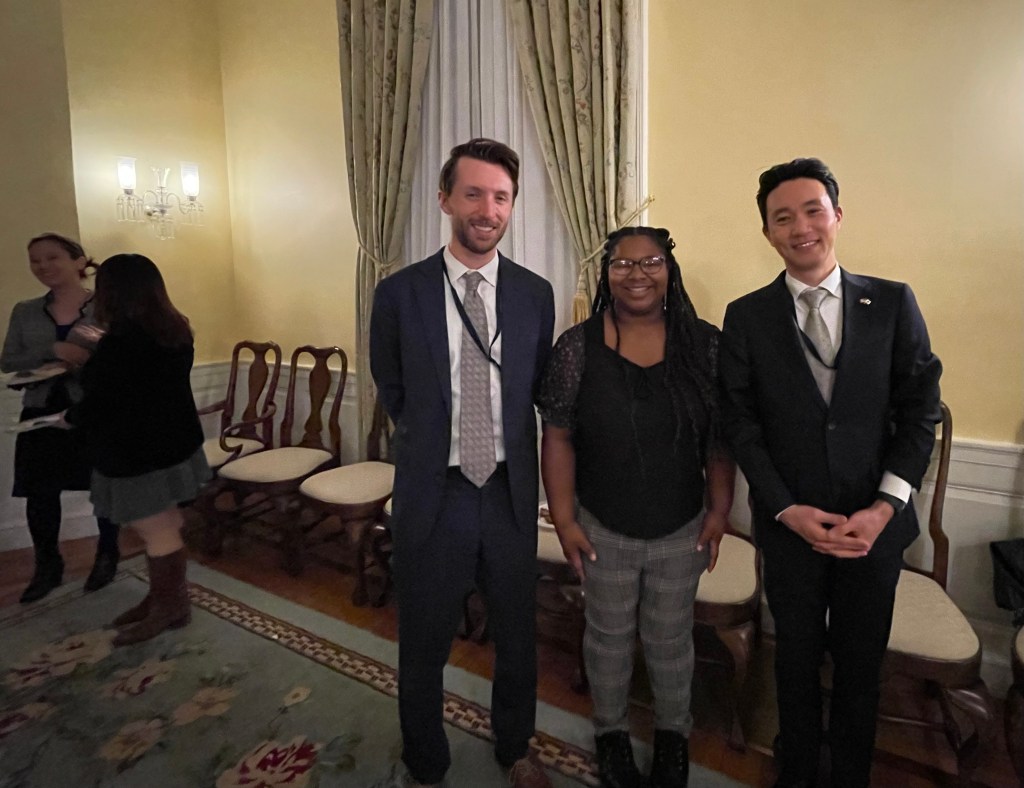
Last Tuesday, December 12, I had the privilege of being invited to the Embassy of Japan. I was very excited upon hearing about this opportunity to put myself out there. And I was beyond excited to find out that the event was to honor our level 1 Japanese teacher, Shoko Hamano-sensei, for her endeavors and dedication working to draw connections within the Japan-D.C. world. We had the pleasure of having Hamano-sensei teach us virtually from California last year. Although virtual, she had an impact on us as she was this cohort’s start into this program. We learned hiragana and our names in katakana from Hamano-sensei, so she’s a big deal to us. Starting Japanese 2, we’ve missed her and it saddened us that we wouldn’t be able to meet her in person. So, I also felt honored to be the first to see and personally greet her on behalf of my cohort.
Getting to see her accept her award, I couldn’t help but think how she’s inspired many people, as the room was filled with other Japanese teachers, former students of hers from college, and myself being the youngest in the room.
I was a bit nervous upon getting to the building. The path leading up to the building, beyond the gate, was tiny stone squares. Guests were coming in alongside us, so I was afraid of stumbling, and of taking pictures. I didn’t want to look like I didn’t belong. Essentially, the fear went away because everyone was very nice. I introduced myself to the people Sally knew and connected with others I had met before. I was also excited to see our other sensei from last year, Tsujioka-sensei. The inside of the prestigious building was bright. I liked the small and flashy vibe it gave.
When Sally had mentioned the food, I was of course more ecstatic as I would have a chance to see what was there and extend my palate. I ate well and spoke with ever greater people who were interested in my future plans (college, path regarding Japan and US relations). Being the youngest no longer intimidated me, as I could speak and hear from others who had the same goals as me, to have an impact on the Japan-DC world. I shared that I would take the opportunity to study in Japan whether directly or through studying abroad. My area of study would be linguistics with concentrations in specific languages. I also want to look into the JET program so I was able to speak with Tim Folsom from the Embassy’s Education Department, who did the program. All in all, I had fun and the evening will be remembered as one of the greatest events I’ve ever attended.
I’m glad I was able to be present and represent high school students and myself. My hope is that high school students can have the opportunity to visit these embassies. I am incredibly grateful to have been invited, and I hope this is one of many events I will attend. A huge congratulations to Hamano-sensei for her active service in international relationships, someone I strive to be.
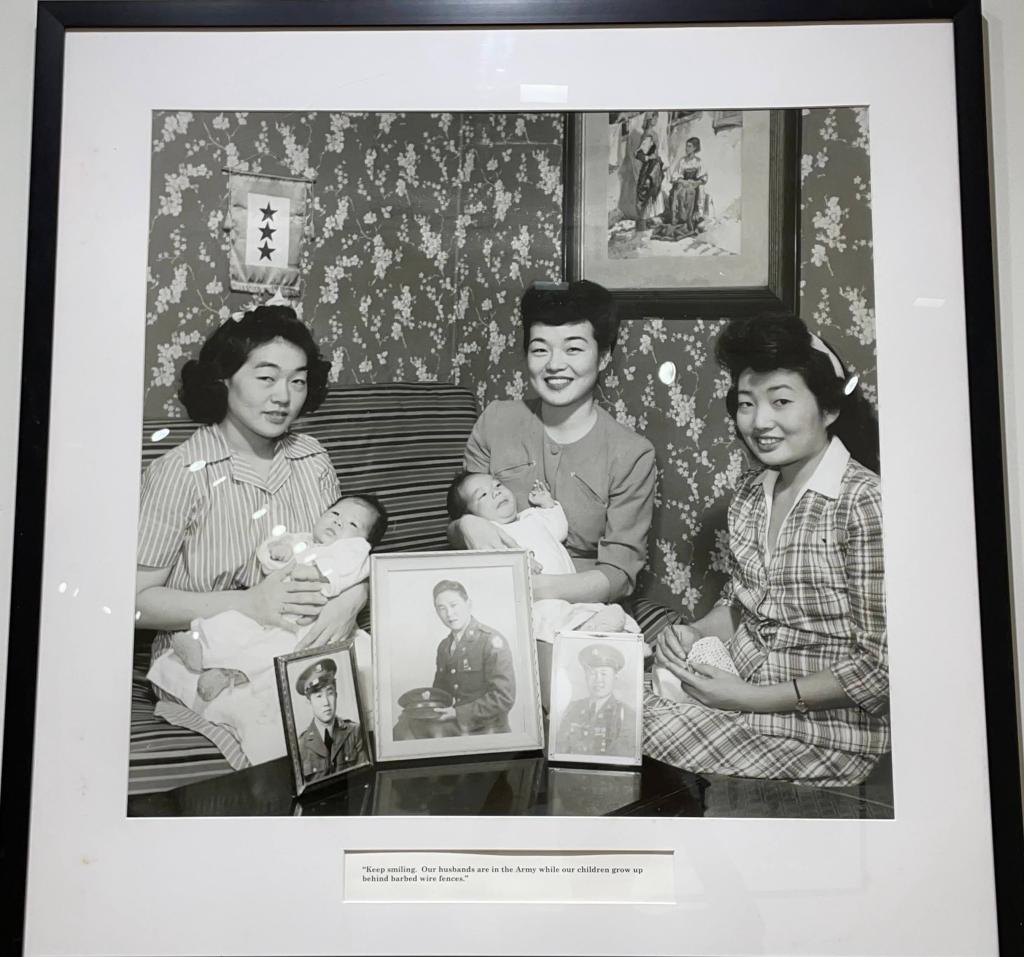
When we went to the JICC in December for Pearl Harbor Day, they had this exhibit featuring photos of Japanese and Japanese-American soldiers during that tough time.
The photo above is one of soldiers’ wives, two holding their newborn children, and all with photos of their husbands before them. It’s captioned “Keep smiling. Our husbands are in the Army while our children grow up behind barbed wire fences.” This stood out to me very much as I agree the emotions and the points of views of the soldiers are valid, but it is really the only story that gets told. It’s very interesting to hear about how others, like the soldiers’ families, think and feel as this also impacts them, especially if they have wives and children.
The caption implies that the wives have to just keep smiling and not show pain as they raise their children alone, because their husbands are away battling in a war. It feels like they’re obligated to hold up this face, while they are directly impacted. And although the children in this photo are newborns, I can’t help but think about the many other families that had children old enough to know and understand that their fathers can’t be around because they are in the Army fighting for their country. In all, this was a time of deep despair and we have the day December 7th to commemorate the soldiers, and strong families that had to hold down the homes while their husbands, dads, brothers, sons strove to protect the country that held their homes and hearts.
Coming up to Level 2 in Japanese, I was beyond excited to dive into more complex language, the toughest writing system to really grasp, Kanji. I have been anticipating both the hardship and excitement of what Kanji would bring. Our first few characters we learned were the days of the week. There was a days of the week song that sensei showed us. It was for kids but it helped me memorize the days in order.
In English, we start our week from Monday and end at Sunday. In Japanese, the week starts on Sunday and ends Saturday. The particle for “day,” regarding to of the week, is よう日 (youbi), so we had to memorize the characters for specific days. The characters have distinct meanings. For example, the character for Tuesday 火 (ka) is also the character for wild(fires), Wednesday’s character 水 (sui) is also water. My absolute favorite in terms of writing and meaning is Friday 金 (kin), meaning money!!! Friday is money day; payday!! The character itself is the most complex with the total of eight short majestic strokes.
I can’t wait to continue this journey of diving deep into essential kanji to further my comprehension skills at this level.
Saturday, September 30 was a happy day for us! The second year of our citywide afterschool program, Japanese Plus, launched at Columbia Heights Education Campus, with 14 returning students and a new Japanese teacher, Chihiro Takahashi. These super-dedicated DC public high school students will be meeting twice a week from now through the end of May – studying Japanese; exploring Japanese culture, history, and potential college/career pathways; and engaging in cultural exchange with peers and others in the US-Japan space. In other words, soaking up all things Japanese. Excitement is the operative word.
So what were they thinking on this first day back?
D’Amonie
In this present moment, I am very excited to be back. I have looked forward to this time again. I still love learning languages and I’ve been very proud of my Japanese learning journey thus far. Being able to go places and read the hiragana and katakana on Japanese products is so exciting for me, but there’s more to learn, which is why I am back. I am confident that I will get to my goal of natural conversational Japanese this year. I can’t wait to go to the next level. I can’t wait for more exchanges and interactions. And I can’t wait to go out and explore firsthand.
Zitlaly
As I was going through the metal detector here at CHEC, it hadn’t hit me that I’d soon be sitting in my Japanese class. I guess you can say it felt surreal. I’ve always been hesitant to push myself beyond limits, especially with languages. Though due to my past year experience, I feel as I can finally reach my language goals in Japanese. So I’m not as nervous nor scared to admit when I need help. I wish myself the best of luck this year especially because I’m a senior and REALLY BUSY!!
Elias
It’s the start of Japanese learning level 2 and honestly I feel good. I’m not particularly nervous. It’s more of a joyful, can’t wait type of feeling. But now that I’m also thinking about my senior year, that sorta does slow me down a little bit but I can manage. Learning through all the challenges and going to places relating to Japanese and Japanese culture keeps me motivated. And because of that, I’ll continue to push through in order to learn Japanese and experience the culture and more.
Aaron
I’m very excited for this year of Japanese Plus. I’ve gotten to see some friends from the class that I’ve missed. I hope to find a way to incorporate my knowledge and learning of the Japanese language into my college courses next year. My dream is to be able to tour my music in Japan or the UK one day.
Kori
I am looking forward to learn more about Japanese culture as well as being able to extend my language. I feel confident that I’ll learn more than I did before, and meet new people, like how I met a Congressman, and traveled to the Embassy of Japan during the summer, which helped me learn more on the history of the persons and embassy. I want to be able to experience more than what I’ve done like the tea ceremony, and being able to try on a traditional outfit.
Aitana
I’m looking forward to the new possibilities year two has to offer to our Japanese class this semester. After my time in Japan these last four months, I am excited to share all about my experiences with my classmates and hopefully inspire them to want to study abroad too. Overall, my goals this year are to maintain my Japanese skills, stay connected with the Japanese community in DC, and seek out new exciting opportunities.
Zion
Coming back to Japanese Plus is like remembering the first time I walked through the doors of our room for Japanese 1. I was late for my first class on Japanese, remembering my first teacher, our first exchange program with Japanese students where we all got to practice our Japanese with native Japanese speakers. It is sort of like going from middle school to high school, with all that I have learned from Japanese 1. I plan to take that knowledge with me to Japanese 2 to further expand my knowledge.
Mai
I am feeling really excited and happy coming into my 2nd year at Japanese Plus, to improve my Japanese skills that obtained last year. This year I am looking forward to learning and understanding daily life Japanese conversations, such as being able to talk about our day and things we like. I also look forward to building complex sentences using kanji. Outside the language aspect of the program, I hope to engage with the Japanese culture such as learning to play taiko drums, Japanese festival, and host again a Japanese high school exchange program.
Felipe
I’m now a level 2 Japanese student which makes me happy but nervous at the same time. I feel like I came out of last year with a good understanding of the language but I think level 2 will ramp up the pace a lot quicker and I’m gonna have to keep up. Luckily I went to Japan over the summer for 3 weeks which definitely helped with keeping my Japanese memorized. I was able to get some speaking and reading practice in as well as just being surrounded by language. This year I’m looking forward to hopefully get to a basic conversational level of Japanese and start learning some kanji.
Chamiya
My main goal for the year is to converse and meet Japanese students. While I was in Japan over the summer, I had the opportunity to practice and learn more Japanese. However, I wasn’t able to talk to students who were my age except for my host sister. Talking in a different language to converse with someone from a different culture was super fun and exciting to me. I learned so many different aspects of their culture and I was able to teach my own culture. There were similarities too and I wish to do it again. That is my goal for this year – to converse with a Japanese student and learn about their culture.
Margarita
Glad to be back!!! Seeing my friends and using Japanese again is making me feel so excited. Although I need to review some things, I am glad I get to do it with a new teacher. Hopefully this year we all grow closer as a class now that we will spend more time in person, and expand our knowledge of Japanese language and culture. I am excited to see how much Kanji we can learn this year and hopefully be able to use it with more Japanese people.
Jennifer
Coming into my second year of Japanese Plus I feel a bit nervous and excited. I feel nervous because I think my Japanese skills aren’t good enough but then I reflect on where I started. I knew nothing but here I am having small conversations and I know how to introduce myself. I am excited to continue learning. I aspire to be fluent so that it may better prepare me for college. I hope to study abroad and this program helped me seek opportunities in which I can. I also hope to get a better understanding of Japanese culture, the language, making connections, and growing with my peers.
Penelope
Although it’s been a while since our last Japanese class, I’m looking forward to picking up where we left off and advancing our language skills even further. I hope that this year we can go to more events around DC to experience Japanese culture, because I enjoyed so many of the ones we attended last year, like Sakura Matsuri and the exhibit at the JICC. I’m also looking forward to learning more kanji, and, of course, working with our new teacher!
Tristan
When I first came back to the program I was surprised by how my peers had changed over the past five months. Along with this I felt a bit awkward initially re-entering the program. I hadn’t many opportunities to practice Japanese over the break, so I felt a bit rusty almost as if I were lagging behind. With that said it would be a lie to say that I didn’t miss the program.
A Japanese university at the NAFSA Expo that sparked my interest was Akita University. The pamphlet I picked up broke down their courses, majors and curriculars. I was particularly intrigued by the way the Japanese language section was set up. They had most classes in English so it catered to that. However they also had a Japanese language and culture immersive program, sort of like what I am in now, but it’ll be at a college level, on a Japanese campus, and with native speakers. This is great for assimilation and trying to immerse myself into the culture. I still have a bunch of research to do, but this is a start!
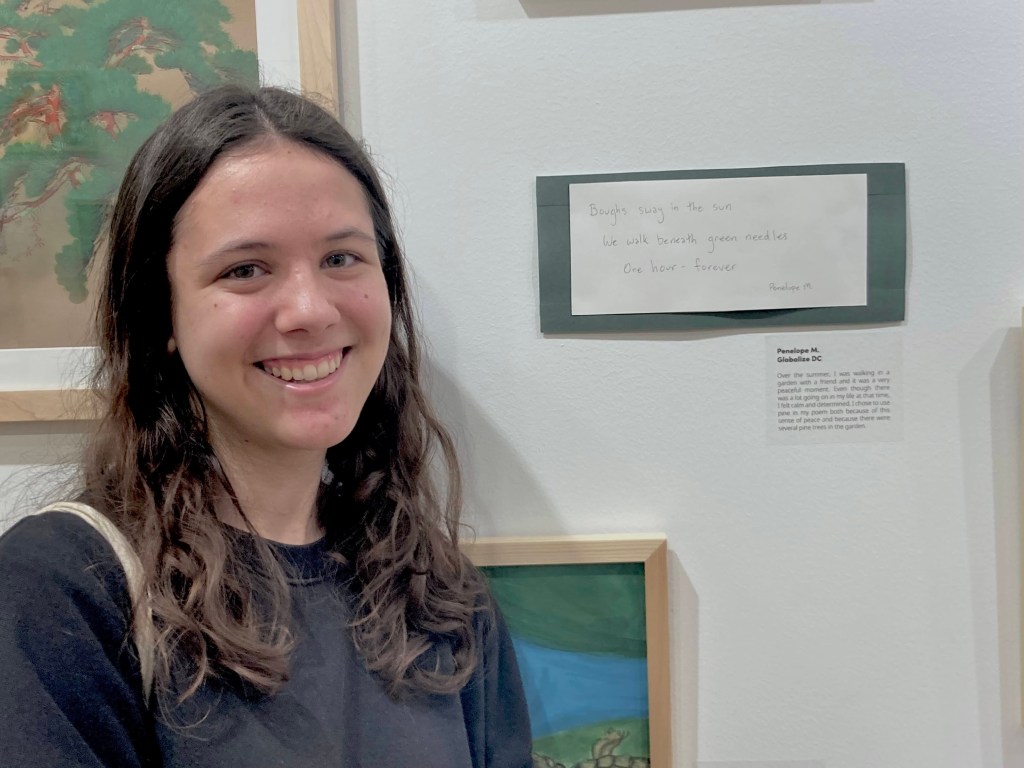
We have finally had the chance to visit the JICC (Japan Information and Culture Center) and see the haiku and flower exhibit for ourselves. Hearing that some of our peers’ works were featured was one thing, but seeing it in person, next to the other wondrous art work, made us very proud of ourselves and confident in our journey. We have been trying to further understand our relationship, our bond as it is tied to Japanese culture. Therefore, we have taken this step to get involved with celebrations that allow us to branch out and retain that knowledge.
Upon arrival, I specifically felt eager about seeing the exhibit as a whole. The set up intrigued me, as it was my first time there. The building is beautifully compact with so much information about Japanese culture and events here in DC. When we met with Aki Regan, she had us go in through the side doors. I felt like we were a very special group, and I thank Aki, Atsushi Iwai, and JICC as a whole for the special treatment, and making sure we were accommodated and could find our art.
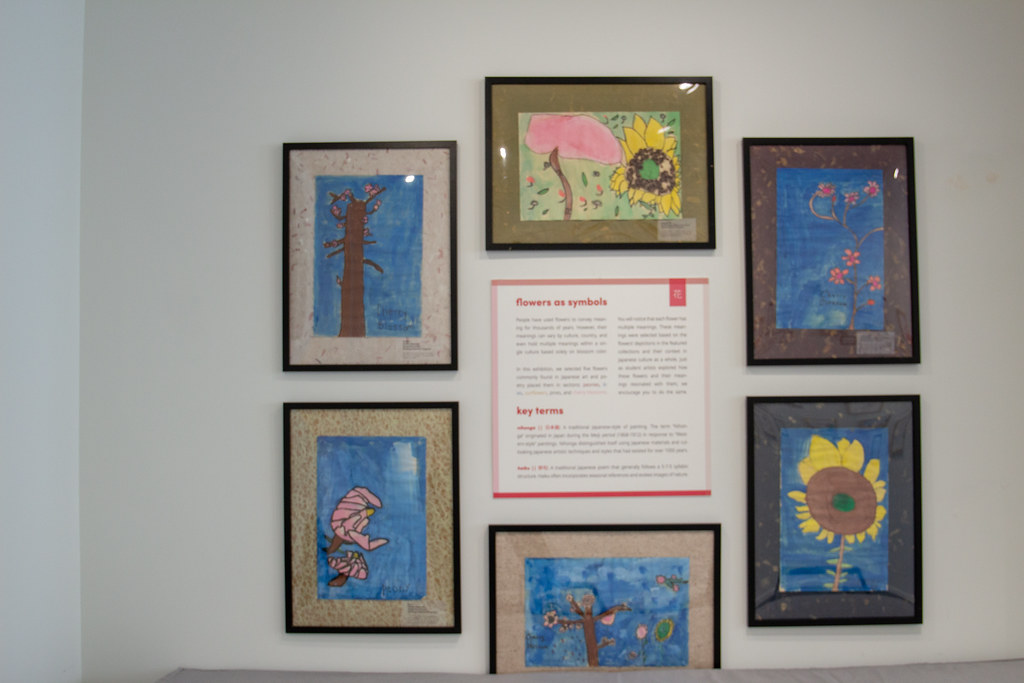
Although there were a specific number of students chosen to be on display, they had a slideshow of everyone’s work, so everyone was represented. The way I thought the exhibit looked exceeded whatever I had imagined — it was beautiful. Each wall was a different flower, with its themes. My favorite part of the showcase was that we saw a variety of talent. Work in the form of just paintings, traditionally with a painting and a haiku, or like us, with just a haiku. I appreciate the JICC for their diversity in schools and programs that they included in the exhibit. It shows the city-wide interest in Japanese culture. There was work from young elementary schoolers to advanced high schoolers.
Apart from an exhibit, they had games, ancient artifacts, and a showcase of traditional Okinawan dances by kids our age and younger. I had the pleasure of staying for the performance portion of the celebration. It was nice to see traditional dances that expressed how children years ago had fun. That day, we learned of the holiday, Children’s Day, where the day is taken to respect and celebrate the happiness of all the children. Aki also told me about this custom, Shichi-Go-San (7-5-3), where children of the ages 3, 5, and 7 are brought to a Shinto shrine, by their families, to thank and pray to Gods to protect them and ensure a long healthy life. The artifact present was one of the things they prayed to. In the performance, the children had these traditional drums, some hand sized, others as big as cellos!
The rhythmic beat which the children mirrored with their drums was great! I took a great liking to it all. Also, the girl who did karate demonstrations was great! Her technique and form was everything! I had a lot of fun that day and again was highly proud of myself and my peers.
I’m truly grateful for the sort of experience and exposure we got from the workers at the JICC. It wasn’t only a visit about haikus but about our city’s relationship with Japanese culture. As we go on with our journey, we will stay determined to continue to always cherish the relationships that we make. One more great big thanks to the JICC for having us be a part of such an incredible project and please stay in touch!
Haiku – not to be confused with Haikyuu, the anime, haha – is a traditional Japanese short three lined poem that adheres to seventeen syllables throughout, following the 5-7-5 syllable format, where the first and last lines are composed of five syllables, and the second is seven. This gives you a chance to play around with this form of art, as you have to choose specific language over others.
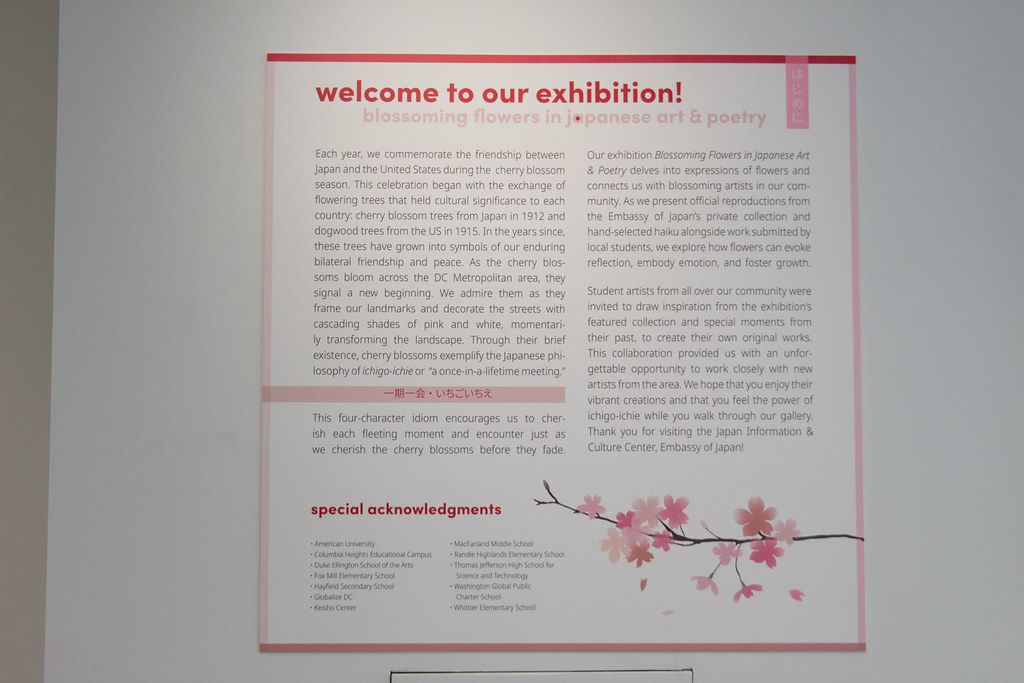
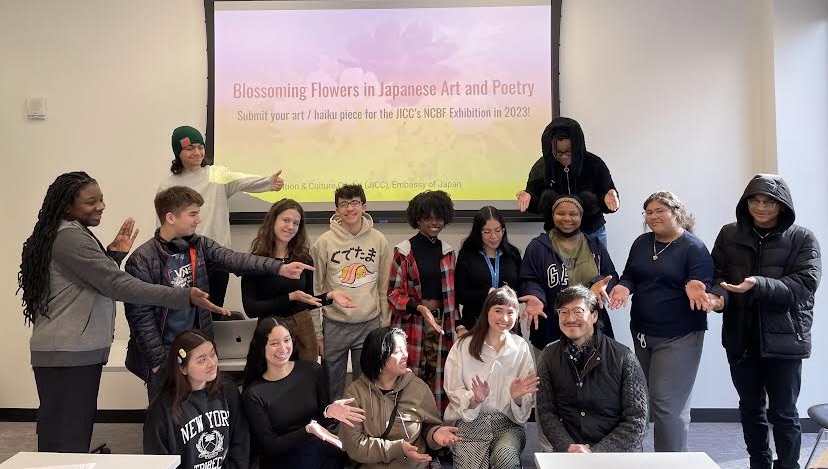
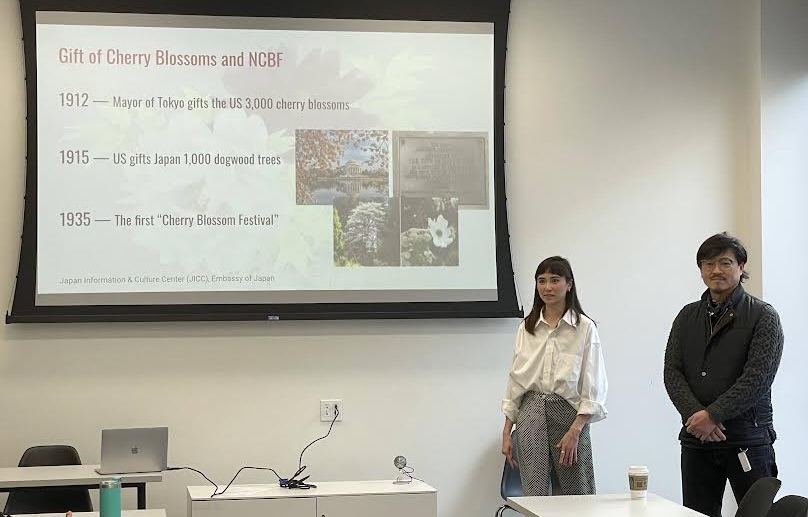
We were visited by Aki Regan and Atsushi Iwai of JICC – the Japanese Information & Culture Center, part of the Embassy of Japan – back in January, in hopes that we would want to take part in their upcoming exhibit, Blossoming Flowers in Japanese Art and Poetry, from March up until May. As the theme was flowers, we were taught about certain virtues associated with specific flowers that are often used for haikus. The main five are as listed:
Peony 牡丹/ぼたん (botan) – beauty, elegance
Lily ゆり (yuri) – purity, innocence
Sunflower ひまわり (himawari) – hope, positivity
Pineまつ (matsu) – sacred, determination
Cherry Blossoms 桜/さくら (sakura) – new beginnings, celebration
During their presentation, Aki and Atsushi shared examples of haiku from famous artists, but their setups were new to me. The haikus were associated with paintings, serving as a visual representation of what the poem was about. That art combination I thought was amazing, as it has never been something that crossed my mind, or anybody’s that I knew. The class was very interactive and we practiced our hiragana when reciting the haikus. My favorite had to be the Lily example, because of the various meanings the haiku had to offer. My interpretation was that the narrator was envious of the purity/innocence that their neighbor possessed.
The Embassy also told us of an idiom to keep in mind – ichigo-ichie (一期一会) or “a once-in-a-lifetime meeting.” This idiom encourages us to cherish each fleeting moment and encounter . . . I think it’s important, for us and everyone, to keep this in mind as we go on meeting new people everyday, because we will never know if the encounter could be what you have been looking for.
The process of writing our poems was pretty simple. Think of a memory that you would like to write about, typically one where you learned something, choose a flower based on the virtues it’s associated with, and then begin constructing a beautiful haiku. My thought process seems to delay when I need it the most, but I pulled through, we all did. The flower I chose to write about was Sakura because I wanted to reflect on new beginnings, such as our transitions back into school buildings from the pandemic, being a huge shift for many. I had knowledge that the Cherry Blossoms bloomed in the spring, which told people that a new school year had begun so it was perfect.
I came up with:
When the blossoms bloom The students meet again No longer through zoom
I am writing after we’ve heard that six of our class’s works got picked to be featured in the exhibition and I have the honor of being one of the students to have their work chosen. If you can, please go down and see the beautiful exhibition full of distinctive exquisite crafts. Find the details here: https://www.us.emb-japan.go.jp/jicc/exhibits/blossoming-flowers.html
Congratulations to the five other amazing peers and thank you to my entire class for sharing their artistry and experiences. And a special thanks to Aki and Atsushi for coming down to speak with us and for wanting us to be a part of the exhibit. We would enjoy having you guys come back to teach us more. We will continue to strive to connect with many through our art. And we will truly always remember to cherish 一期一会– – ”a-once-in-a-lifetime-meeting”.












 GLOBALIZE DC: JAPAN