
By Ana Nguyen
The first time I walked into a Christian church, I was 15 years old.
So, my family are Buddhists. Though I was raised with the statue of Buddha in my house, and my parents practiced Buddhist traditions and praying methods, it wasn’t strictly ingrained into me. Though churches here can have a welcoming atmosphere, no matter the area one is in, I felt really uncomfortable walking into that church. Religion wasn’t a huge thing in my upbringing, and I felt like I was trespassing on someone’s house.
From “A Geek in Japan,” I learned religion is entwined with the culture and daily life of people in Japan compared to the U.S. In Japan, one can be Christian and still go to a Shinto shrine to make a wish. Religion in the U.S. stays within the church or home mainly, and yes, people practice their religion in their daily lives, but it’s not widely done. That’s compared to Japan where saying “itadakimasu” before eating is a habit to say thank you for the food, but it also stems from a religious practice similar to giving grace. That separation of religion and school or work sort of creates a barrier. It’s amazing that religions like Christianity, Catholicism, Buddhism, or Shinto can cross over one another in Japan, while here it stays separate.
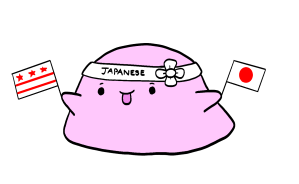 Inspired by the cute mascots from Japan, jello and the Pokémon ditto, punipuni was born. I wanted to make our mascot have a “kawaii” look, similar to the mascots of Japan but also simple so that it’s easy to remember and recognizable. While doodling on homework, I sketched several nameless forms along with a few cats and punipuni was born. Punipuni is holding the DC and the Japan flag in its hand representing Japanese Plus. It’s the only program in DC that offers Japanese to students and the mascot represents how we’re integrating more Japanese culture into DC students. The pink, formless blob represents how this program can take any shape because of the students in it.


 GLOBALIZE DC: JAPAN