On March 30th, I as well as the other members of Japanese Plus had the privilege of welcoming 16 Japanese high school students to DC and to our program. The TOMODACHI (which translates to “friend”) Exchange Program was originally created following the 2011 Great East Japan Earthquake to bring Japanese students from the Tohoku region to the US as a way of maintaining the bond between Japan and the US. These exchanges still happen today and we were lucky to be a part of one.
When the students first arrived, we welcomed them by explaining our program and what we do and initiated the social activities with a rotation of speaking partners. We formed groups of 2-3 people and went around talking to the students about our respective lives and similarities between them. I found similarities with the students especially in videogames, sports, like tennis and soccer, and music tastes. I met two guys that I had a lot in common with and they supported me during the group presentations we had to do shortly after, by cheering me on and giving me tips. Our presentations were about different places in DC that may not be as famous but are worth knowing about to understand DC, like Anacostia, the Tidal Basin, and Georgetown. I even mentioned some fun facts like how Georgetown had the best movie theater seats.
Following the presentation we walked to the American History Museum. In smaller groups, we then toured the museum. The museum had very nice exhibits that I feel overall represented American culture well. One of my favorites was an exhibit that showed American pop culture throughout the decades, including sports achievements/jerseys, movie props, and famous outfits. I also enjoyed the exhibit that showed how the average American house changed throughout history from the 1700s to today. It was an experience I enjoyed a lot and I’d love to participate in exchanges in the future.
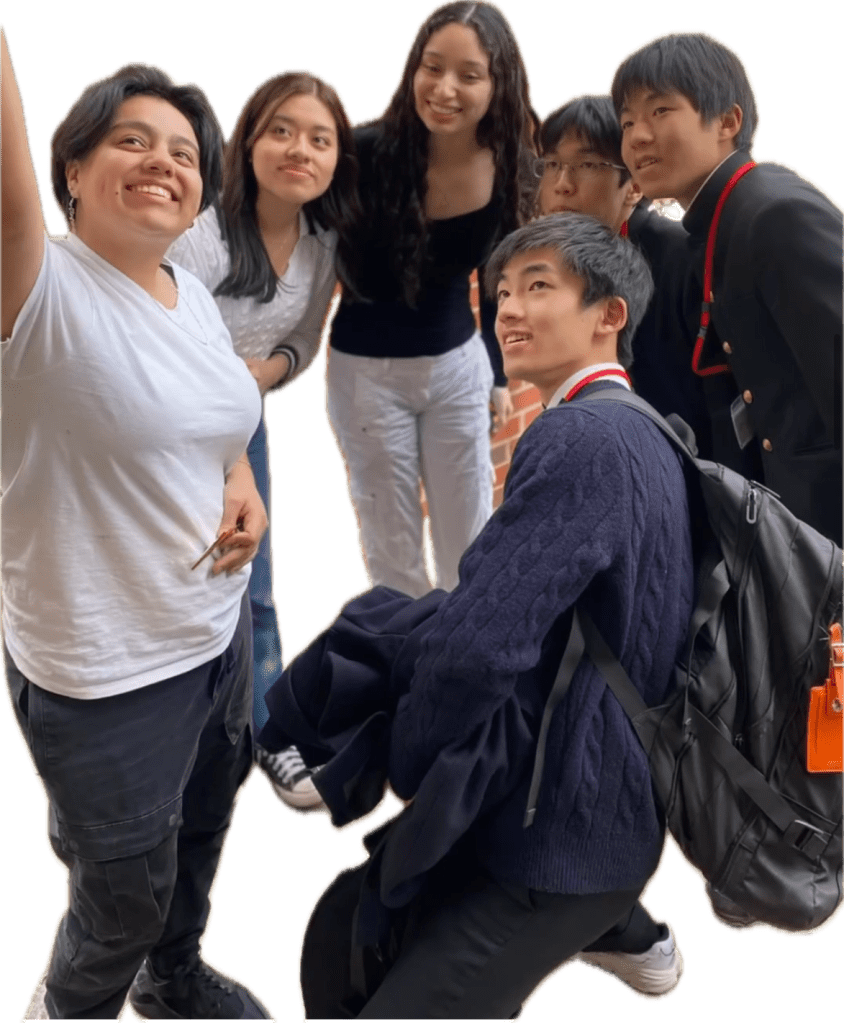
On March 26, some of my Japanese Plus colleagues and I first interacted with the KAKEHASHI group. Our school, District of Columbia International School, first hosted them. I was paired with Riki, one of the nine boys. Over the course of three days seeing each other on different occasions, we got familiar with each other. On Tuesday and Thursday, they visited our school and then visited Japanese Plus on Wednesday. We also hung out on the National Mall, going to a museum and played sports like soccer, frisbee, and badminton just to have extra time together.
Riki and the other boys were easy to talk to and fun to be around. Riki was an easygoing person and also invested in conversations by asking more questions and wanting to know more. His overall character was very genuine and nice. I’m glad I got to meet him.
That’s Riki in the middle.
I feel as through my classmates and I really made a strong connection with the KAKEHASHI group. I learned a lot from their presentations, like what made a good castle (to make a good castle it should be on a hill and have complex entrances), how to make origami, cherry blossoms (how they also represent the finish of friendships, and how they are short lived but beautiful, etc). I also learned a lot of differences from America and Japan, for example like social media. The US often posts pictures of friends, selfies, and a lot of things we do. Whereas in Japan they often don’t show their faces, often just showing their food and activities. It was exciting to see things in another perspective. For example, how most American foods have cheese on it. Also how squirrels are actually rare to see in some areas.
Sad to see them leave but glad that we met. This exchange was very memorable for me and will continue to encourage me to continue my language learning and my relationship with Japan.
Every time I meet a new group of Japanese students I am excited to test my Japanese language skills and meet new friends. While talking with Japanese students, I felt thrilled that I was able to practice my Japanese and that they could understand what I wanted to say. While speaking with them, I got excited to see my own progress.
Due to the scheduling we got to meet two different groups of Japanese students in one week. With the KAKEHASHI group I was able to see their presentations on さくら (sakura), しろ (castles), and おりがみ (origami). It was also very fun with this group because they were able to spend a day at my school, DC International. I’m glad that they got to see the difference between American and Japanese schools. For example, in Japan the students stay in one class the whole day while the teachers are the ones to move around. Here in the US it is the opposite. The next day with the group we got to play soccer on the National Mall.
That same Saturday I was able to meet with students from the TOMODACHI group. While exploring the city and eating lunch with them, something that stood out to me was conversing with girls my age from a different country. From talking about things about school and food to TV shows and boyfriends, these are conversations I will remember and look back on happily. Seeing the students’ perspective on my city and how they would take pictures of things that I considered normal (one student actually said that squirrels aren’t common in Japan) made me view DC in a different light and be thankful that I am here. I hope to meet all the new friends I made again.
Have you ever embarked on the journey of learning a new language only to find yourself drowning in doubts along the way? Were you plagued with questions like, “Am I really getting this right?” or “Will I ever be able to hold a conversation?” For me, learning Japanese has been a rollercoaster of doubt and determination. As I delved deeper into the language, doubts lingered as I was absorbing new material. Could I actually speak Japanese?
On Saturday, March 30th, Japanese students from the TOMODACHI Amway Japan Foundation Tohoku Future Leader Program came to Washington DC. They were from the Tohoku area and I had the opportunity to immerse myself in their company. I spent the day with them from 10:00 am to 5:00 pm.
In the beginning, I found myself in an unexpected situation. Due to an odd number of Japanese Plus students, I wasn’t paired with a DC partner. Instead, I was thrust into conversations with two or three Japanese peers at a time without an English-speaking partner of my own. It was nerve wracking at first, however, it was thrilling. I realized that I could indeed hold my own conversation. I used new vocabulary such as “おすすめ” (recommend) and “みなさん” (everyone). It was really fun figuring out the extent to how much I understood from the Japanese students. Our conversations ranged from what type of music we like to listen to, to recommending each other different places to visit in our hometowns.
For one of the activities, we were tasked with a challenge to design a virtual adventure tour for the American students, showcasing sightseeing spots from Tohoku. This activity was aimed to bridge cultural gaps and give us a taste of rural Japan. I was grouped with 3 Japanese students and my classmate, Kori. They were really eager to tailor their experience to our interests and asked us, “Would you want to hike? Do you want to eat traditional Japanese breakfast in the morning? Do you want to wake up early?” Based on me and Kori’s responses, they crafted the start of a morning. We would wake up at 5 am and journey to the top of Mountain Iwate to watch the sunrise. Afterwards, we would eat a traditional Japanese breakfast that consisted of Miso soup, rice, tamagoyaki (rolled omelet), and fish. During the activity, what struck the most was their choice that consisted of natural beauty and local traditions over the conventional tourist attractions such as museums and restaurants. It gave me a glimpse into the life of Tohoku.
After the activity, there was a panel to discuss the tsunami that struck Japan on March 11, 2011 and how it affected Tohoku. The panel featured three Japanese adults, each sharing their perspectives on the disaster’s impact and the recovery efforts that followed. One of the panel discussions that I found interesting revolved around a disconnected landline phone, known as the “Phone of the Wind”. The phone is situated in a small white phone booth which overlooks the Pacific Ocean. However, it offers those left behind the opportunity to communicate with loved ones lost to the disaster. This discussion was interesting to me because it highlights how different cultures approach healing and remembrance. It not only shed light on Japan’s cultural response to disaster and loss, but also underscored the universal need for emotional outlets and communal healing,
As the day unfolded, our adventures took us to the White House and the Smithsonian National Museum of American History. Every step of the way, I seized the opportunity to engage with as many Japanese students as possible, from creating a TikTok video to delving into a myriad of topics.
In those moments, doubts melted away, replaced by a newfound confidence in my abilities. It was a revelation, a tangible proof of progress that fueled my determination to continue this journey of language learning. This experience not only served as a communication revelation, but gave me more insight into Japan’s culture.
On March 26, DC International School (DCI) received the amazing opportunity to meet 9 Japanese exchange students who won the American Bowl to spend a day in the life of a U.S high school student. It was especially exciting because even though I had experienced exchanges with Japanese high school students, it was the first time I would show my school, class environment, and my friends to them. Once the Japanese students arrived to my school, Shunsuke became my partner and he would shadow me during my classes. Before going to class, I met with Margarita and Jennifer with their exchange student partners and gave them a tour of our school.
They were so surprised because our school is very big and that in my school we only take four classes daily, but they last 1h 25m; meanwhile, in my partner’s school they take seven classes daily. During this tour I found out through Shunsuke that my school and his school share some similarities and differences. For example, they have geology as a science class but we don’t. Meanwhile, my school offers different language classes while they are required to take English. After the school tour, our first was French class. During this class we were reviewing how to compose a sentence with different structure. Shunsuke would ask me questions about the meaning of the French phrases and I thought how studious and cute he was when he would take notes on the lesson. Later, we regrouped with the rest of the exchange students in the library. During this time me, Margarita, Koki, Shunsuke, and Ryo talked about our school experience. Shunsuke would tell his friends that he found my math class really hard, especially a certain math problem which his friends tried to solve and then I told them that they are supposed to use the Maclaurin series to solve the problem. Their faces quickly became surprised because in Japan this type of math concept is learned during college.
After, our short talk, the Japanese exchange students presented to us their presentation. The first presentation was about さくら (Cherry Blossoms). I learned that the Cherry blossom to people is beautiful, cute, and hope. But Cherry blossom can also means short lived and endings, such as in relationships. The next presentation was about お城 (Oshiro) which means castles which were built for military purposes. I really liked this presentation because in every slide there would be a question and we got to choose how we wanted the 城 (Oshiro) built. The last presentation was about origami. We got to see how origami is used to solve math problems and applied in real life situations which I thought was really cool. We even got to do some origami by learning to make a general hat.
This is us during lunch time
After the presentations, it was lunch time and because it was sunny outside we chose to have lunch in the field. The Japanese students got to see how DCI students spend their time during lunch time like playing soccer and frisbee. During this time we talked about what we like, such as anime, songs, and about our school life. They also gifted some snacks such as candies, cookies, and tea which had a little message in the packaging. Once lunch ended, it was time to say goodbye which made me sad because I wanted them to see more of DCI. This experience showed me that despite our homes being hundreds and thousands of miles apart we still make the same jokes, laugh at the same things, and share similar views.
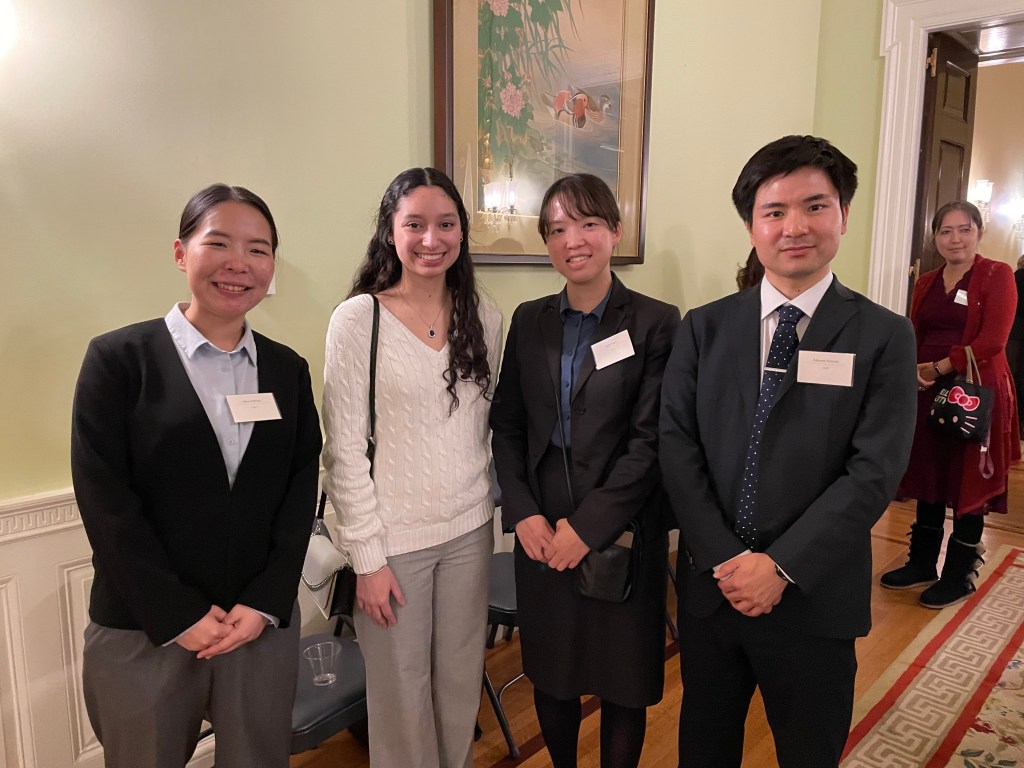
NOTE: On March 22, 2024 Japanese Plus student Margarita Muñoz Salazar and Program Director Sally Schwartz were invited to attend a special reception at the Embassy of Japan held to honor the Japanese participants in the Long-Term Education Administration (LEAP) Program. LEAP, a program sponsored by the Japanese government, brings young administrators from Japanese universities to the United States to learn from and exchange information with international program specialists at American universities. The embassy reception was held at the end of the 10-month program. The participants returned to Japan the following day.
Going to the Japanese Embassy was a culturally immersive experience, not just an event. Every moment was insightful, from discovering the accessibility of educational possibilities, to witnessing the consistency of Japanese punctuality.
Importantly, the embassy provided valuable information about possibly studying in Japan. It is not easy to start studying in a new country and as someone interested in going to Japan, learning about the wide range of programs and opportunities in Japan was fascinating. One that stood out to me the most was through American University School of International Service which would allow me to get an undergraduate dual degree (BA in International Studies). Students that participate in the program will spend 2 years at American University and another 2 in Ritsumeikan University. Participating in this program will allow me to gain the skills and experience to excel in careers in both countries. Not to mention that the tuition for Japanese universities is significantly cheaper than in America. All the programs and scholarships I learned about motivated me even more to study in Japan, and I encourage anyone interested to keep looking for something that fits their needs because there is bound to be something for them.
In relation to culture, I considered the Japanese dedication to punctuality to be remarkable. When I got to the event, it had already started and I was just four minutes late. This would pass for on time in many western cultures, but it would be considered tardy in Japan. It really is proof of the customs and traditions that are deeply integrated in Japanese expectations. This event acted as a reminder of how important it is to respect other cultural traditions and practices, even when it comes to presumably unimportant things like punctuality.
It was also interesting to learn about Japanese business etiquette. It left an impression that swapping business cards was appreciated. In Japan, exchanging business cards, or めいし, is not only standard practice but also a sign of professionalism and respect. Watching this practice genuinely highlighted how important small actions are to creating trust and relationships.
Of course, visiting the Japanese Embassy wouldn’t be complete without trying some Japanese food. Having sushi (すし), a traditional Japanese dish, was the high point of the visit. Each dish’s excellent flavors and careful presentation showed Japan’s unique tradition.
Overall, attending the event was an honor. It provided a glimpse into Japan’s rich cultural history and left me inspired to explore more of what Japan has to offer.




 GLOBALIZE DC: JAPAN