
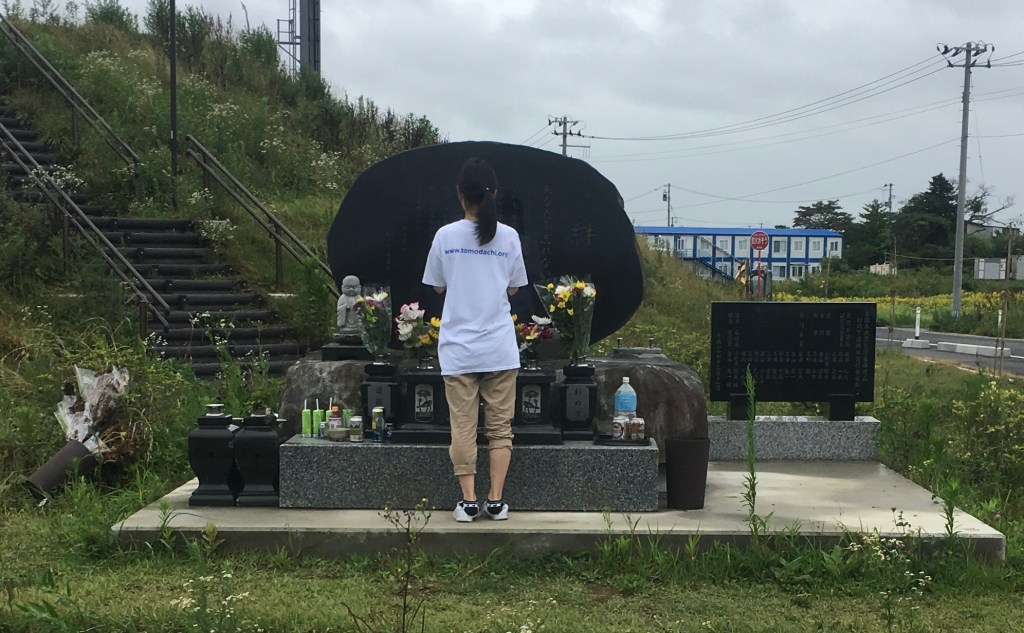
NOTE FROM THE PROGRAM DIRECTOR: On March 11, 2011, the Great East Japan Earthquake struck the Tohoku region of Japan, causing tremendous loss of life and widespread destruction of homes and communities. For six years Globalize DC was privileged to participate in the TOMODACHI US-Japan Youth Exchange Program, which allowed DC high school students to visit towns and cities directly affected by the earthquake, and to meet and engage with their Japanese peers in the region. These experiences have been deeply affecting and informative to all of us. So each year we take a few moments to recall the events of 3-11, to learn, and to reflect. This year our Japanese Plus students watched the emotionally riveting film, The Tsunami and the Cherry Blossom, which vividly documents the events of that day and the aftermath. These are some of our students’ reflections after viewing the film.
Chamiya
It was hard to watch the film about the tsunami that hit Tohoku on 3-11. Watching people lose their lives and witnessing survivors lose hope after experiencing a devastating tragedy was devastating to me. One guy said that he doesn’t want clothes or home, or anything material. He wanted his friend back, and that is something that I relate to. I admire these people for finding hope in the cherry blossoms. Finding something to look forward to, as something as small as watching the cherry blossoms bloom is admirable.
Zitlaly
It was hard to hear of the tragedies and how everyone had to accept the fact that the tsunami changed everything. Despite the fact that many lost what they would consider their lives/reason for living, they still continued to stay positive, to have some type of hope. I admire Japan for persevering and finding something or someone to hold onto during this hard and excruciating experience for so many. Also, I admire that many looked at the blooming of the cherry blossoms as a form of a new beginning, a remembrance, “rebirth,” hope, and a push to keep on going. Despite that, some felt envy for the blooming.
PS. May those who have not been found find serenity.
Felipe
One thing that stood out to me in the film was the man who lost his best friend. At the beginning he was distraught and at one point said that he had lost the meaning of his life and everything that was a part of it. However, once reflecting on the cherry blossoms and what they represented, he realized everybody was trying to bounce back because they were still alive and they shouldn’t give up. Another thing I found inspiring was what the woman at the end of the film was saying. She said she would photograph how the town was rebuilding but she also mentioned how the yearly blossoming of the cherry trees was giving her hope for the future. She said that the next time the trees blossomed, the town would be more rebuilt and the year after that even more. This made me reflect on how time is continuous and things will improve over time if you keep looking forward.
Mai
- For many people in Tohoku they couldn’t believe that a tsunami was actually happening right before their eyes.
- How easy it was for the tsunami to destroy and swallow their homes and loved ones. They could only watch, not being able to help.
- “Nature is filled with beauty and terror but sometimes we forget about the terrors.”
- The cherry blossoms have different meanings depending on how we feel and what memories we associate with them. They are goodbyes and new beginnings.
- There was a tree that has lived for more than 80 years. When the Tohoku people saw the cherry blossoms, they felt healed, allowing them to have hope and motivation to rebuild their homes.
- Cherry blossom trees have steps of growth: ichibu-zaki (which is the first step of the cherry blossoms growing) and maichiru (when the cherry blossom flowers begin to fall).
- Sakura are yuuga (beautiful but not too showy). The Japanese people have a kanji for the concept of yuuga: 優雅
Jennifer
Although the cherry blossom trees also suffered the tsunami, they managed to strive to be alive. It became a hope to most and a reflection to those who survived. The tsunami hit them hard. Some grew from it, some resented it. The cherry blossoms give a sort of reflection on how they feel about the tsunami and what they feel about the future.
Elias
I noticed the destruction which caused the deaths of many friends and families who mourned for them after the disaster. Going through something as traumatizing as a tsunami taking your home and friends and families led people to lose everything, giving them a sense of emptiness from their tragic losses.
D’Amonie Armstrong
I believe that going through something like this is absolutely devastating and will have long-lasting impact on the people of Tohoku. To see visual evidence of such disaster and watching as people tried to get to a safe haven was very disheartening. The people showed extreme bravery for abandoning or deciding to try to salvage their belongings. Many people suffered badly. However, during this time, the cherry blossoms were also almost in bloom, and that was used to bring hope for a better future. Every year that they bloom around that time, it is seen as a reason to keep going and how with each passing year, the rebuilding gets better and better.
Zion
It was heartbreaking to see the people holding out hope that their families were still alive. Children having to watch their parents get swept away. The people that just watched knowing they could not do anything to save them. The people that were just coming out of their homes, the ones that could have died if they had waited just one second longer and the many other stories of the people who had relatives that died or were missing. I could not imagine going through what they went through and I hope that the people featured in the documentary are still alive.
Margarita
It was interesting to see how much cherry blossoms are integrated into Japanese culture and life. Many people in the film mentioned how they grew up alongside the cherry blossoms. The cherry blossoms were viewed as hope when they start blooming, not long after the disaster of March 11. The film showed how the family of one of the victims had planted their own cherry tree before the tsunami, which had started to bloom afterwards. The difference between showing solidarity compared to America is also very interesting. Unlike in Japan when natural disasters happen or any kind of devastation, in the United States the news and solidarity usually remains local. Across all of Japan people were grieving, which shows just how devastating the event was. I can’t imagine how traumatizing it must have been for everyone affected.
 GLOBALIZE DC: JAPAN