During a recent lesson, the Japanese Plus class learned about sumo, a Japanese wrestling sport in which competitors try to force their opponent out of a ring, or into touching the ground with any part of their body other than the soles of their feet. Takahashi-sensei brought up sumo in the context of the week’s grammar lesson – describing the time and location of an event. So not only did we get to learn about the sport itself, we got to learn a bit about the culture surrounding it and how Japanese people interact with it.
Takahashi-sensei explained that many sumo tournaments occur throughout the year in Japan, usually at large halls where substantial crowds can gather, and she showed us a brief video of a sumo match. I was surprised by how quickly the match was over, and especially by how different it was from other martial arts with which I’m personally more familiar. I’m used to seeing lots of kicks, punches, and other more aggressive attacks in combat sports, but the sumo wrestlers had a very different fighting style that involved much more grappling and close contact. Overall, the lesson on sumo was very interesting and I enjoyed getting this insight into a part of Japanese culture about which I didn’t know a lot before.
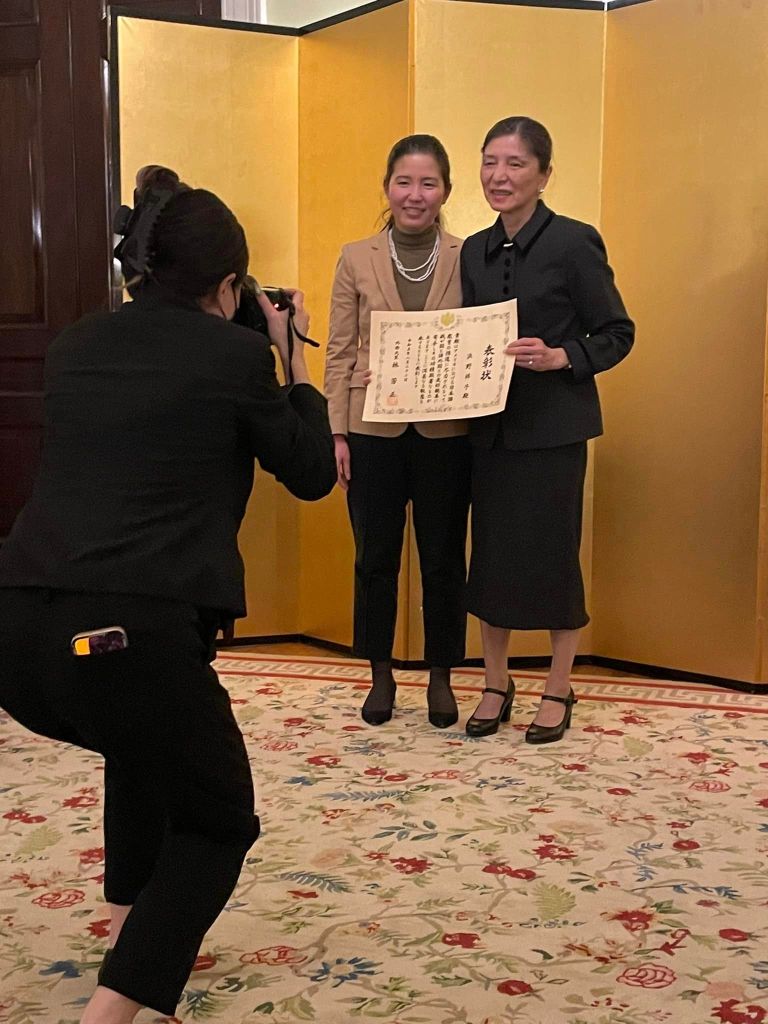
Last Tuesday, December 12, I had the privilege of being invited to the Embassy of Japan. I was very excited upon hearing about this opportunity to put myself out there. And I was beyond excited to find out that the event was to honor our level 1 Japanese teacher, Shoko Hamano-sensei, for her endeavors and dedication working to draw connections within the Japan-D.C. world. We had the pleasure of having Hamano-sensei teach us virtually from California last year. Although virtual, she had an impact on us as she was this cohort’s start into this program. We learned hiragana and our names in katakana from Hamano-sensei, so she’s a big deal to us. Starting Japanese 2, we’ve missed her and it saddened us that we wouldn’t be able to meet her in person. So, I also felt honored to be the first to see and personally greet her on behalf of my cohort.
Getting to see her accept her award, I couldn’t help but think how she’s inspired many people, as the room was filled with other Japanese teachers, former students of hers from college, and myself being the youngest in the room.
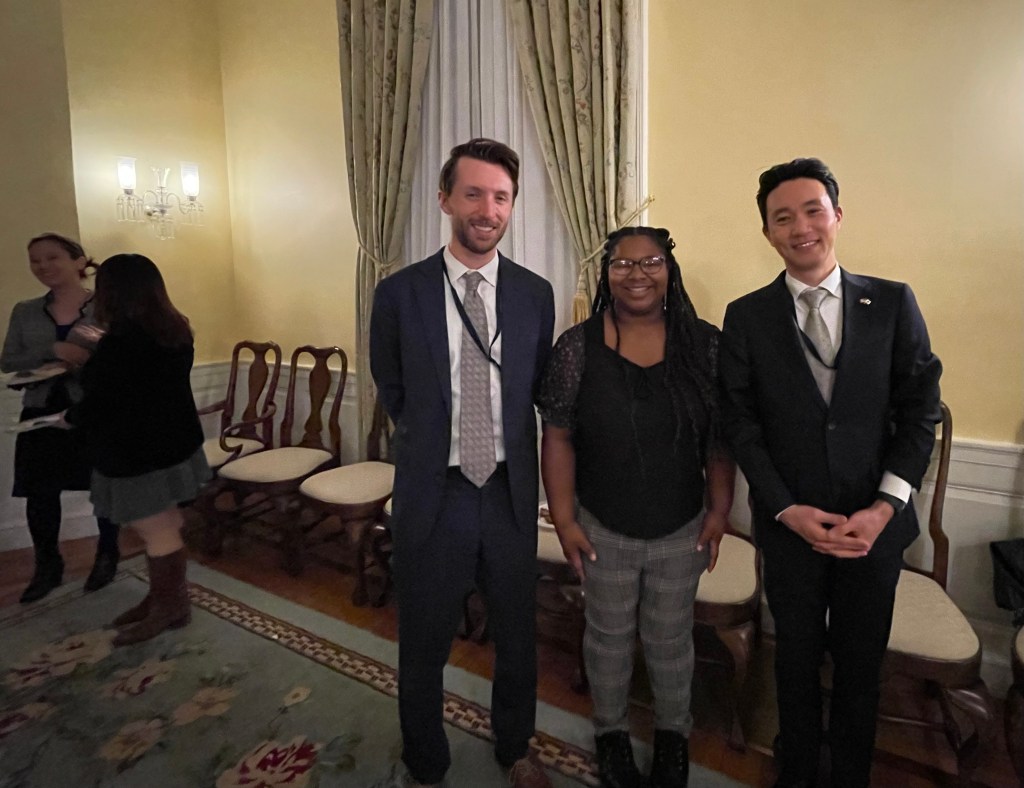
I was a bit nervous upon getting to the building. The path leading up to the building, beyond the gate, was tiny stone squares. Guests were coming in alongside us, so I was afraid of stumbling, and of taking pictures. I didn’t want to look like I didn’t belong. Essentially, the fear went away because everyone was very nice. I introduced myself to the people Sally knew and connected with others I had met before. I was also excited to see our other sensei from last year, Tsujioka-sensei. The inside of the prestigious building was bright. I liked the small and flashy vibe it gave.
When Sally had mentioned the food, I was of course more ecstatic as I would have a chance to see what was there and extend my palate. I ate well and spoke with ever greater people who were interested in my future plans (college, path regarding Japan and US relations). Being the youngest no longer intimidated me, as I could speak and hear from others who had the same goals as me, to have an impact on the Japan-DC world. I shared that I would take the opportunity to study in Japan whether directly or through studying abroad. My area of study would be linguistics with concentrations in specific languages. I also want to look into the JET program so I was able to speak with Tim Folsom from the Embassy’s Education Department, who did the program. All in all, I had fun and the evening will be remembered as one of the greatest events I’ve ever attended.
I’m glad I was able to be present and represent high school students and myself. My hope is that high school students can have the opportunity to visit these embassies. I am incredibly grateful to have been invited, and I hope this is one of many events I will attend. A huge congratulations to Hamano-sensei for her active service in international relationships, someone I strive to be.
In October, our Japanese teacher dropped some knowledge bombs and initiated us into the arts of the Japanese Rock-Paper-Scissors. Otherwise, known as じゃんけん (Janken)! Although it is called different names in different places, the rules of the game are generally the same in every country.
グー (Guu) = Rock チョキ(Choki) = Scissors パー (Paa) = Paper
To start the game, players show their fists at the same time. Players will say “じゃんけんぽん” (Jankenpon) which is a phrase to be chanted by the players together. Players are to show their hands at the same time when they say “ぽん”(pon). To make it more chaotic, in class, everyone battled against the teacher. The students were standing tall and ready to defeat the teacher, “せんせい,” in the game, while the teacher was positioned in the front with her hands ready. Victory belonged to the last person standing, the one who outsmarted せんせい. And if no one could beat her, せんせい emerged as the champion.
After the class played a round of じゃんけん against our teacher, せんせい taught the class a different version of じゃんけん. The game starts generally the same where players would show their fists at the same time. “じゃんけんぽん” is chanted at the same time and players would show their hands at “ぽん”. This is where the fun begins to play out. In this version, グー, チョキ, and パー represented different numbers.
グー (Guu) = 1 チョキ(Choki) = 2 パー (Paa) = 5
Picture this, players unveiled their hands and a thrilling race begins. The challenge? Lightning-fast mental math. Here’s the twist: quickly announce the total in Japanese after adding up the numbers displayed on both hands! For example, player one has グー and player two has パー. The added number is 六 (6). The first person to yell out “六” wins the game.
I personally love this version of じゃんけん. The more players in the mix, the crazier the number-crunching ride becomes. The pressure to add, convert to Japanese, and blurt it out first is super stressful but also really exciting. It’s also a great practice for learning numbers in Japanese. Whenever I play Rock-Paper-Scissors with my friends or family, I teach them the Japanese version. It’s so fun for both me and them because they learned a different version of じゃんけん and I’m excited to teach them about it.
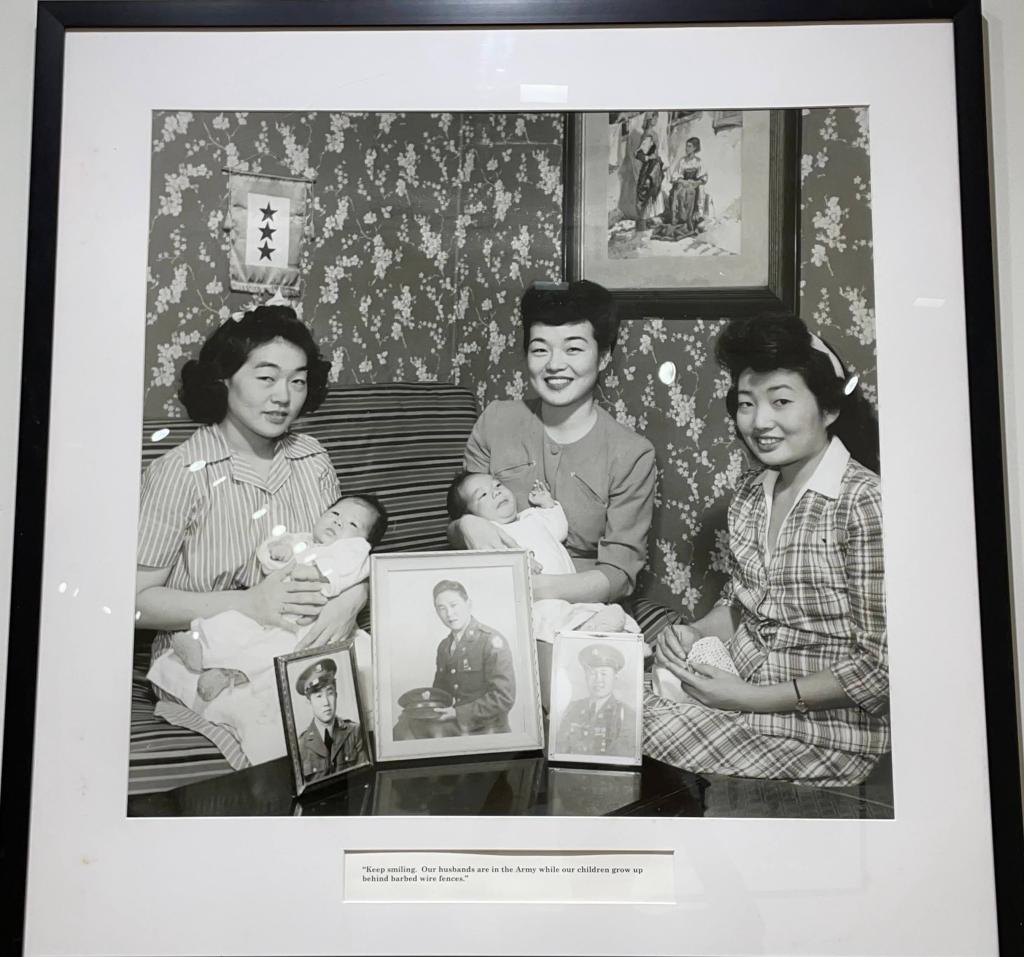
When we went to the JICC in December for Pearl Harbor Day, they had this exhibit featuring photos of Japanese and Japanese-American soldiers during that tough time.
The photo above is one of soldiers’ wives, two holding their newborn children, and all with photos of their husbands before them. It’s captioned “Keep smiling. Our husbands are in the Army while our children grow up behind barbed wire fences.” This stood out to me very much as I agree the emotions and the points of views of the soldiers are valid, but it is really the only story that gets told. It’s very interesting to hear about how others, like the soldiers’ families, think and feel as this also impacts them, especially if they have wives and children.
The caption implies that the wives have to just keep smiling and not show pain as they raise their children alone, because their husbands are away battling in a war. It feels like they’re obligated to hold up this face, while they are directly impacted. And although the children in this photo are newborns, I can’t help but think about the many other families that had children old enough to know and understand that their fathers can’t be around because they are in the Army fighting for their country. In all, this was a time of deep despair and we have the day December 7th to commemorate the soldiers, and strong families that had to hold down the homes while their husbands, dads, brothers, sons strove to protect the country that held their homes and hearts.
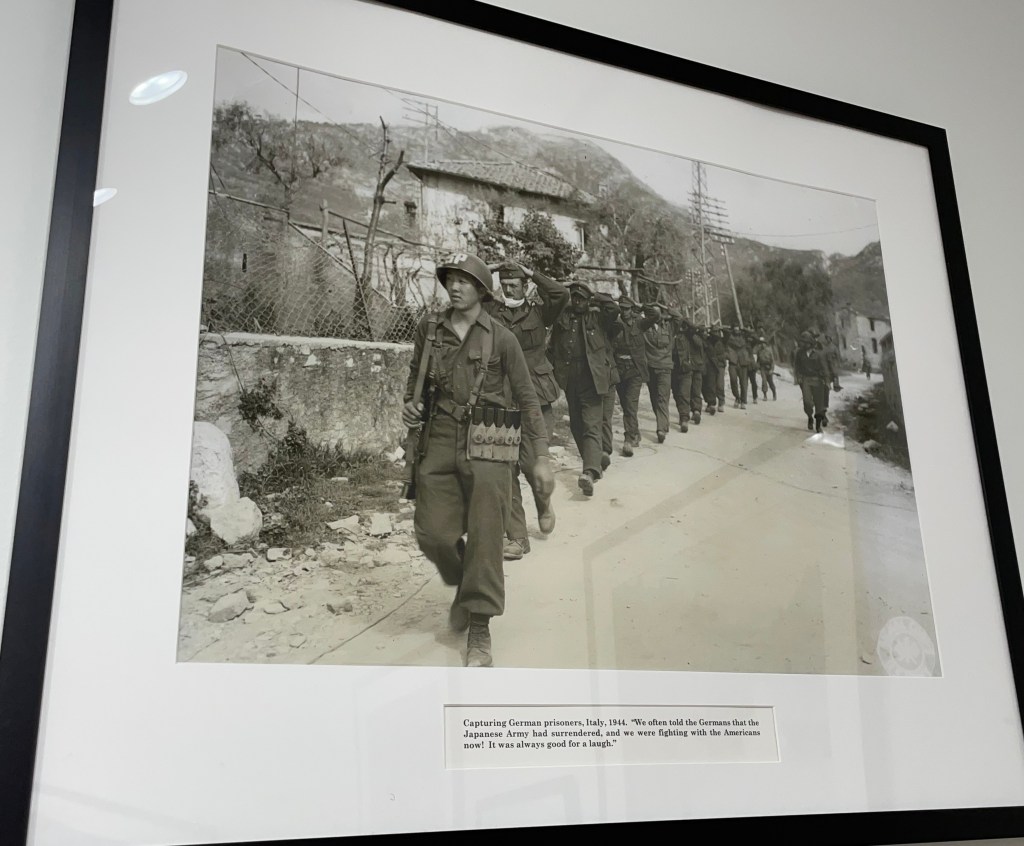
While our class was visiting the current JICC exhibit, there was a picture that really captured my attention. The picture had enemy soldiers lined up being taken somewhere while being escorted by Japanese-American soldiers. What stood out is that instead of being a tragic or upsetting description, it was humorous. After capturing German soldiers, the Japanese-Americans are able to make jokes of the situation and their situation by saying that the Japanese Army surrendered and confusing the enemy. Seeing that even these soldiers are able to have fun and stay somewhat positive made me feel happy for them, knowing that after all the hostility they have received, they are still willing to fight for their country and stay optimistic. This gives me a new perspective on the way I should see life. What these soldiers are telling everyone is that it’s okay to have fun during depressing times because we are human and it’s in our nature to look for distraction.
This picture features General Frank D. Merrill with interpreters Herbert Miyasaki and Akiji Yoshimura. The photo represents a fraction of the 14 Japanese American linguists and infantrymen who were part of “Merrill’s Marauders,” which fought in the Asia theater after Pearl Harbor. This picture specifically intrigues me because the men are smiling at something behind the lens. Regardless of the cause of their smile, it’s heartwarming and comforting to me. These men of different ethnicities have worked with each other. They collaborate with a shared objective in mind. They are enjoying each other’s company. In a strange sense, it gives me comfort to know that anyone can enjoy each other’s company if these men, of different ethnic backgrounds, can.
Although I unfortunately was not able to attend the Pearl Harbor memorial event, I was deeply moved looking through the pictures taken by the class. One that especially touched me was this one, showing Japanese soldiers recruited by the United States army to fight in the Second World War– it’s hard to imagine what they must have been feeling at that moment. On one hand, they were Americans, and I’ve heard many accounts of Japanese Americans who were proud to fight for the U.S. On the other hand, fighting against one’s homeland must be a difficult thing to do no matter if one was born there or not. Additionally, this photo was taken just a few months after the United States government began imprisoning Japanese Americans in internment camps, so this likely complicated the new soldiers’ feelings as well. Though at first glance this photo seems somewhat impersonal, all the layers to the soldiers’ predicament make the image a very touching one.
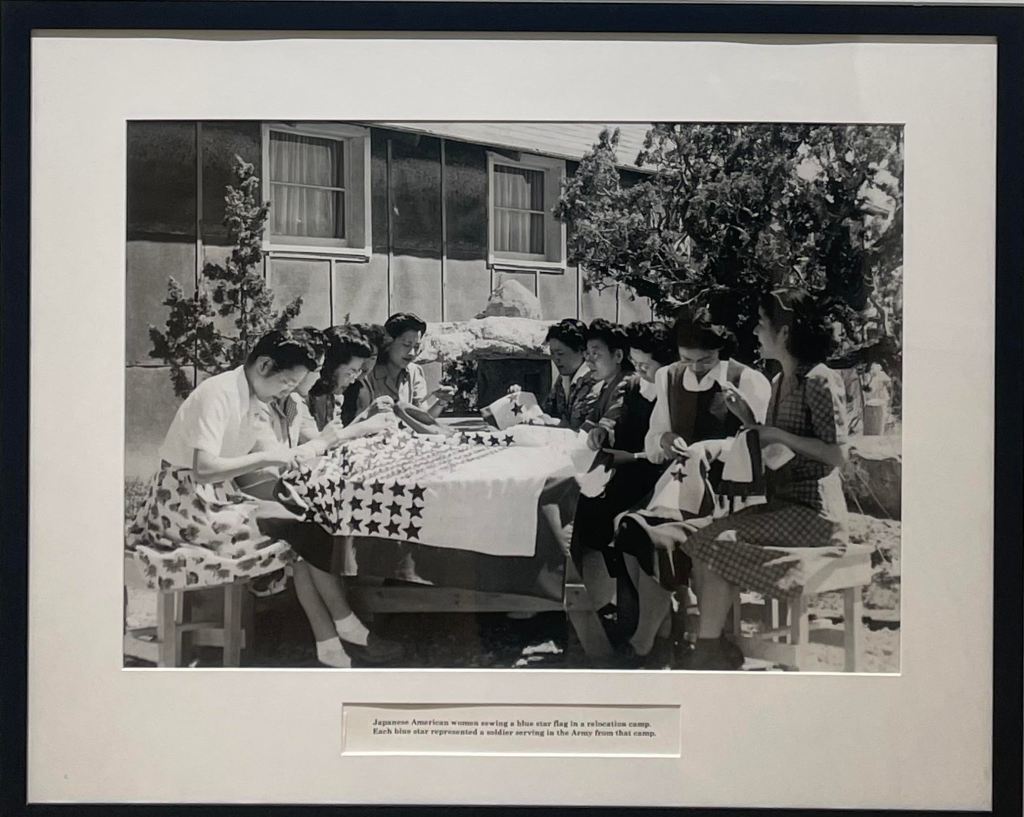
During World War II, a worldwide conflict emerged, encompassing countless individuals from different nations, all of whom made substantial sacrifices for their respective countries. Amidst this chaotic era, the often-overlooked narratives revolve around Japanese American women who found themselves confined in Internment camps alongside their children, while their husbands dutifully served in the United States Army. During the aftermath of the Pearl Harbor attack in 1941, numerous Japanese American women, alongside their families, were compelled to relocate to internment camps. Despite the difficulties posed by internment, these women actively participated in volunteer activities within the camps. One notable example was their involvement in sewing blue stars, symbolizing each Japanese American soldier serving during that period, as depicted in the provided image.
During the war, Japanese American women, like their counterparts across the United States, stepped into roles traditionally occupied by men who were serving in the military. They took up positions in various sectors such as manufacturing and agriculture, making significant contributions to the wartime economy. Following the war, these women encountered the daunting task of rebuilding their lives. Many had suffered the loss of their homes, businesses, and belongings due to internment, yet they played a pivotal role in the resettlement process. They adapted to new circumstances and actively participated in the post-war recovery efforts. The strength and resilience displayed by Japanese American women during World War II and the internment period highlight their unwavering determination in the face of adversity. Moreover, their unwavering commitment to supporting their communities and country further exemplifies their remarkable character.
Japanese Plus went to the Japan Information and Culture Center (JICC) to visit their World War ll “Go For Broke” exhibition. There were many photos of families, relatives in the army, the Japanese-American contributions to World War ll, and many more. One thing I noticed while walking around is that most of the photos were in black and white because of the period of time. However, there was one photo that was in color near the entrance that was a reunion of the Japanese-American veterans fighting for the U.S.
While walking around there were many photos that caught my attention. One that captured my attention the most was of three women sitting around a table smiling at the camera, two of whom held babies in their arms, and on the table were three pictures of their husbands in their military uniforms. At first, I thought that this meant their husbands had passed away until I read the caption. “Keep smiling. Our husbands are in the Army while our children grow up behind barbed wire fences.” This was in reference to the Japanese-Americans being in camps because President Franklin D. Roosevelt issued Executive Order 9066. E.O. 9066 meant Japanese-Americans were sent to camps behind barbed wire fences, weren’t able to leave, and had no role in deciding if they wanted to stay in their homes. The Army took volunteers to help fight in battle and their brave husbands stepped up to the plate along with many other Japanese-Americans, despite being held in imprisonment.
The realization that these babies have to grow up in a harsh environment without their fathers made me feel sad. Then I also realized that the wives must be very worried about their husbands that they can die in the line of fire, and yet these strong women are still able to smile for a picture and continue to live in inadequate living conditions while taking care of their children. There was a deeper meaning behind this photo which is what really captured my attention. Not only the bravery of the husbands fighting in combat but the strength of the mothers. “Keep smiling” is the phrase that made me realize how grateful I should be. It makes us realize how privileged we are and reflect on how we should be more grateful and appreciative.
On December 7th, our Japanese Plus program got to go to the Navy Yard in southeast DC to participate in a special event commemorating the lives lost when the Japanese attacked Pearl Harbor in 1941. We were invited to take part in a Pearl Harbor Remembrance Day Program there by the National Museum of the US Navy. On behalf of our whole group, we want to express appreciation to Education Director Paul Perry and the others at the museum for inviting us and for being such great hosts.
Tristan, Elias, Kori, Felipe, D’Amonie, and me – with our Japanese teacher Takahashi-sensei, DC State Board member Dr. Jacque Patterson, and Globalize DC’s Sally Schwartz. Paul Perry giving us instructions for the day.
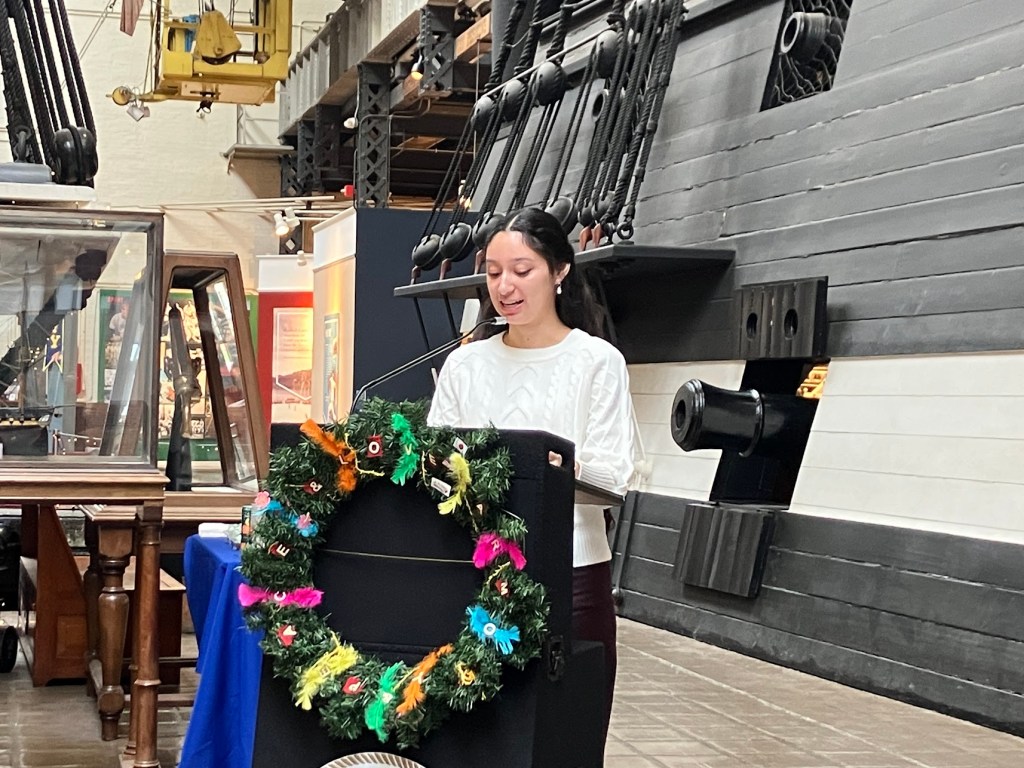
Days before the event, thanks to a visit from Paul to our class, we got the opportunity to create our own wreaths that would be put on display. Wreath making was fun as we all got to show off our artistic and creative skills. Not only that but it gave us a chance to reflect on why people should commemorate the loss of life at Pearl Harbor, and how to include those thoughts on our design.
On top of making the wreaths we had to write a statement on why we believe it’s important to commemorate the lives lost, both Americans and Japanese. Coming up with the statement required me to reflect on the war’s involvement in history and how it affected people at the time. I was able to reflect on the consequences of war and the importance of avoiding similar tragedies.
“Remembering both American and Japanese-American lives lost during Pearl Harbor is important in acknowledging the complexities of history. It recognizes the significance of respect and compassion among diverse communities while accepting the pain and losses suffered by people on both sides of the conflict.”
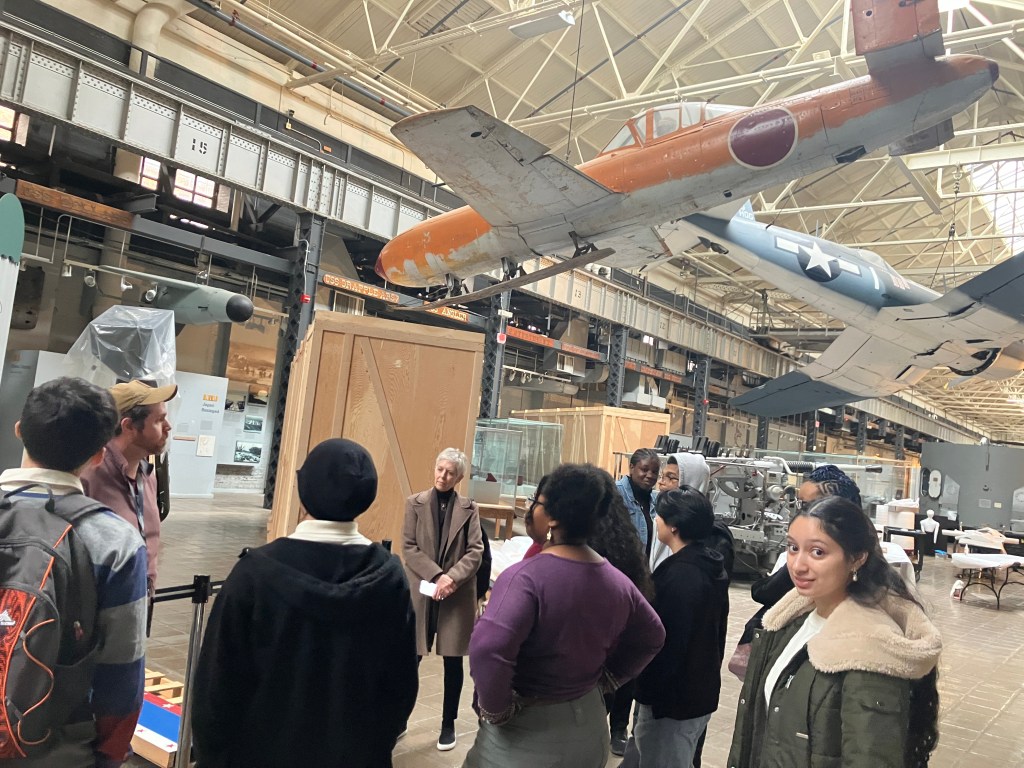
The Navy Yard itself is magnificent; it is as if I was walking into a history book. All the artifacts and ship models were so remarkable. It was as if I was learning about American history all over again. My personal favorite exhibit was the life sized version of the inside of a wooden boat. Being able to see a life sized cannon is not something very common. I recommend that people go see the museum themselves.











 GLOBALIZE DC: JAPAN