By Elias Lovos
To me, and I’d like to assume to the others as well, going to places that hold historical significance towards Japan helps keep my motivation to pursue Japanese language learning even further. Reading, looking, and imagining how everything was put into place behind the history just inspires you to read more into it, wanting to learn more about the topic and the overall history.
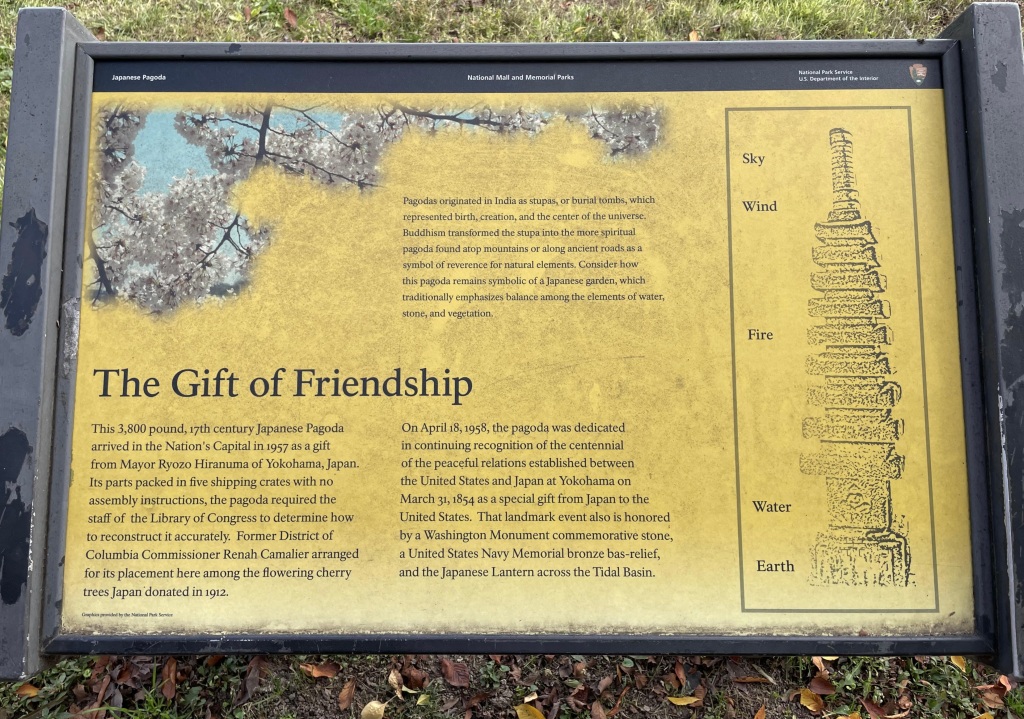
Thankfully, in Washington D.C., there are historical landmarks and workshops we’ve gone to. For example, we spent a Saturday morning last month walking around the Tidal Basin, which is located near the National Mall. A pagoda we found near the FDR Memorial includes the 5 elements: Sky, Wind, Fire, Water and Earth. This historical piece was given to the United States from Mayor Ryozo Hiranuma of Yokohama, Japan in 1957. It’s honored and kept in good condition by the people who choose to admire the piece instead of attempt to vandalize it. It’s respected by all, signifying the US and Japan relationship to be strong, and shows Japan’s appreciation to the US by giving them a piece of themselves along with the cherry blossoms around the Tidal Basin.
Furthermore, on November 4th, Japanese Plus students attended another workshop by Onigiri Action, sponsored by Table For Two, which happened at Marianne’s Cafe on the first floor of the Martin Luther King Jr. Memorial Library in downtown Washington D.C.
The workshop allows you to make your own onigiri (rice balls) to enjoy, savoring the taste. But in return, taking a quick picture and posting it on social media using their hashtag or on their website will allow you to feed starving children around the world. The significance this has on children’s lives by only making an onigiri and posting it to the public for more awareness is a wonderful experience and action.

These are just a few experiences the class and I have attended. Hopefully we get to attend more field trips surrounded by Japan’s history, whether its music, art, environment, and even architecture. Because of these field trips, we all are replenishing the drive that drove us to join this program: learning the culture and language of Japan.
 GLOBALIZE DC: JAPAN