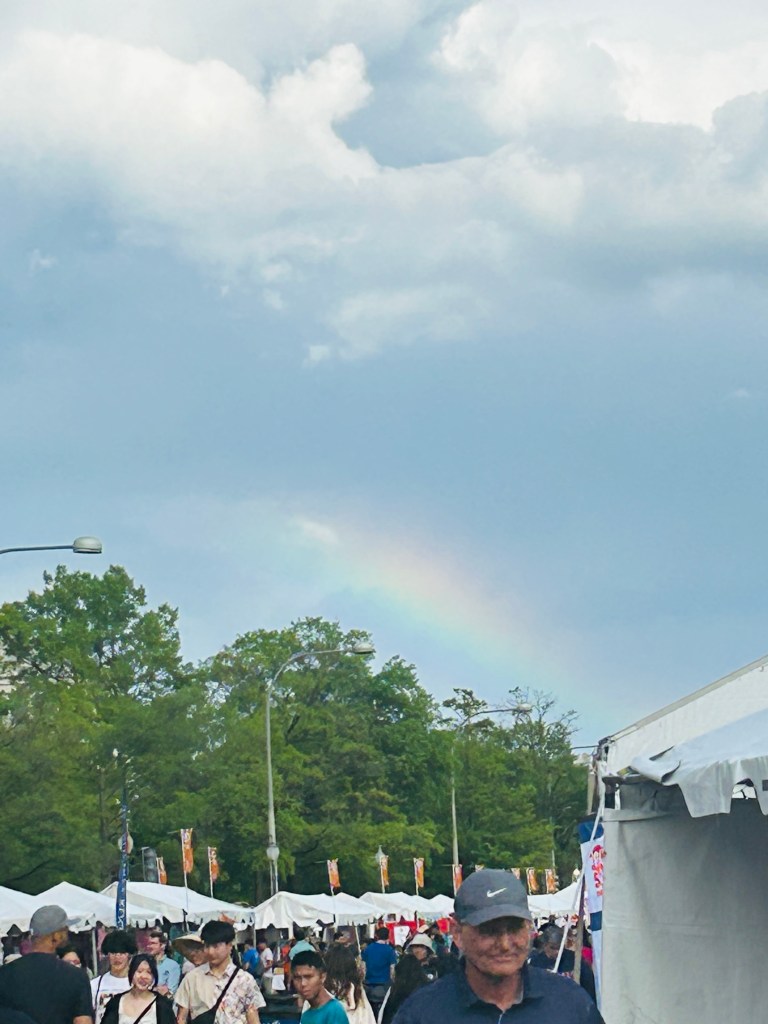
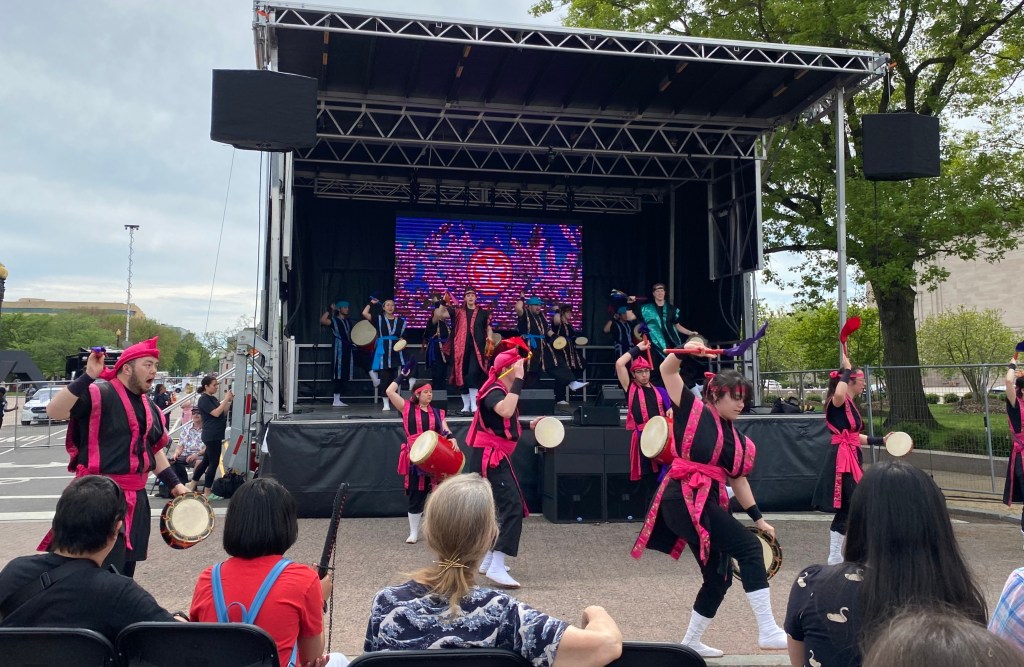
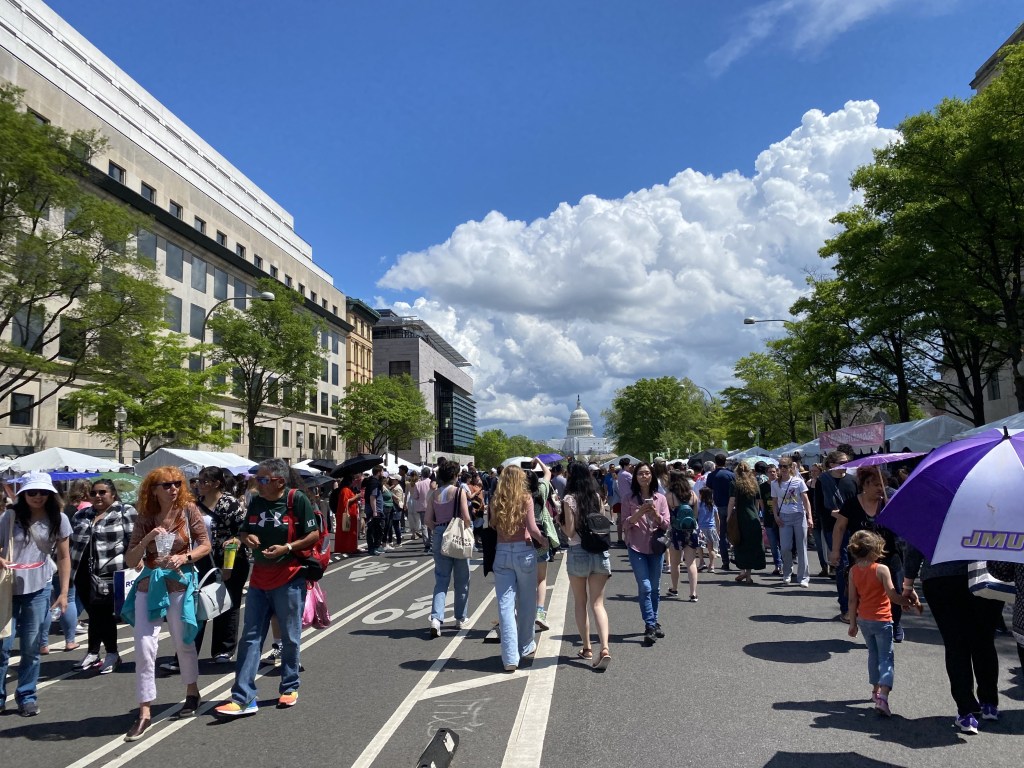
From April 15-16, me and the other Japanese Plus students got to work at the Sakura Matsuri. Over the course of two days, the Japanese street festival Sakura Matsuri takes Japan right into the heart of the nation’s capital. The event, which spanned from 3rd to 7th Streets, NW on Pennsylvania Ave at the foot of Capitol Hill, offered two days of authentic Japanese food and beverages, cultural performances, handmade Japanese crafts, and so much more.
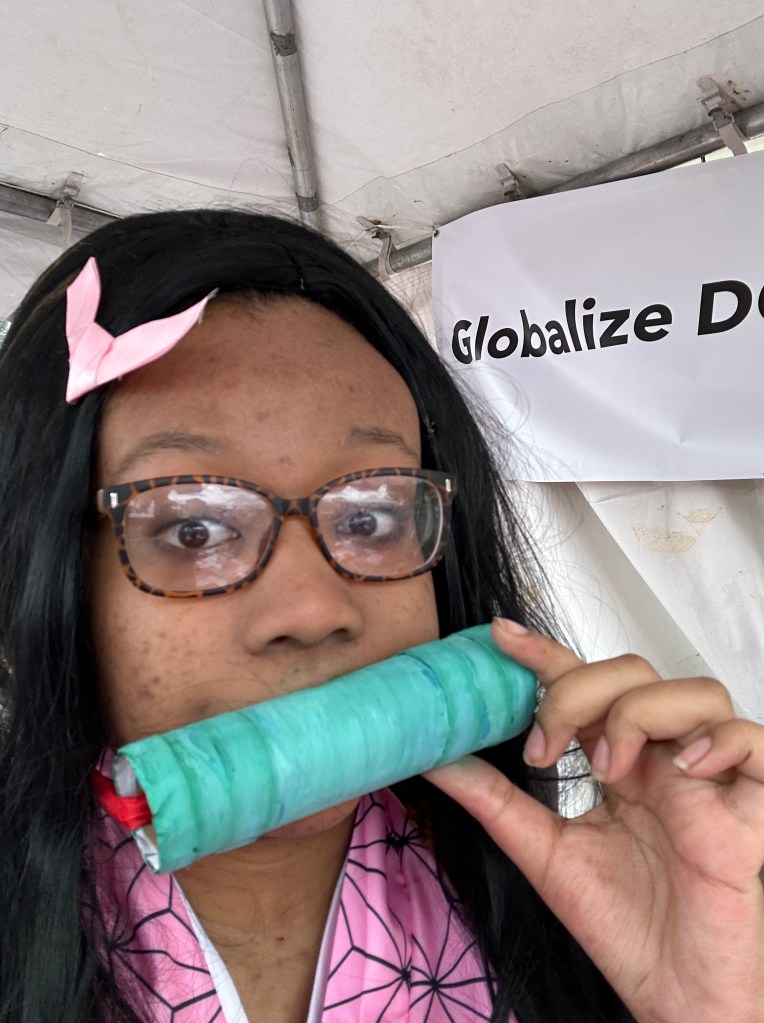
I was able to dress up the first day of the Sakura Matsuri, cosplaying as a character many had known and was able to even get a few pictures with other cosplayers while working at the Japanese Plus booth. I was able to meet many people, some who even lived in Japan who were able to give us some tips if we ever decided to work or study abroad in Japan as we grow. Once I finished a shift, I decided to walk around and explore the festival, which came to an abrupt stop as it began to pour down with rain causing a lot of people in different booths to stay under for a few minutes, even meeting some students from past Japanese Plus programs.
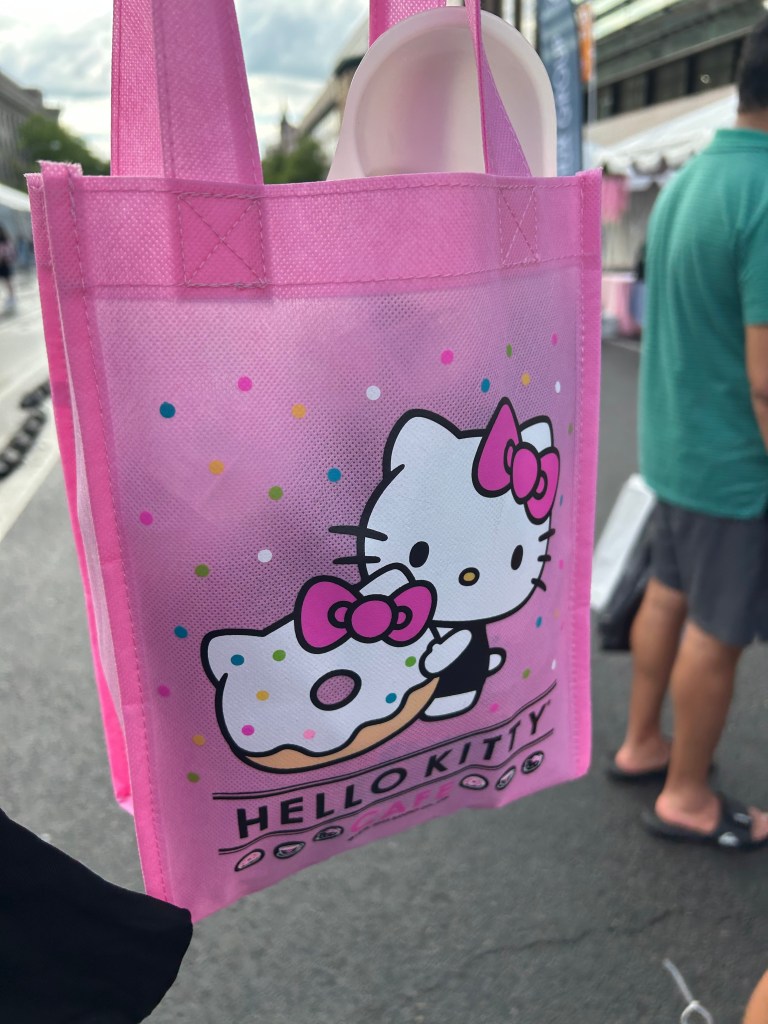
After the rain began to stop, that’s when I took my time to walk around the festival for real this time. Getting the chance to try many different foods, Chicken Katsu, Sakura Mochi and Kakigori over the two days. I even had the chance to go to the Hello Kitty Cafe Truck, a short line thanks to the rain but it was extremely long earlier in the day. If you ever find out where the truck is make sure to get there early as lines will be long and you’ll be stuck for a bit.
Combined with gachapon and crane games scattered along the festival, and many different shows of Taiko Drums, and just many different showcases, the Sakura Matsuri is definitely an experience you want to participate in. If you can, you’ll be able to try many different cultural foods and even buy handmade items from Japan.
I will definitely be going again next year to see what will be different from my 2023 experience.
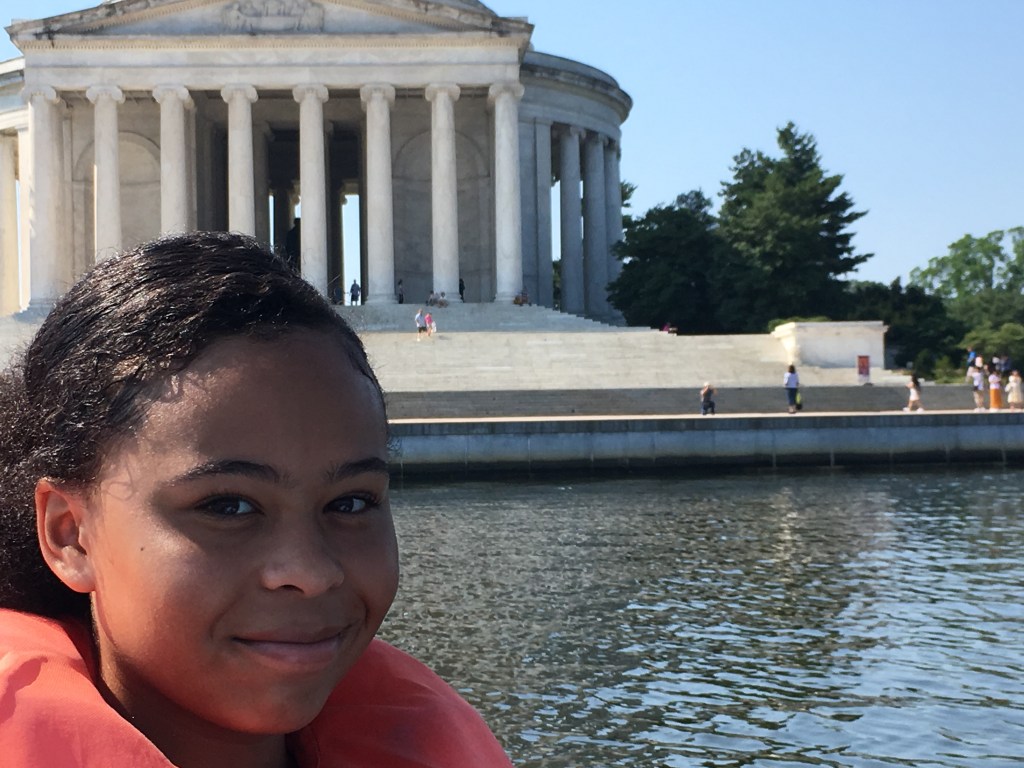
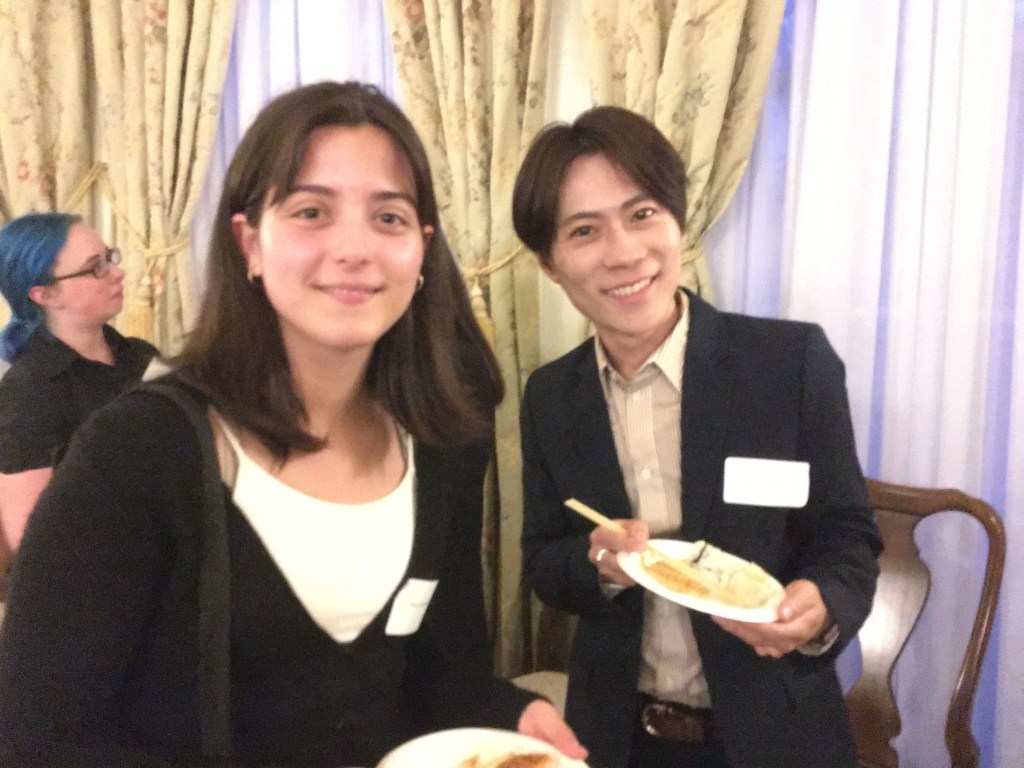
Current student D’Amonie, alumnus Carlos Ramirez, our teacher Tsujioka-sensei, and Tomoyuki Watanabe visiting from US-Japan Foundation.
By Penelope Morris
One of the first things that comes to mind when one thinks about Japan, especially as it relates to DC, is the cherry blossom tree. This tree and its blossoms feature heavily in Japanese culture and symbolize the fleetingness of beauty. They also symbolize the relationship between the US and Japan, as the several thousand trees that grace the banks of the city’s Tidal Basin were a gift from Japan to the US to symbolize the friendship between the two countries. Now, DC celebrates the blooming of the flowers each year with the National Cherry Blossom Festival. The part of this weeks-long festival that is most exciting to us is the Sakura Matsuri, a two-day street festival on Pennsylvania Avenue organized by the Japan America Society of Washington DC. The students of Japanese Plus were able to experience the festivities up close from our own booth.
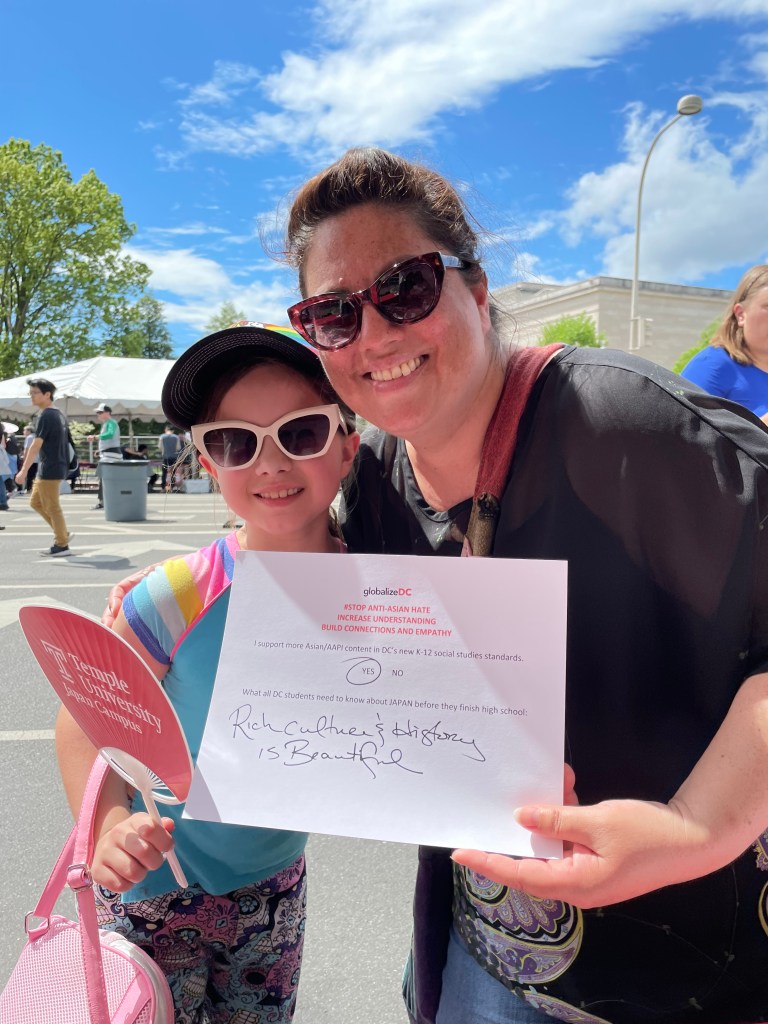
Planning for the festival was chaotic, because we wanted to share so much with the public: what our program is about, what we’ve been learning, how we reach out to the community, and even our anti-Asian hate project. Eventually, we decided to feature the anti-Asian hate project, a children’s coloring station, and an activity where passersby could create quilt panels around the theme of DC loves Japan. We also sold copies of a book created by students in Globalize DC’s summer Japan in DC program.
When we weren’t at our own booth, we had a lot of fun wandering around the festival and taking in everything there was to see. There were arts and crafts, food, educational organizations, and so much more. Not only was it fun to experience the Japanese culture, but there were opportunities to use the language that we had learned in class as well!
The Sakura Matsuri was an amazing experience for all of the Japanese Plus students. We had such a fun time organizing and running the booth, and sharing our program with other people who are passionate about the relationship between Japan and DC.
The Sakura Matsuri was an amazing experience! I’m so glad I was able to attend the festival. One highlight I had of the festival was meeting new people and experiencing some of the cultural aspects like the food, the dancing, and looking at Japanese traditional clothing. During my time there I was able to share out what I’ve learned during the program and how much I’ve grown. During my shift at the booth, we had to meet students my age who live around the DMV area. I was able to connect with other teens my age on certain interests. During the festival, I went out to look at other booths and got my name written in katakana, see a show, and looks at the college booth. We were right next to Temple University-Japan!
On April 15, 2023 Japanese Plus was able to have a booth in the biggest Japanese festival of the country, Sakura Matsuri. Although our booth wasn’t the biggest or most entertaining, I can proudly say our whole group enjoyed the whole experience.
We got to interact with people that came up to our booth asking questions about the program. People coming up to us and talking about their own experience with Japan. It was very interesting to see how all of us there were connected by a common interest in Japan. However, there were moments when the booth would die down. So my classmates and I were able to sneak out of the booth and look around. Close to us there were people writing your name in Japanese calligraphy. All of us learned how to write our names but we just wanted to do that for fun. I would say that that’s how the whole festival felt, just having fun even if you already know or don’t know what you are learning about Japan.
Throughout the year, Japanese Plus students had been learning and practicing Rajio Taiso (or radio exercise in Japanese). Rajio Taiso is a stretching warmup to music that Japanese people do every day either at work or school or even at their own house – it could be anywhere. You can look on Youtube and find a lot of Rajio Taiso videos to practice to. It was pretty funny as we were learning it, because everyone was messing up as people looking through our classroom windows at MLK Library were able to watch us. So it was pretty surprising to learn that we were invited by the hip hop education organization Words Beats and Life and the DowntownDC BID to do Rajio Taiso to open their Jazz and Blossoms event at Franklin Park downtown on April 8 as part of the Cherry Blossom Festival.
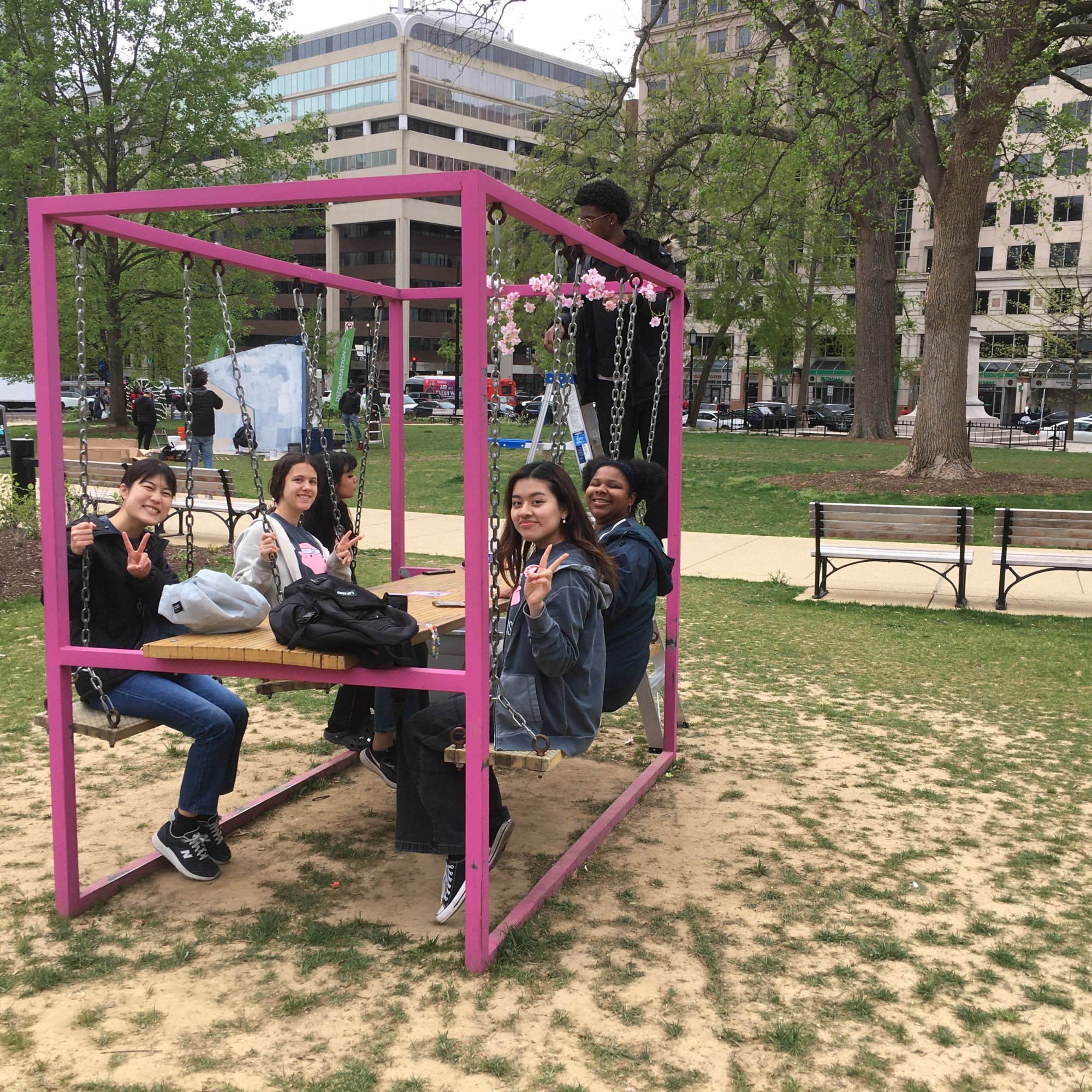
So after our regular class that Saturday, where we received our new Japanese Plus t-shirts, we walked the few blocks to Franklin Park where we’d be doing Rajio Taiso. When all of us got there, we enjoyed ourselves with the minigames around the park that were set up for whoever wanted to play. They had games like chess with huge pieces, a huge version of jenga and a big connect four as well. They also had a small concert stage where a band would perform some songs that were very relaxing. But as time was passing by, our performance was nearing. We all gathered in front of the stage as other people in the park were joining in to see what was up.
Most of us were nervous since we didn’t expect such a crowd to rise as we were waiting for the staff to set up the video as we were beginning. Once the staff got the video going up, we began to do the routine. Personally, I was nervous and others were too, but when I saw that other people were doing the routine as well I started to feel a little less nervous. For some reason it felt like I was up there for an eternity but it only really lasted for about 3 minutes and a half. But once we finished, the crowd started clapping and we proceeded to walk over to the side as they continued with the festival at the park. It was genuinely a fun experience and we all parted ways afterwards.
We are DC high school students who have been studying Japanese with Globalize DC since summer 2021. Back in 2021, in the depths of the pandemic, a group of students from our online Japanese program (including the two of us) advocated for the new DC social studies standards, which were soon to be updated, to be more inclusive of Asians and Asian Americans. During and after the pandemic, anti-Asian hate crimes rose substantially. In order to combat anti-Asian hate and violence, we concluded that people need to be taught about Asia, Asians, and AAPI content in order to feel compassion and understanding for these communities.
In June 2021, Penelope, alongside other students from Globalize DC, testified before the DC State Board of Education (SBOE) to discuss the improvements that the new standards needed. In December 2022, the Office of the State Superintendent of Education (OSSE) released the first draft of the new standards. We were extremely unsatisfied with the draft, because OSSE did not respond to our suggestions at all. In fact, the standards regressed in the amount of content for Asia, Asians, and Asian Americans. After we discussed what could be improved, the two of us (now in Globalize DC’s afterschool Japanese Plus program) testified before SBOE in January 2023 to again demand that the standards include more Asians and Asian Americans. We advocated for standards that include specific AAPI and Asian content and the introduction of Asian/AAPI content in earlier grades. After a very strenuous rewriting process, OSSE released a revised draft of the new social studies standards on March 29th, 2023, and we were deeply pleased by the outcome.
After reading this latest draft, we compiled a list of all the standards that explicitly mentioned Asia, Asians, and Asian Americans. We were especially happy about the specificity and amount of this content. In grade 6, OSSE revised the standards to analyze cultural elements of a country located in Asia and its significance for and influence on other societies. Although the standards analyze cultural elements of only one country located in Asia, it is a very important step to add cultural aspects of Asia. We were also pleased to see that OSSE modified the standards to name some specific elements of Asian culture, such as Sikhism and the philosophical writings of Wang Yangming, compared to the vague nature of the previous draft.
In World History 2, OSSE included a lot more standards that discuss a variety of countries such as South Korea, Japan, the Philippines, China, Cambodia, and many more. More people related to Asia are also discussed such as Ibn Battuta, Marco Polo, and Zheng He. In Government and Civics, United States v. Bhagat Singh Thind, United States v. Wong Kim Ark, and Korematsu v. United States are included, which are cases that helped shape America. Overall, OSSE has most definitely added a lot more countries and specific people to the social studies standards.
Instantly, we recognized that OSSE fulfilled our suggestion of introducing Asian/AAPI content in earlier grades. In grade 1, the standards introduce Asian communities as well as other communities to explain how they have shaped and defined Washington, DC. The standards also introduce specific community leaders, including Lee Yick and Liliʻuokalani. In grade 2, OSSE expanded Asian history in the periods between 1100 and 1400. In grade 3, OSSE included greater representation of AAPI history in Washington, DC. In grade 5, OSSE included all Asian immigration during this time period, as well as additional standards about the impact of the Chinese Exclusion Act.
In conclusion, these new standards are what we wanted to be included. They highlight the impact that AAPI communities have had on Washington, DC, as well as expanding Asian history, which will build understanding and compassion among the younger children. Our greatest hope is that teachers will make great use of these standards and incorporate field trips and create other opportunities for children to learn about Asian/AAPI communities firsthand. These standards pair well with excursions to learn about many different communities that make up our city and nation.
We want to give special thanks to Dr. Sohyun An, a professor of social studies education at Kennesaw State University and an expert reviewer for these new standards, for using her expertise to advocate, alongside Globalize DC, for the inclusion of Asia, Asian, and Asian American content. We would also like to thank the members of the State Board of Education and OSSE for listening to our suggestions and taking them seriously.
You can find the latest full draft of the K-12 social studies, along with other background information on the revision process, here.
Globalize DC is very happy to once again be able to offer our Japan in DC program in summer 2023, thanks to continued support from the United States-Japan Foundation. We are currently in the process of recruiting up to 20 super interested DC public high school students and two Program Leaders to make this exciting program a reality. Our goal is to complete our selections by the end of this month. Please read on and share!
About the JAPAN IN DC Program: Over six weeks (June 26-August 4), students will move around the city to explore and experience a wide variety of people, places, organizations, businesses, government agencies, and cultural institutions in DC with connections to Japan. This is a really fun program – and life-transforming. Students will document their experiences through writing, photography, and other creative expression. This free program will be offered in partnership with the Marion Barry Summer Youth Employment Program (MBSYEP), which allows registered students to earn summer pay for participation. The deadline for students to apply to MBSYEP has now passed.
To Apply for JAPAN IN DC: Globalize DC will select students for JAPAN IN DC through a citywide application process. The program is open to DC public high school students (DCPS or charter). Click below for more program details and to submit an application. We plan to accept up to twenty (20) students.
Spread the word: Please help share this information with interested students and parents, as well as teachers, partners, and others who can help us spread the word to DC high school students throughout all 8 wards of the city. You can use the link to our JAPAN IN DC webpage, which will be updated with new information as it develops.
WE ARE ALSO SEEKING TWO DYNAMIC PART-TIME STAFF MEMBERS FOR THIS SUMMER’S JAPAN IN DC PROGRAM
We are currently recruiting two Co-Teachers to lead this summer’s JAPAN IN DC Program. Ideal candidates would be secondary teachers, international education professionals, JET alumni, graduate students, or others with relevant experience. This is a fun program, for students and adult leaders, with significant movement across the city. High energy, dedication to high school student learning, and knowledge of DC geography a must.
On Thursday March 23rd, I was invited by Education Counsellor Taichi Kaneshiro to spend an evening at the Embassy of Japan in Washington DC. Apart from enjoying fresh sushi and great company, this event was hosted to bid farewell to the graduates of the LEAP exchange program (Long-Term Education Administrators Program), who had been working in America for the last year and to congratulate them on their hard work. While representing Japanese Plus, I had the pleasure to meet a wide variety of officials from all over DC and Japan and to get to know the LEAP graduates. Funny enough, without having to even leave my very own city, I had the privilege to stand on Japanese soil that night.
The highlight of the evening was speaking with the LEAP alumni in Japanese. They were fascinating individuals who shared valuable perspectives with me that night. It turned out they had been dispersed all over the country, one being in New York, others in Alabama and Arizona, but had rejoined as a group in Washington DC before they would board one final flight back home to Japan. When I told them I would be joining them in Japan very soon to study abroad, I asked for some advice. Surprisingly, they shared they were worried about going home because of how much they felt America had changed them; they of course missed their families, but would miss America more. It seemed they too were conflicted, but for reasons different from mine.
This April, I will be studying abroad in Chiba, Japan for a semester through a program called AYUSA. One week prior to this evening, I had been solely focused on preparing for my exchange trip, so much so that I did not take any time to stop and breathe for a second. My world at that point was nothing but what was coming up in the next two weeks. I was finishing all of my final exams in March, months early, and already beginning to say my goodbyes to close friends and teachers. Though it was a stressful time full of late night studying and packing lists, the dinner that evening was like a breath of fresh air. Visiting the Japanese Embassy for the first time taught me the meaning of the phrase “the world is your oyster.” The world of Japan is not just a language website on my phone or late night study sessions. I realized that if only I opened my eyes a little more, I would see there is a lot more out there than what I previously thought; I just have to be willing to look for it.
I am very grateful to have been invited to such an event, and I am excited to attend many more in the future once I return from Japan. It was especially an honor to be the youngest one there, and I am thankful for everyone in the Japanese Embassy who made that special evening possible.
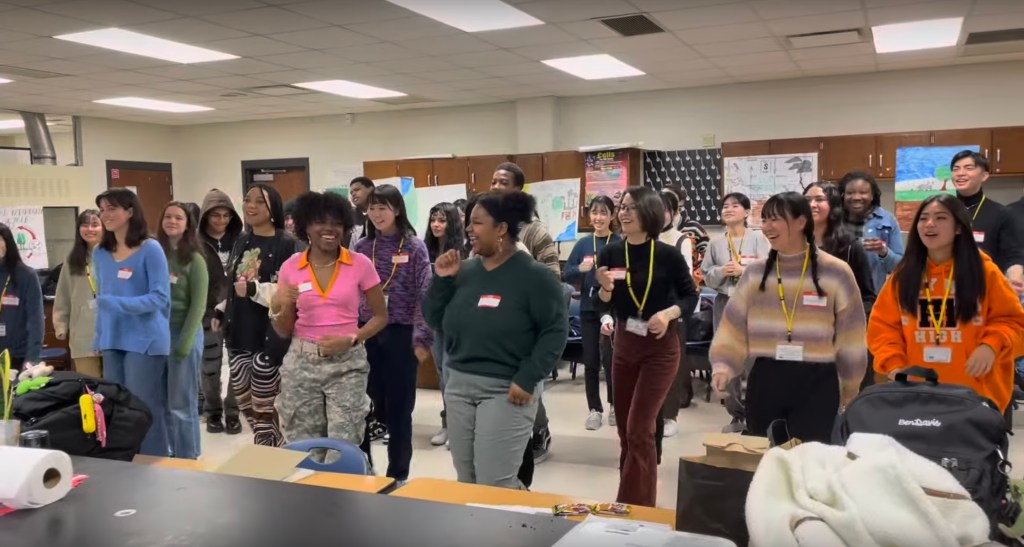
One of the fondest memories that I have of Japanese Plus is the Cha Cha Slide. For the KAKEHASHI visits that occurred in March (March 18th and March 25th), the visits were broken up into 4 different parts. Conversational exchanges between Japanese and American students, the Japanese students teaching their culture to American students through presentations, American students showing their culture through a performance, and lunch time. Besides conversing with the Japanese students, my favorite part of the visit was teaching the Japanese students the Cha Cha Slide.
The Cha Cha Slide is a very popular dance that relatively every American knows how to dance to. The history of the Cha Cha Slide is very interesting as it didn’t actually begin as a song or dance, but rather an aerobic workout. DJ Casper, the creator of the Cha Cha Slide, put music to the workout and began selling copies of the song. The rest is history, as the song became popular, and people are still dancing to it 20 years later.
Since the Cha Cha Slide is a popular dance and Japanese Plus wants to show the Japanese students a piece of American culture, the Cha Cha slide was the perfect choice. D’Amonie Armstrong and I chose to explain the significance of the dance and how to dance to it. First, we began explaining that the Cha Cha Slide is a pivotal dance that almost every American knows. You can practically dance it for every occasion, a wedding, a birthday party, prom, etc. Next, we showed the different moves that the Japanese students needed to know. Of course, we taught the basic Cha Cha move where you swish your hips while you move back and forth. We also taught that the dance is basically a huge instruction manual since the dance literally tells you when to go right, left, back, jump, stomp, etc. Lastly, we taught OUR version of the Charlie Brown move. We know that many people have different versions of the Charlie Brown move. Some may kick their feet up or spin around in a circle. But we decided that we would show the most iconic move (in my opinion), the running man move. It’s basically when the dancer does a hopping move with alternating feet and with arm motion. After D’Amonie and I finished explaining the instructions, we began dancing to the song.
After we finished dancing to the Cha Cha Slide, I looked around and saw that everyone had smiles on their faces. The Cha Cha Slide helped everyone open up a bit as the Japanese students talked with the American students afterwards. I asked a few Japanese students whether they liked the dance and they said that they really liked it. I was very proud after I showed the dance to both KAKEHASHI groups. We showed a glimpse of what American culture is like.









 GLOBALIZE DC: JAPAN