A new experience through new students


By Felipe Lemos

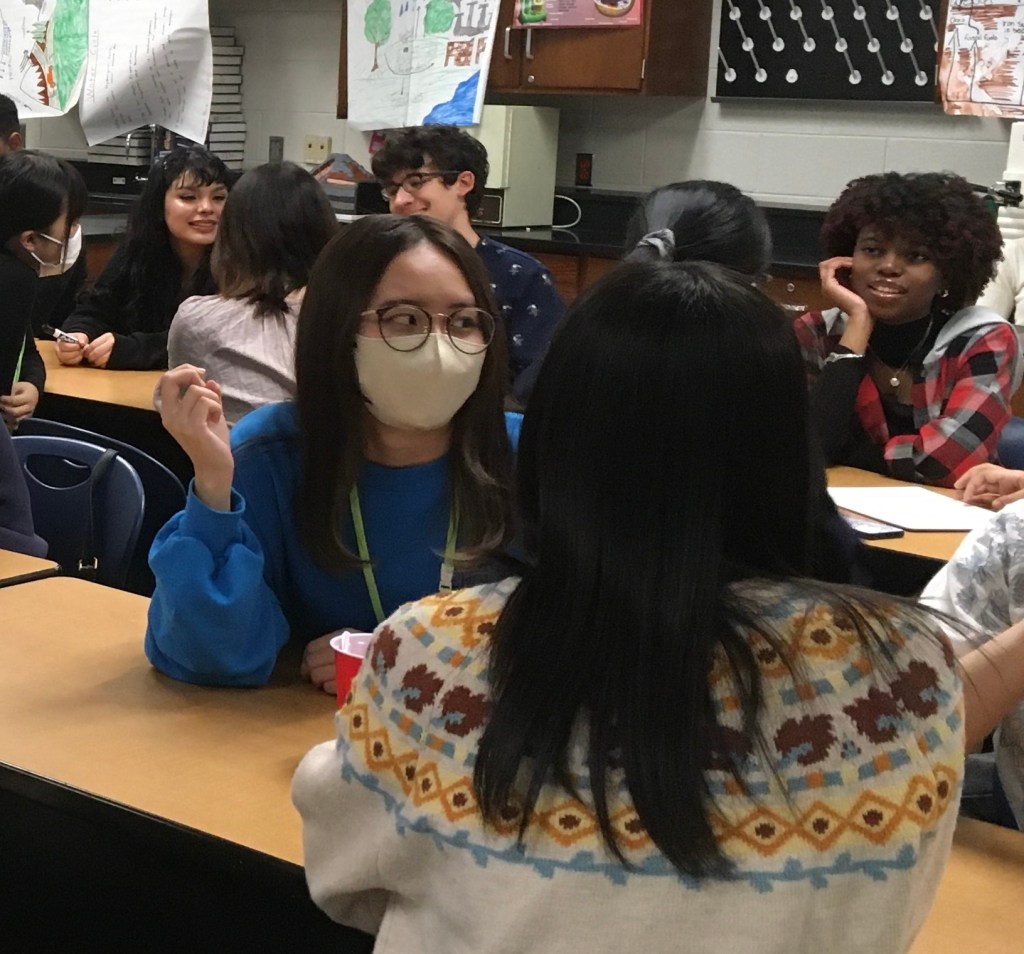
On March 25th, I was able to join my peers in the Japanese Plus Program in an exchange with a group of Japanese students from Okinawa, visiting DC through a KAKEHASHI Exchange program called TOFU (Think of Okinawa’s Future in the United States). This was the third group of KAKEHASHI students I met with as a part of Japanese Plus, so I was already a bit used to these exchanges and felt ready. At first, we all went into a room and sat down at 4-person tables with 2 Japanese and 2 American students. We introduced ourselves and I was the youngest one at the table being 15. We asked each other some questions we had to pick out of a cup which gave me an opportunity for some Japanese practice. As I started talking it got easier to communicate and the nervousness I had vanished. However, we almost always communicated in English because like in the other exchanges, their English is miles better than my Japanese. But in the end, I enjoyed the exchange more than I thought I would going in.

We also learned more about Okinawan history and culture through the presentations the students showed us. I thought there would be some repeated information from the last group of students from Okinawa but I was surprised to see very little that I had already learned. The most interesting thing to me was the American influence and presence on the island. They told us that 80% of their town was a US military base which is unreal. They also showcased the dialect of Japanese that was from there that had some influence from English, like adding -er to the end of words to make it someone who is that word. They even use American brands as the words for some objects like using Pampers as a word for diapers.

I liked the experience overall and while there were some embarrassing parts for me, like having to teach another group of students the Cha-Cha Slide, I hope that we can do more exchanges in the future of this program, because getting to know these students and talking to them helps us improve our Japanese and our knowledge of the culture of Japan.

Life-changing はいく


By D’Amonie Armstrong

Haiku – not to be confused with Haikyuu, the anime, haha – is a traditional Japanese short three lined poem that adheres to seventeen syllables throughout, following the 5-7-5 syllable format, where the first and last lines are composed of five syllables, and the second is seven. This gives you a chance to play around with this form of art, as you have to choose specific language over others. 

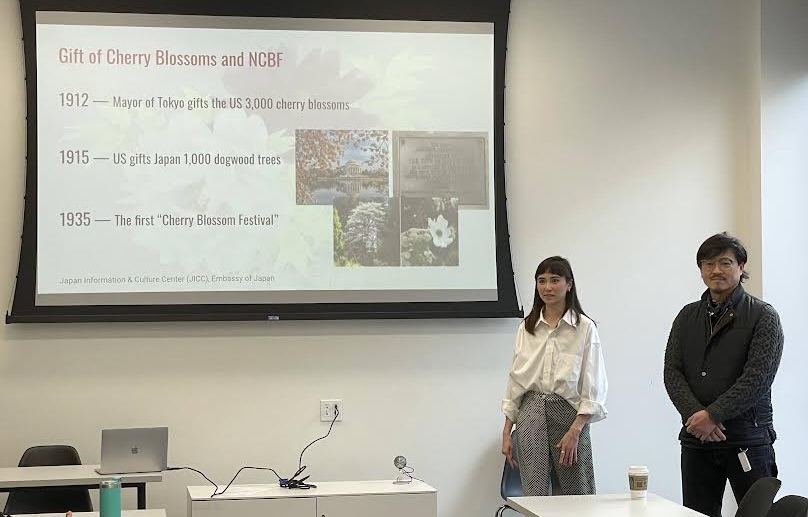
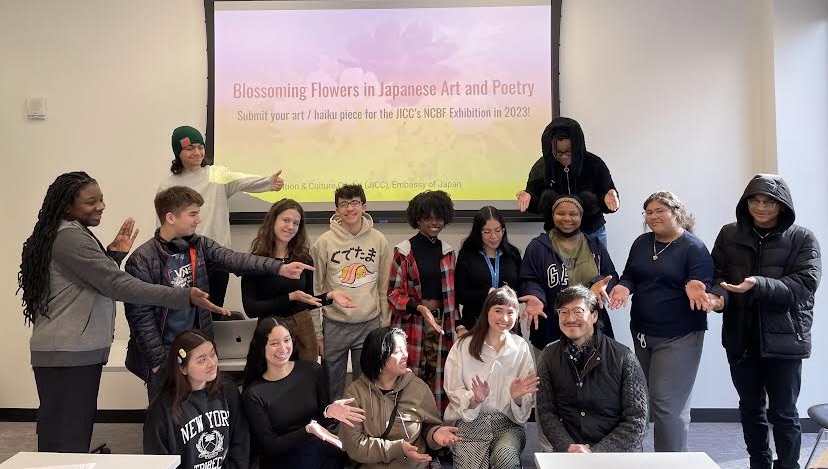
We were visited by Aki Regan and Atsushi Iwai of JICC – the Japanese Information & Culture Center, part of the Embassy of Japan – back in January, in hopes that we would want to take part in their upcoming exhibit, Blossoming Flowers in Japanese Art and Poetry, from March up until May. As the theme was flowers, we were taught about certain virtues associated with specific flowers that are often used for haikus. The main five are as listed:

Peony 牡丹/ぼたん (botan) – beauty, elegance

Lily ゆり (yuri) – purity, innocence

Sunflower ひまわり (himawari) – hope, positivity

Pineまつ (matsu) sacred, determination

Cherry Blossoms 桜/さくら (sakura) new beginnings, celebration

During their presentation, Aki and Atsushi shared examples of haiku from famous artists, but their setups were new to me. The haikus were associated with paintings, serving as a visual representation of what the poem was about. That art combination I thought was amazing, as it has never been something that crossed my mind, or anybody’s that I knew. The class was very interactive and we practiced our hiragana when reciting the haikus. My favorite had to be the Lily example, because of the various meanings the haiku had to offer. My interpretation was that the narrator was envious of the purity/innocence that their neighbor possessed.


The Embassy also told us of an idiom to keep in mind – ichigo-ichie (一期一会) or “a once-in-a-lifetime meeting.” This idiom encourages us to cherish each fleeting moment and encounter . . . I think it’s important, for us and everyone, to keep this in mind as we go on meeting new people everyday, because we will never know if the encounter could be what you have been looking for.

The process of writing our poems was pretty simple. Think of a memory that you would like to write about, typically one where you learned something, choose a flower based on the virtues it’s associated with, and then begin constructing a beautiful haiku. My thought process seems to delay when I need it the most, but I pulled through, we all did. The flower I chose to write about was Sakura because I wanted to reflect on new beginnings, such as our transitions back into school buildings from the pandemic, being a huge shift for many. I had knowledge that the Cherry Blossoms bloomed in the spring, which told people that a new school year had begun so it was perfect. 

I came up with:

When the blossoms bloom
The students meet again 
No longer through zoom

I am writing after we’ve heard that six of our class’s works got picked to be featured in the exhibition and I have the honor of being one of the students to have their work chosen. If you can, please go down and see the beautiful exhibition full of distinctive exquisite crafts. Find the details here: https://www.us.emb-japan.go.jp/jicc/exhibits/blossoming-flowers.html

Congratulations to the five other amazing peers and thank you to my entire class for sharing their artistry and experiences. And a special thanks to Aki and Atsushi for coming down to speak with us and for wanting us to be a part of the exhibit. We would enjoy having you guys come back to teach us more. We will continue to strive to connect with many through our art. And we will truly always remember to cherish 一期一会– – ”a-once-in-a-lifetime-meeting”.

A pleasant surprise


By Aaron Weeks

Our March 18 Saturday class was an overall new experience for me with meeting the group of 20 KAKEHASHI exchange students visiting DC from Okinawa, Japan. I arrived at Columbia Heights Education Campus (CHEC), where we held the exchange, not really knowing what to expect or think about it because I hadn’t gone to meet the first group of kids from the KAKEHASHI exchange program, and was kinda lost in what was going on, but it was an enjoyable experience and it was much better than how I thought it would go. I made more conversation than I thought I would and overall found myself having a nice conversation with a Japanese student.

We also learned about Okinawan culture, nature, and history. The thing I enjoyed learning about the most was Okinawan music and the music scale that they use and how it differs from the Western scale. The Okinawan musical scale cuts out the fourth and seventh scale degree to eliminate half step intervals. Basically there are two less notes than a Western musician would expect! We also learned about Okinawan food and that also was interesting to me because of the mixture of cultures that came together to create the foods. We talked about champuru, a stir fry dish composed of different vegetables to bring out the best parts of everything. 

Overall the experience was new at first and I felt anxious about it, but as I acclimated myself to the environment I enjoyed myself more. I even got to make new friends and learn new information out of the exchange, and I’m excited to do it again!

kiritsu, kiotsuke, rei, chakuseki


Elias Lovos

The first time I had done the routine, I was nervous. kiritsu, meaning to get up from your seat, kiotsuke is to get your attention, rei means to bow, and in a class setting you either say おはよう ございます meaning good morning at the start of the class, then ありがとう ございます meaning thank you and chakuseki meaning to sit down. At the end of the class, the teacher finishes last minute information and then we say さようなら, meaning goodbye.

It was nice to perform a Japanese routine done in every class, it made me feel like I was actually a part of a usual Japanese class without being inside of Japan. I enjoyed the practice and look forward to doing it again in class as time goes on.

No No Girl


By Chamiya Carnathan

On March 5th, 2023, Penelope Morris, XiaoYi Luo, and I, alongside Ms Sally Schwartz, went to the DC Independent Film Forum (DCIFF) which featured No No Girl for its closing night. Directed by Paul Daisuke Goodman, the film was about a Japanese American family who buried a secret in their backyard garden eighty years ago, on the eve of war and incarceration. Three generations later, a clue was discovered which unearthed the trauma and truth of their historic past. 

No No Girl is a story narrated by generations of Japanese Americans who are still suffering from their relatives’ internment during World War II. Following the bombing of Pearl Harbor, 120,000 Japanese and Japanese Americans were evicted from their houses and were transferred to barracks in isolated camps distributed across the United States by executive order. Several families, including the fictional one shown in No No Girl, did not want to leave behind beloved belongings that were too large or otherwise impractical to transport, so they buried them. After the war, Japanese American families would return to their homes to find them ransacked, destroyed, and vandalized as they faced racism and hate from white Americans. Sometimes, their belongings were outright stolen and they would have to start again and move on. No No Girl explored three generations of Japanese Americans who discovered the existence of family heirlooms in a home that is no longer theirs. In this film, we explored identity and family; nationality and pride as we watch the characters ask themselves: if it’s yours, is it really stealing?

Before the movie started, we had the opportunity to speak with Mika Dyo, the actress who played the main character in the film. Mika Dyo told us that she related to the movie because as a Japanese American, the internment camps impacted her family generations after the war, whether it was directly or indirectly. 

I asked her the question “Why is the film called No No Girl?” She responded by saying that the film was named after the No-No Boys, a group of boys who answered “no” to questions 27 and 28 on a loyalty questionnaire given to Japanese Americans during the war. Question number 27 asked if they were willing to serve on combat duty wherever ordered and asked everyone else if they would be willing to serve in other ways, such as serving in the Women’s Army Auxiliary Corps. Question number 28 asked “Will you swear to abide by the laws of the United States and take no action which would in any way interfere with the war effort of the United States?” The No-No Boys were castigated by both the Japanese Americans and the general public because they were seen as disloyal traitors to the United States. However, the group was embraced by younger activists in the 1970s who were looking for those who resisted mass incarceration. 

The movie explored topics that I had never learned in my history classes. The history books taught me about the internment camps but I had never learned about the generations of Japanese Americans who were still being affected by the events during WWII. This movie showed the bigotry, the racism, the exploitation of Japanese American families, and the generational trauma that followed in the aftermath of World War II. This is the kind of information that our #Stop Asian Hate Project believes should be included in DC’s new social studies standards so that future DC students will gain a much deeper understanding of Asian American history.

Confidence and growth

By Jenny Gonzalez

Want to study more of your Japanese? Well, don’t you worry about it! In this program, our teachers and mini teachers (tutors)  will take the time out of their day to help you. Don’t be shy to ask for help! Trust me, I was very shy to ask for help and shyness will leave you behind. I was capable to study more of my hiragana! Everyone has room to study and learn! If you want to get out of the house, come to the Japanese study session! It helps a whole ton, and the tutors are so nice and helpful! I’ll love to even thank Satsuki-san and another tutor, Hiroki-san, in this mini blog!

I love this program and I get to learn more about Japanese culture and language. A little fun fact – Japan and China were close to each other. In the number section, it wasn’t always いち、に、さん。 (ichi, ni, san) They were ひとつ、ふた、三つ、よっす。(hitotsu, futatsu, mittsu, yottsu) There’s always room to learn anything! I suggest coming and joining Japanese Plus!

おりがみ (Origami)

By Zitlaly Hernandez

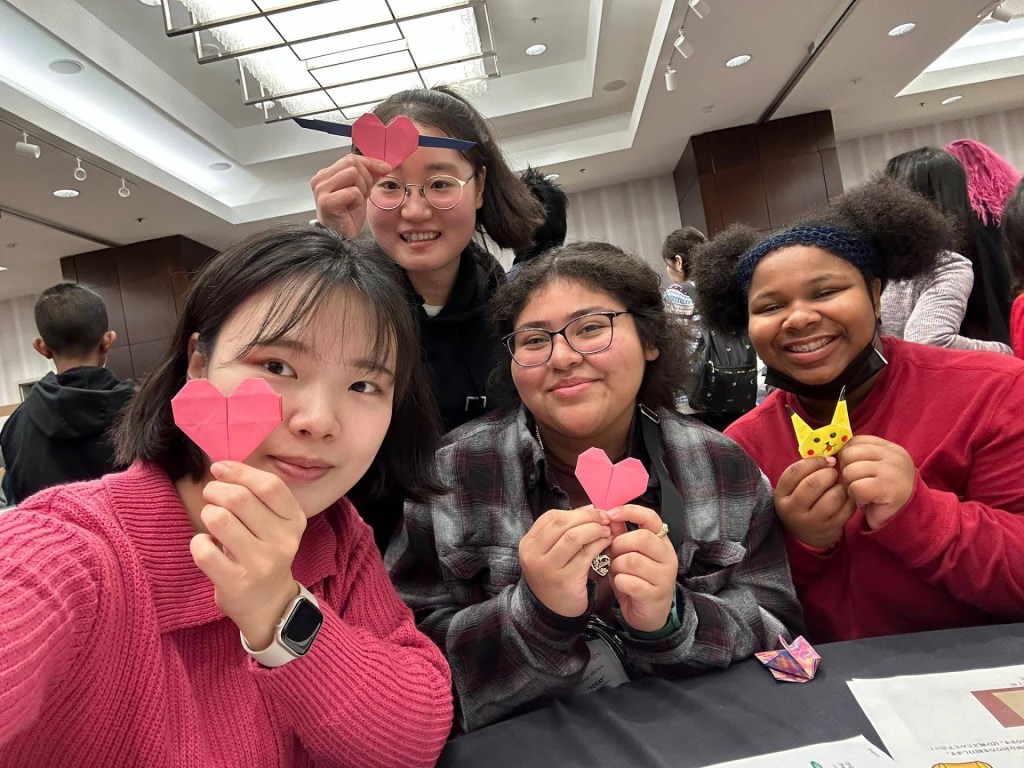
This poem is based on my experience at the JCAW New Year’s Festival I attended on January 29 in downtown DC. When making the origami, I was able to create relationships. Also, when creating these relationships, we were able to all laugh and joke about how we couldn’t for the life of us create the origamis, well not without help at least. My friends Soyeon and Seunga decided to look for an “easier” way to create a heart origami. We laughed about how we felt embarrassed to have to look up an “easier” version.

This is how my experience went but the poem talks about what origami can bring into your life and what it is. When making origami, you can connect with someone and who knows, you might make new friends or create a better relationship with those you’re already friends with. This poem was how I wanted to briefly explain but describe my experience when making Origami with these lovely people who I still keep in contact with til this day.

A beautiful art. 
A control of technique.
A test of patience.
An art of focus.
A test of trusting the process, yourself, and your capabilities
A way to connect with others through the complex forms of this beautiful art.